ARTICLE | FEAR FRANCHISES

“Everything’s Gone Jackanory”:

After 28 Days Later.

BY FRANK FALISI | February 23, 2026

Trying to write about the 28 movies—that most blitzed-out and body-baggy horror franchise measured in days, weeks, years—I turned, like a good hauntologist, to half-remembered popular music. This is a franchise defined by the motion of objects (temporal, biological, sociological, eschatological) across the British Isles. Theirs is a viral physics, determined by the tick of time and the relative expediency with which bodies move through it. “London calling to the zombies of death”—isn’t a song also like a virus? It’s always trying to catch on and spread, to become part of your body before entering the society constituted of millions of other yous. What does England shake loose in the stuttering hip-hop of Young Fathers? How do Brian Eno’s atmospheres teach us about the emptiness of a post-British world? And will something as gaudy and hair-sprayed as Duran Duran provide a cure to our zombified present?

Maybe more than its cousin subforms of narrative-fiction moving image, horror films straddle the space between throwaway schlock commodity and the kind of clarity available to us only in dreams. In this way, it makes the perfect bedmate of pop music. Laid together, the hope is that some rogue couplet of Spice Girls or Blur might reveal something contagious about desiring horror or about apprehending catchiness. Applied back across mediums, pop itself becomes the theory by which the moving image can be read, and horror the theory by which melody and discord do or don’t resolve. Formerly steady cultural objects and their ensuing genres undergo turbulence. A shaky vibration occurs. 

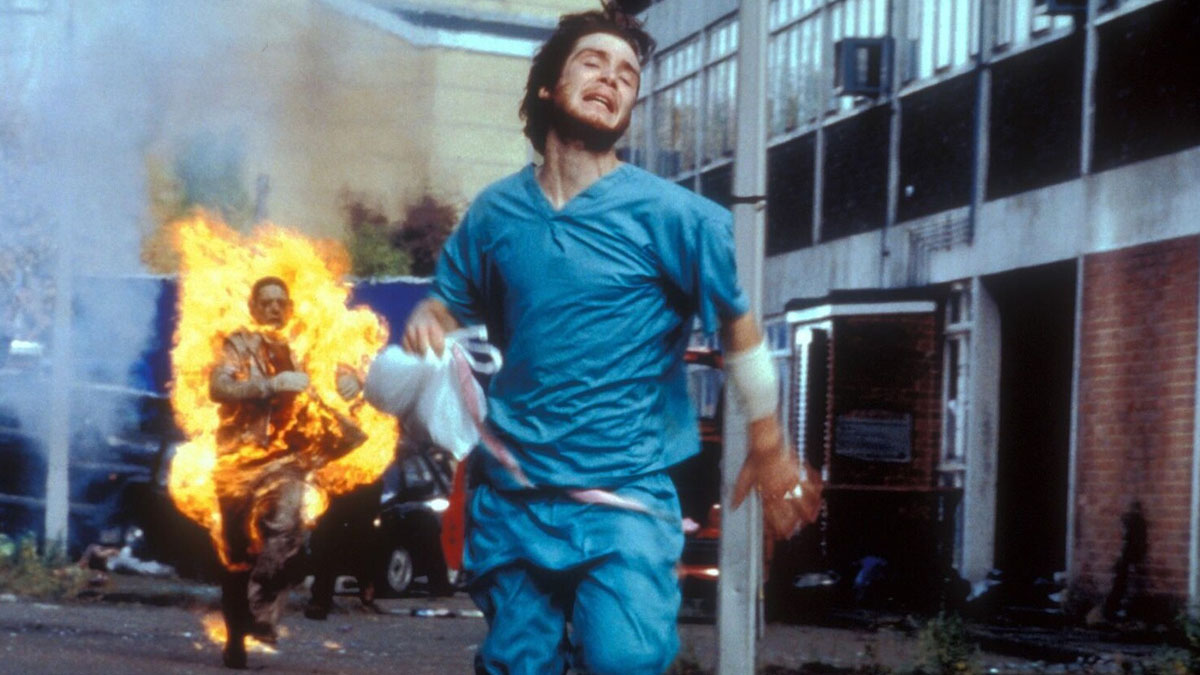
“Pop transformation” (or “vibration”) might be the modus operandi of Danny Boyle, the first marshal of these movies, which inaugurated with 28 Days Later (2002). Sometimes passing as awards-friendly ballads of exceptional individuals, often subverting the staid filmmaking expected in these traditions, and always experimenting with technique in near-musical ways, Boyle’s tonally undefinable cinema is constituted by ping-pong edits, calculated camera angles, and the gummy sense that the sound, image, or format could change at any time. In frequent collaborator Alex Garland, Boyle found a complement rather than a mirror. Even with his directorial efforts, the sometimes-novelist Garland’s purest instinct is the writer’s endless pursuit of revelation, if not quite reflection. His stories often totally swerve in their third acts, a tendency that when misapplied, feels stupid in a patronizing way and when well-deployed, feels stupid in a revelatory way. It resembles M. Night Shyamalan, another contemporary pop spiritualist. Garland’s increased forthrightness over his love of (and simultaneous self-revulsion for loving) the combat video game Call of Duty has deepened some of his insistent narrative instincts. Totalizing misanthropy is easier to stomach when it’s absorbed as the result of the militarized present, just as sentimentality for family bonds feels like a respite from conservatism’s weaponization of those same nuclear structures when understood to be a material rather than moral good. Society is constituted by its bodies; our individual conditions mirror its governing principles. And so the world of 28 Days Later does not predict or react to 9/11 so much as it re(as)sembles it in mise-en-scène. This is a corpus populated by infected monsters but contaminated by Western militaries left to dominate, go to seed, and death-rattle. Boyle has insisted that his and Garland’s 2002 film is not a zombie picture, and this insistence amounts to welcome clarity. While zombie proxies figure plenty, they are only the container by which a horror movie might enter into dialogue with our terrorized modernity. What’s stupider than a war on terror? One must accept viral-brained ill-logic to believe this collection of letters as a mandate, let alone reality.

“The stupid” returns us to pop music. How can you have lucid thoughts when something is stuck in your head? Stupidity indicates any absence of good sense in judgment. It is the necessary condition of eros and seduction, of power and desire. Transformative as they are to our bodies and actions, these afflictions—infections, if you will—constitute the quadrants dwelt in and summarily obliterated by these four films. Stupidity (of a sort) is also a prerequisite for zombification. A primary goal of the pop song is to temporarily annihilate time; when ensconced in the folds of melody gritted just so with discord, anxieties as well as clarities fade away. Cinema depends upon a knowledge of time (and our dearest metacognitive curse, mortality): as the film reel goes, so do we.

Built into their name, the 28 films are exercises in waning temporality. They tell the story of humanity’s afterlife by accruing days, weeks, and years. They are in a constant state of dating themselves, depending equally on our cultural and communal knowledge of 9/11, domestic surveillance, state-sanctioned torture, the War on Terror, climate collapse, and the COVID-19 pandemic, as well as what (if anything) comes next. Their characters cling to their pop pasts—heavy-metal vinyl records, grocery-store junk snacks, eccentric radio disc jockeys—as buoy proof that there was a past at all, which is to say, that there might be a future. These films have not concluded yet, but when they do, it will be back at their start: when Nia DaCosta’s 2026 contribution reintroduces Cillian Murphy’s Jim, last seen in Boyle’s 2002 original, it is disquieting how much the narrative move feels akin to the other super-powered cinematic universes clotting up our megaplex consciousness. This is how franchises move, especially at present. Something comes back from the past, only to realize that the story has morphed. And so a leap into the unknown in reverse, all to get back to the first moment of infection.

28 Years Later: The Bone Temple

When Boyle and Garland unleashed the first entry of their 2020s trilogy into the brutal light of 2025 AD, their scrutiny located itself in a perhaps-unlikely quirk of tenderness and torture: that of a child’s gaze. More The Road than road movie and set (as its title suggests) nearly three decades after the rage virus first began spreading, 28 Years Later sends a boy—Spike (Alfie Williams)—journeying from his backwards-reaching isolated island home into both the wilderness of mainland Britain and burgeoning consciousness of the stakes of life and death, especially as adjudicated by men in power. Even as Boyle and cinematographer Anthony Dod Mantle recklessly prank the image—the film was primarily shot on iPhone 15 Pro Maxes—a child is the story’s grounding presence. The boy’s shifting perspective extends to his parents and the gender roles they’re infected with, to post-modernity and what civilization means in its morphing context, to the narrow spit bridging grief and love. The by-turns cowed and awed way in which he sees the world is a constant reminder that what terrifies us does so because it forces new perspectives into our field of view, constantly. The infected horrify mainly because they’re mirror proof of the uninfected, an obvious and flailing digital fragment of the systemic human violence that often goes unnoticed for generations.

Just as swiftly as Garland’s script dials into Spike’s universe, its immediate sequel, The Bone Temple, pulls back into the grown-up world. At once less unsettled, more legibly “horror,” and direly crueler, DaCosta’s direction escalates the very-English freakout of its immediate predecessor into the realm of universal horrorizing. 28 Years Later shape-shifted past brutal zombie film into a heart-beating meditation on losing one parent to disease as another succumbs to the dependably limiting pitfalls of masculinity. The Bone Temple morphs the franchise again, picaresquely settling into a poppy tale of two fathers and the children who watch them, nearly helpless. Introduced as supporting presences in Years, the twinned personas of Dr. Kelson (Ralph Fiennes) and Sir Lord Jimmy Crystal (Jack O’Connell) compete for the soul of the film.

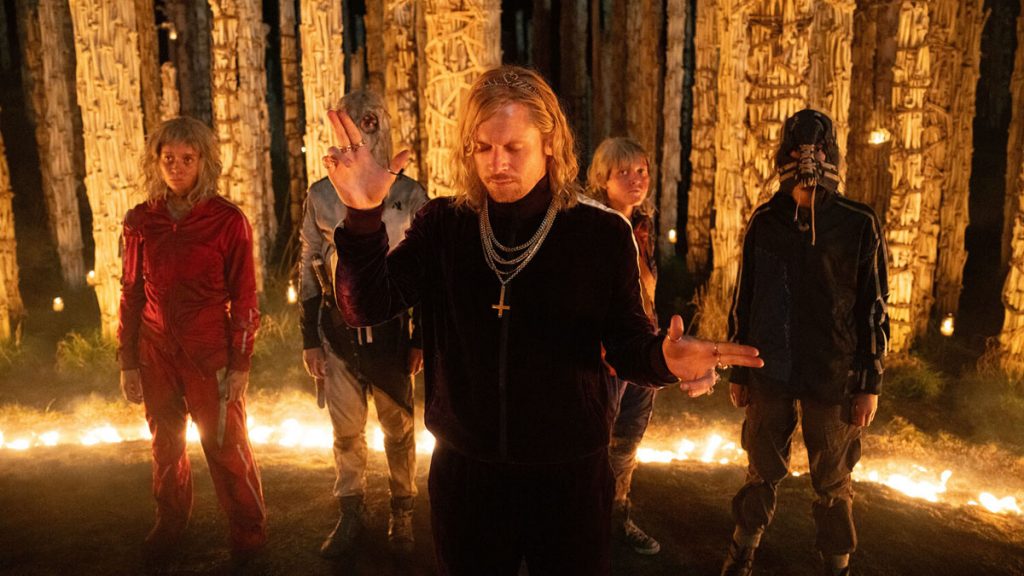
Shot directly after 28 Years Later, DaCosta’s movie picks up right on its narrative heels, with Alfie saved by and abducted into a post–post Clockwork Orange gang of youth clad in tracksuits and shambolic white-blonde wigs who each introduce themselves as “Jimmy.” Crystal insists to his small flock that he is Satan’s chosen son, elected by his father, “Old Nick,” to enact charity on (and so, torture) the remnants of humanity crawling through this new Hell on Earth. He spares Alfie’s life simply because the boy is able to kill one of Crystal’s followers. Played in a drained, mossed-over pool reminiscent of the one Garland shot for fungal horror in Annihilation (2018), this early scene of the young Jimmy bleeding out from his femoral artery while his comrades and father-commander look on chuckling establishes a familiar narrative feint for the non-zombie film operating in the zombie mode: the evil that men do often surpasses that of their horror-movie avatars.

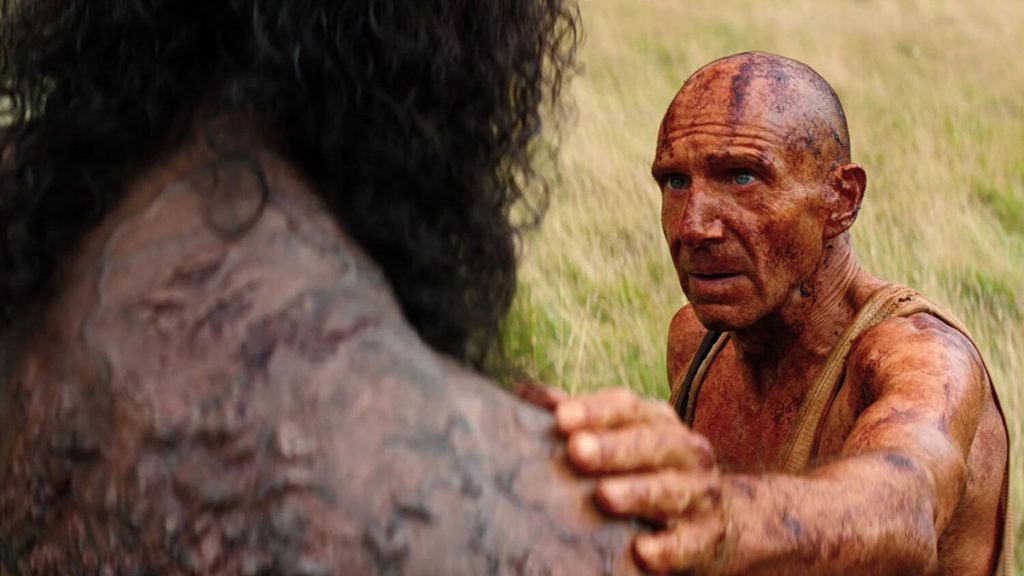
Just as the outwardly monstrous infected reflect their human tethers, Jimmy’s depravity responds to Kelson’s innate goodness. Introduced in Years as an ex-NHS doctor in hermitage who constructs an ossuary that pays tribute to the dead, Kelson receives both more screentime in The Bone Temple as well as a more significant weight in the film’s moral consciousness. Kelson spends his time creating a cultural object in the spirit of caretaking. He treats the infected and human alike, in life and death, cremating all bodies he finds, commingling all bones in a sprawling monument. In Years, it’s Alfie’s POV from which we scrutinize Kelson. He initially appears threatening, doused as he is in fire-orange iodine. And when Kelson reveals himself to Alfie—journeying into the unknown with his sick mother looking for medicine or solace, or both—as not a threat but an aid, this role too is constructed from Alfie’s perspective, up and out. Kelson is wise in Years, and he lends that film a daffy, calming spiritualism, more Madeleine L’Engle than George Romero.

In DaCosta’s vision, Kelson is reintroduced as living on his own terms. Grounded in the wisdom of adhering to rituals, he is a lonely man. He sings and talks to himself most of the day, collecting and burning corpses. He plays salvaged pop records in a subterranean room-flat by night. His daily collections and skeletal art-piecing are meager structures to cling to in the absence of human conversation, let alone connection. Still, he treats the infected with dignity in their waking days, too, as Kelson finds himself the unlikely caretaker of a sort of extra-adrenal infected patient, an “Alpha” he has dubbed “Samson” (Chi Lewis-Parry, in an honest-to-god Fairbanksian silent performance). From a blowgun, he shares morphine with the hulking infected thing, whose new opioid calm allows the gently mad doctor an opportunity to share time with him, which is also to say, to share a pop song. The first time we hear Duran Duran in The Bone Temple, it’s Kelson breathily humming “Girls on Film” to himself. The next is the non-diegetic slow-jam jangle of “Ordinary World,” Kelson and Samson sharing an awkward near-embracing shimmy.

Kelson’s readiness to befriend Samson is as predicated on the Groundhog Day despair felt by someone with nothing left to lose as it is on a belief in the humanity left somewhere in Samson’s wild eyes. But how far can belief bridge the gap between what is and what may be? Along with Fiennes, O’Connell and Lewis-Parry deserve ample co-compositional credit for the film’s whorl of brittle and heart-y tones. DaCosta wisely acknowledges that her trio has charisma to spare, and so The Bone Temple becomes a test of how far you might believe in someone or -thing, so long as it’s charming. O’Connell’s deeply magnetic performance, in particular, is enhanced by how willing he and his director are to leave it incoherent, with Crystal all but confirming his culty story as bullshit to Kelson when they do finally collide. Yet the script neither exposes Crystal as a con man nor designates him as a zealot. First introduced in the prologue of Years as a boy watching first Teletubbies and then a pack of infected bloodily dismantle and transmogrify his family—priest father included—past their human identity, Crystal is the latest in a line of franchise family figures haunted by moral and ethical decisions made by (and sometimes for) them.

In 28 Weeks Later (2007), this short circuit of the familial bond leads to narrative irony reasserting itself as the dominating cosmic force. Here, though, there is no grand irony. In The Bone Temple—as much a moniker for Kelson’s castle as it is his dirty, weary frame—there is merely a certain discombobulation, a transmission of past traumas into present nightmares. The sensation of waking from a nested phantasm into something worse. The loss even of a child’s feeling of fear and trembling. The horror that it is happening again. Garland’s old penchant for the bad logic of twisting rears up, and the two figures who emblematized The Bone Temple’s search for a soul are eradicated by the film’s end. They make way for the familiar face of Cillian Murphy as the good Jim. After almost 30 years of off-screen peace, he is rousted to reenter the story. It remains to be seen what that story will be. It will be, we know—these two 2020 entries talked enough at the box office to greenlight the third piece of Boyle and Garland’s proposed trilogy. “Jim will return…,” “Everything, everything in its right place,and so on. 

A franchise is like an infection. Life proceeds nearly like it always did, sort of. A set of new principals begin to dictate the body, the atmosphere, even the instinct of narrative. In the way a virus transforms how we breathe or think, a franchise refigures cinematography—which is to say, how the world looks and is looked at—because it refigures coincidence and recognition.

28 Years Later: The Bone Temple

There are a few scant shots in The Bone Temple to which no POV can be assigned. I am thinking of a particularly dramatic sequence when a soaring, scanning camera scrutinizes the ossuary while dusk air turns to stars. Radiohead’s “Everything in Its Right Place” plays, nominally cued up by Kelson on vinyl in his bunker-domicile. It feels like a music video, and it precedes the film’s viral highlight: Kelson performing pyrotechnic lip sync to Iron Maiden’s “The Number of the Beast,” begrudgingly and ecstatically meeting Jimmy Crystal’s demands that he play Satan so that Jimmy’s culty lie might continue. The distance between Kid A–era Radiohead and Maiden’s 1982 masterpiece isn’t as vast as it may appear. If you squint, the line from Thatcher to Blair is straight and sharp, as is the morph in England’s youth culture, from the dirty exuberance of punk and metal to the glitchy paranoia of a Thom Yorke freak-out. Mix in Kelson’s beloved Duran Duran (Rio was also released in 1982), and you see how a human body could hold all that disparate pop in its bones.

I don’t think it’s incidental that The Bone Temple’s musical identity is defined by preexisting English popular music zombified up into moving image meaning, while 28 Years Later yielded an entirely new album of Youth Fathers songs. That sounds like a value judgment, though it needn’t be. What DaCosta does is create more room for performance in frame, as Hildur Guðnadóttir’s score reacts to the actors and their gestures toward the diegetic pop, rather than the other way around. Sources as disparate as R.L. Stine’s Say Cheese and Die! and Robert Altman’s Images (1972) have indicated that a possibly inevitable facet of the camera is how it latches onto, processes, and disposes of the heat inside human performance. Or: “Girls on film, (got your picture)—girls on film.”

There is a constant unsettledness in Edinburgh’s Young Fathers. Halfway between stuttered indie and underground hip-hop, theirs is a dusty intimacy, like drum ’n’ bass bedroom pop. They are—happily—irrelevant in 2026, which is to say, they exist outside the purview of the trends or morays of the market but not outside its shadows. This is the method by which popular and experimental urges meld, and probably the reason that such implacable experimentalists contributed six songs to the soundtrack of Boyle’s other career corpse reviver, T2 Trainspotting (2017).

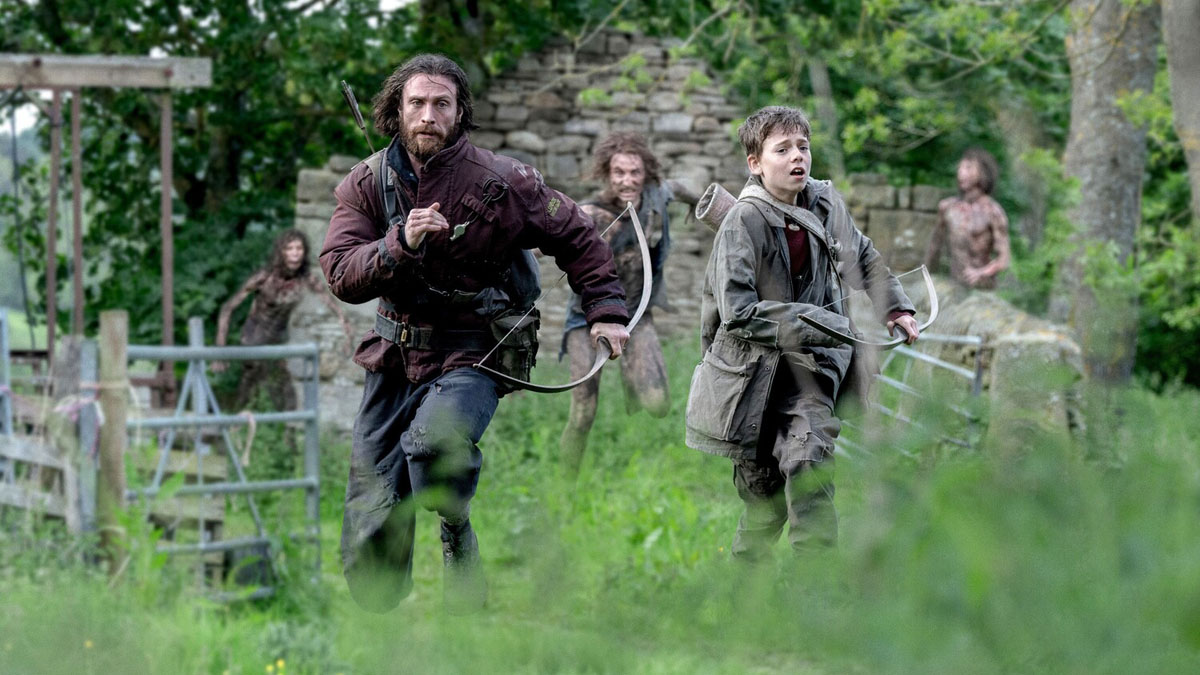
The promised land of 28 Years Later sounds like Young Fathers—fractured, slathered in weird harmony, too much butter under not enough bread. There are human voices, somewhere in all that din. In 2030, with all of Britain under permanent quarantine after 28 years of the rage virus ravaging, a community of survivors carve out a medieval-esque keep on Lindisfarne. The Northeast tidal island is defended from attack by virtue of its access causeway, which floods with the tide. Lindisfarne—Holy Island, colloquially, which has an archive of recorded history dating back to the 6th century AD—is doubly defended from within by appealing to the past. Its men patrol its gate with bow and arrow, while its women sow and till fields. Its children play, before following on those disparate paths. Setting off with his father, Jamie (Aaron Taylor-Johnson), for the mainland and leaving his ailing mother, Isla (Jodie Comer), Spike must engage in the oldest forced ritual of masculinity: he must kill something. It will be his first kill. As any movie with sequels reminds us, the presence of a first promises proliferation.

The transcendent sequences of Years depend upon the way its Young Fathers score wiggles and pulses. In Jamie and Spike’s desperate hurtle home across the land bridge later in the film, the pulsing aurora borealis on-screen seems conjured by how the score morphs to accommodate Mahler as much as a metal garbage can full of bottle rockets. The image and the song move in tandem. They push and pull, rather than seek to dominate. “Boots,” interpolating Taylor Holmes’s 1915 recording of Kipling’s poem of the same name, fractures Boyle’s film thrice over, as archival footage of marching soldiers commingles with Spike and Jamie’s journey from protected keep into wilderness. Into this cross-time, multiform duet, Boyle inserts narrative-fiction footage of Olivier’s Henry V, of medieval knights hurling volleys of arrows down battlement walls. The mash-up promises equity to its images; pure editing annihilates prior meaning and marshals it into new shapes. An England emerges, gnarled by an eternal deference to arms and order. A body politic can become an infected thing, too. Here is a frankly disarming degree of formal play, let alone in a genre popcorn movie, and it more resembles the terse and multi-modal lyricisms of Terence Davies’s elegiac Benediction (2021) or Pietro Marcello’s Martin Eden (2019) than the fungus of legacy sequels crowding up our collective multiplex.

J.M.W. Turner’s 1830 watercolor of Lindisfarne is an apt watermark for Boyle and Garland’s film. Here is the depiction of a merrier England, and an England whose merriness seems blotched and hazy. Children litter a sunned-up shore, a father holds a boy aloft. A mother, curiously, is lost. Here also is the disquieting sense that this place has no stability in its vision, even in memory. Toward the top left of the watercolor, ruins hulk in blighting sun. Half of the painting exists in darkness. It is unclear if this darkness is coming or going. A painting tells the lie that time stands still, and the best ones hint at their own slippage. Modernity is encoded in our semblances of the past: at the horizon line, in the middle portion of the rightmost part of Turner’s scene, a modern steamer chuffs away, dirty proof of the present inside the pastoral. 28 Years Later, too, contains such time travel—careful viewing of that early montage sequence yields that Boyle and editor Jon Harris cut from medieval soldiers and volleys of arrows straight to a modern sniper rifle’s sights. It scans a crowd of panicked people, dressed in contemporary garb and spreading wild in every direction. This footage is literally the franchise’s past, poached as it were from 28 Weeks Later, Juan Carlos Fresnadillo’s 2007 entry.
                                                                                        28 Weeks Later

Weeks, similar to The Bone Temple, wrinkles the straight line of auteurism that tends to be lazily slopped onto genre projects with even a modicum of voice. Boyle and Garland return as caretakers, in executive-producer roles, and the former contributed several days of second-unit shooting, most obvious in the sequel’s delirious flashback opener: holed up in a country house just outside of London, Don (Robert Carlyle, a Boyle troupe member) and Alice (Catherine McCormack) weather the early days of Britain’s rage-virus pandemic with an assortment of other refugees. As with each of the franchise’s cold opens, the puncture comes quick and cruel: a boy begs to be let into their hidden house, the group obliges, a mob of Infected follow, Don begs Alice to run with him and leave the boy, Alice refuses, Don runs. Twenty-eight weeks later, the threat of Infected has been nominally exhausted—after the island is quarantined, this six-month period is all it takes for the Infected to die from starvation. Replacing them is an occupation of U.S.-led NATO forces, charged with rebuilding Britain under martial law.

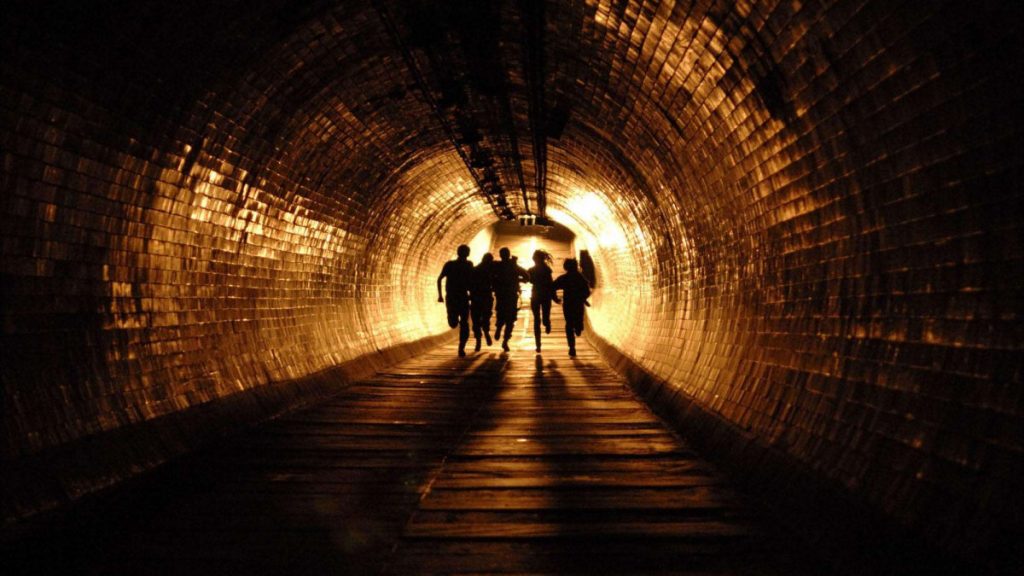
Don prefigures Jamie, the emotionally constipated bad dad of 28 Years Later. Its militarized disaster capitalism rhymes with Days’ birth-obsessed army outfit, and prefigures the Black Ops wankery of Years. Most compelling about these films is their internal rhymes, less the product of world-building than the fallout of world-collapsing. Most clarifying about Weeks is the sense that a bottom has truly been reached: it lacks compassion, either narratively or thematically. Watched in the shadow of the benign Kelson—who, vis-à-vis the logic of franchise universes, we must believe to be alive but silent somewhere in this heavily patrolled semi-safe zone—it has a shockingly clear vision of (mostly masculine) authority: inept and violent, nasty and brutish. The sequence quoted via rifle scopes in Years’ mash-up sees a cadre of marine snipers ordered to open fire and shoot with extreme prejudice every body in their sights, all in the fruitless hope of containing a new outbreak. Watched in the corona of the COVID-19 pandemic, it’s hard to think this isn’t exactly how things might have proceeded, or maybe did proceed. And at the end of Weeks, all suffering and sacrifice is not only endured, but fruitless. The outbreak reaches mainland Europe, the Infected scramble glitch-like up from Paris tunnels, the Eiffel Tower barely glimpsing through the shaky handheld.

Are the 28 films a collation of brutal post-life ravages showing how innocence and trust get soured, first by the England that was and then by the England that will be? In Weeks, Bush-era paranoias over our extra-surveilled present are depicted in precisely the violent tones that they are—the public is so much meat to be churned at a moment’s notice. The Bone Temple strips it even further, as DaCosta and O’Connell channel the millennial cultural objects that emerged from this temporal moment—Hostel (2005) and Saw (2004) among them—in a skin-flaying barn sequence that touches on the torture porn of that era. And in Years, Boyle’s visual imagination is as relentlessly inventive as ever when it comes to the methods by which a human’s spine can be removed, and to the ways in which a camera can capture such de-spining.

Cruelty turned inside out is something like pleasure at expressions of care—what of the weird ways in which hope and care turn up in this Rolodex of red-eyed horror? Babies survive, somehow. Children, too. As the survivors of The Bone Temple run across an English plain at that film’s end, the reentry of Jim into the story is a deliberate moral maneuver. Watching two people flee danger, Jim’s daughter asks if they should help them. Of course, Jim reasons. Help exists in this world, too.

Between care and cruelty, which behavior is natural? And which is the result of infection?
28 Years Later

28 Years Later attempts to render liturgical memento mori in the language of popcorn film. It’s not about dying, it’s how we move toward it, first in apprehension of its gore-making gravity, then with acceptance, then with discombobulation. And so of course it rattles like the requiems do, pinging Mount Eerie’s dictum: “Death is real: someone’s there and then they’re not / And it’s not for singing about, it’s not for turning into art.” If you have heard these words, encased on the 2017 album, A Crow Looked at Me, then you have already heard the exact shape of those exact words clenching and unspooling, a scattering-feeling over the intentionality of acoustic strum and vocal thrum. This album of death songs does more to inform what “death means” than most anything else. For all of Mount Eerie’s wariness about figuring or figurizing the fuck-all ephemera of grief, a song (like a film) still composes something. These objects can be turned to in similar moments of strife. We identify with and in them.

I had forgotten that 28 Days Later also contains a Boyle montage. While from a story perspective, Days begins with a rash of climate activists attempting to set a group of laboratory chimpanzees free, the first images in the film are a DV-fuzzed montage of police brutalizing protestors cutting to riot-geared marines stomping through streets cutting to a mob, running madly. The camera pulls back, and the spectator is revealed: a chimp, latched to electrodes, watches these cruel acts, seemingly on loop. It’s a perhaps-apt portrait of us as viewers, as mean-spirited as it is cheeky. I had also forgotten that the origin of the infection that creates the conditions for all these bloody moving images is graciously ephemeral, nearly metaphorical. “The chimps are infected!” a scientist shouts, as animal activists struggle to uncouple cages in the dark. “Infected with what?” The scientist hesitates. “Rage.”

And so what if the infection first takes hold without needles or injections or gamma rays or even skin being breached? What if it’s purely visual? Here at the beginning, we have no proof to the contrary—the chimps catch rage from the image of rage. I don’t think this is Boyle and Garland hand-wringing over the “influence of violent video games,” that most familiar boogeyman meant to absorb attention away from how social alienation, over-surveillance, and a militarized police force breed violence. Instead, it’s their reflection of what images affect what change. As a metaphoric force of both narrative and meaning, the Infected’s best cinematic antecedent is maybe Joe Dante’s Gremlins—multiplication happens quick, and as monstrous as they appear, a scrunch of sympathy renders a weird sympathy.

It’s this sympathy that the 28 films find themselves in in the present moment. After nearly three decades of mystification, The Bone Temple is perhaps extra moving because it features Kelson levelheadedly hypothesizing that the rage virus covers the Infected patient’s brain, rather than reconstituting it. His beloved Sampson is not beyond looking at the moon (or: the image of the moon) and calling it, “moon.” Kelson’s cure is a cocktail of medicines, but it’s also the time and care taken to want that cure in the first place. 🩸

28 Years Later
FRANK FALISI

is a New Jersey–based writer. He’s an Associate Editor at Bright Wall/Dark Room, and his writing has appeared in Reverse Shot, MUBI Notebook, the Los Angeles Review of Books, and elsewhere.

How to see 28 Years Later: The Bone Temple:

The film opened in theaters on January 16.
RELATED CONTENT
    FRESH BLOOD
ARTICLE | FEAR FRANCHISES
After four canonical films and two offshoots, the indomitable series returns to glory with Prey.

Of the many recurring horror villains, Freddy Krueger is famously distinguished by his crispy face and razor claws, Jason Voorhees by his hockey mask and machete, and Leatherface by his human-flesh mask and chainsaw.

BY LAURA KERN  |  August 17, 2022

ARTICLE | FEAR FRANCHISES
A deep dive into the world of James Wan and Leigh Whannell’s Insidious, one of the more complex, mystically minded horror franchises, which 13 years in closes on an unexpected high note.

Last night I watched myself sleep then I flew away, a young boy named Dalton writes in crayon shortly before his spirit leaves his physical body and becomes prey...

BY NICHOLAS RUSSELL  |  Updated July 11, 2023

ARTICLE | FEAR FRANCHISES
The ultimate evil-kid figure presides over the first two of hopefully many Orphan films.

A horde of diabolical children have preceded Esther of Orphan (2009), directed by Jaume Collet-Serra, but she has secured a place among horror cinema’s most memorable enfants terribles, even before its long-awaited prequel, Orphan: First Kill, arrived last year.

BY KELLI WESTON  |  April 28, 2023

RECOMMENDED
    RAVENOUS
GUIDE | ORIGINS

Supernatural

(Victor Halperin, USA, 1933)

This pre-Code offering packs a lot of story into its typically brisk running time, with several plot threads weaving together a (not always successful) tapestry of spooky and criminal doings.

READ MORE >

BY  ANN OLSSON  |  Month 00, 2021

REVIEW

The Keep

(Michael Mann, USA, 1983)

In what could be the fastest-resulting rape revenge movie, a drunken lout brutally forces himself on Ida, the young woman who doesn't return his affections, during a party over Labor Day.

READ MORE >

BY  LAURA KERN  |  Month 00, 2021

REVIEW

We Need To Do Something

(Sean King O'Grady, USA, 2021)

Beast is a lot of movies in one package - fractured fairy tale, belated-coming-of-age story, psychological drama, regional horror film - but above all it's a calling card for its leading lady, Jessie Buckley.

READ MORE >

BY  LAURA KERN  |  Month 00, 2021

🖨 📄