

Has anyone not had a nightmare about school long after school days were done? They’re a sleep terror staple. We’re naked in school to the thunderous laughter of ex-peers who have returned to witness our personal horror show, picked on by monstrous tormentors and former friends, stuck within those walls of learning as adults as if consigned there for eternity, and, of course, oversleeping through an exam that is a matter of life and death.
In school, kids are our colleagues, our buddies, our enemies, people we hope to impress, who impress us, scare us sometimes, inspire envy, dread, fear. We care what others think. We definitely care what they say about us (and what they don’t and wish they would). You share the things you like and love. This show, this online clip, that band, this movie, which can impact your standing in the social pecking order. After all, you don’t want to tout a film you watched five times only to be told by a group of kids that it sucked, and what are you, 7 years old?
Hip kids know the best stuff. Like that introverted freshman you did a science project with in fifth grade but haven’t talked to since who listens to The Velvet Underground now that it’s junior year of high school and made a comment in English class about giallo films and did it casually, like it wasn’t any big deal, because that’s how cool he is.
One suspects that in a TikTok world of MrBeast inanities and the incessant rotting of minds—and what’s becoming a collective inability to think at all—there are fewer of these cool kids, but there’ll always be some. What we get out of school is itself a matter of what we wish to. Those who want to learn usually do; those who don’t, don’t. Some kids are in love with learning; others act like there’s nothing worse. The latter have a knack for making life hell for the former—a version of a real-life horror film.
Then again, there are field trips—and isn’t every actual horror film a form of field trip?—and being with your friends and making new friends and passing notes and playing games at recess and discovering that you could do the math after all. The stuff of some of our happiest, most rewarding memories. Plus, we always have the hope that the latest year of school will be better than any to date, a hope that extends in other forms into the rest of our lives. Including when we watch a horror film with a school setting and those veins of past times and burnished apples and a crisp pack of crayons and changing leaves are tapped again. We don’t want to see something lame.
In that school spirit, let’s pretend a teacher is giving us our homework. But fear not—well, you know—it’s the fun kind, oxymorons be damned. The assignment: watch these school-based horror movies. But as ever, assume there won’t be a quiz at your peril.
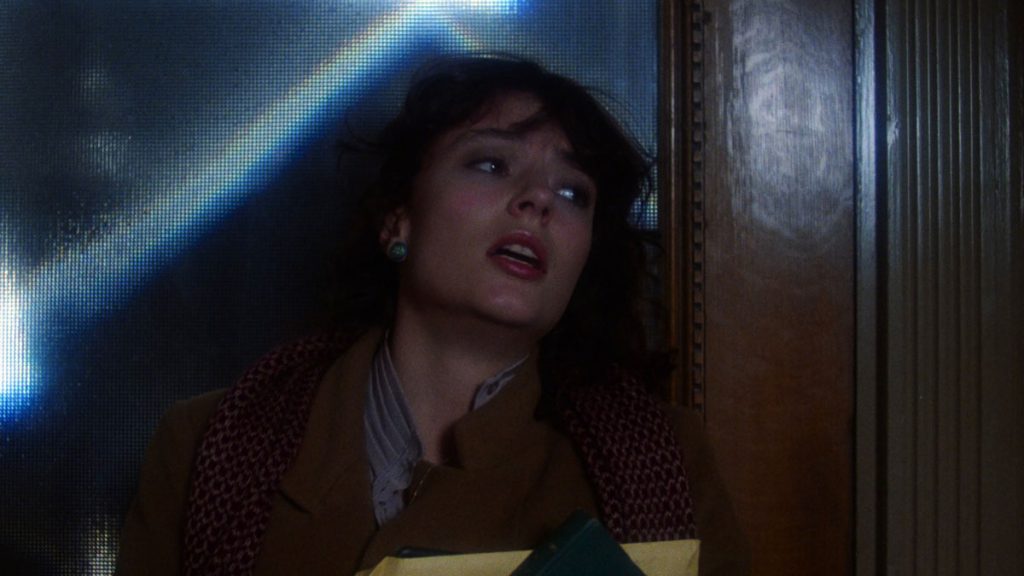
For all the chatter about the “Sunday scaries” and the recommencing of another long week before it’s time again for a two-day repose, we’d be amiss not to consider the end-of-summer scaries. Some children and teachers can’t wait for school to begin anew. Clean slate! Old friends! Maybe that girl I like will like me back now that we’re in a new grade!Others are plunged into a funk. Do I have to go? This is gonna suck. I can’t wait for next summer. No matter how much we may love school, it has its stresses. Academically, socially. The straight-A student didn’t come by those marks by being “chill.” Our girl worked her tail off. We’re never going to forget the things that happen here, for better or worse. But hesitant and fearful as you may be, you’re going to have to show up the same as everyone else. Usually it’s not too bad.
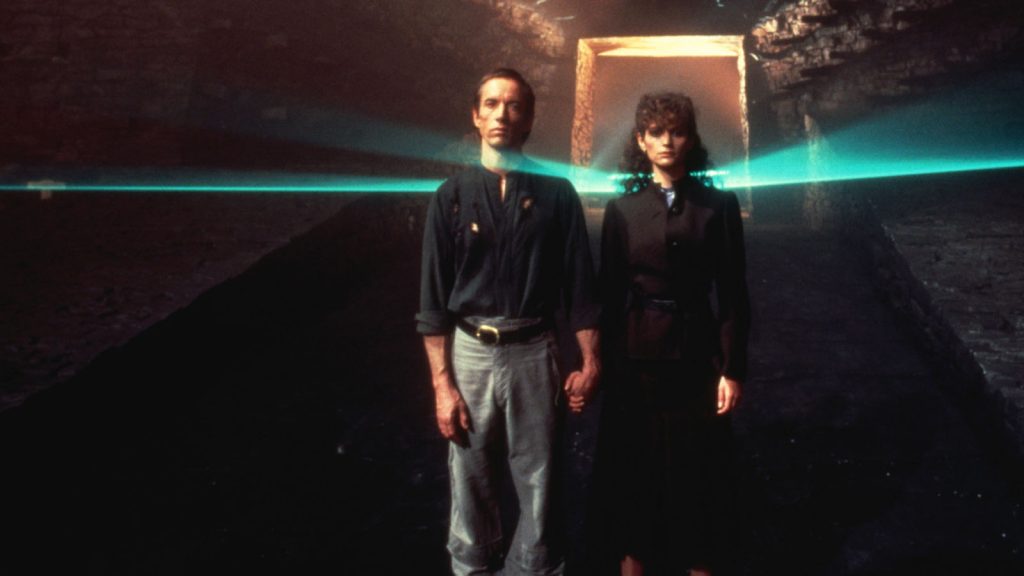
Ken Hughes’s 1981 slasher/police procedural Night School serves as perfect accompaniment in making that leap into presumed darkness, if you’re among the terrified or remember marching among their number. It’s the back-to-school horror-film version of downing that coffee you made extra strong that’s remained in the pot for a couple days where it has somehow become blacker yet. A school-oriented horror film to put hair on your chest, which you swim-team people can always shave off later.
School takes all forms. The same as it takes people of all ages. We usually associate school with the morning, but there’s this whole other world of learning that comes out at night, as both Dracula and the instructor of creative writing at the adult education center know well. Night School is set around Boston’s Beacon Hill, a place where if you take a nocturnal ramble among its warren of streets, complete with replica gas lamps, you wouldn’t be surprised to see Jack the Ripper race by in an ulster with blood from severed body parts leaking from his bag. Location, location, location. Leonard Mann plays Lt. Judd Austin, the cop trying to solve a series of beheadings. Heads roll often in this sucker. A particularly memorable instance involves the giant tank at the New England Aquarium and a ricochet off an unsuspecting turtle.
Slasher films can be fun, but Night School is a grim affair. The dominant colors are gunmetal gray, “damn, you’ve got the blues” blue, and that aforesaid death-coffee black. The overall effect is dour. Resigned. The setting does a lot of the legwork for the mood. Meanwhile, school goes on, because that’s what school does.
There’s a professor (Drew Snyder) with a penchant for railing his students, which wasn’t seen as awesome in the early 1980s—he’s scolded but not discharged (make a joke here if you must and giggle like a kid in the last row)—but also not as bad as it came to be viewed. We play the “whodunnit” game while suspecting, à la Black Christmas, that this is likely to prove a problem without a solution, the same of which can’t be said for that last item on your kid’s algebra homework that you haven’t been able to help them figure out for a half hour and counting. Night School is arguably the best horror film set in Boston, a prime locale for schooling, although it’s not like a ton of hands would be shooting up were the class asked to name some others.
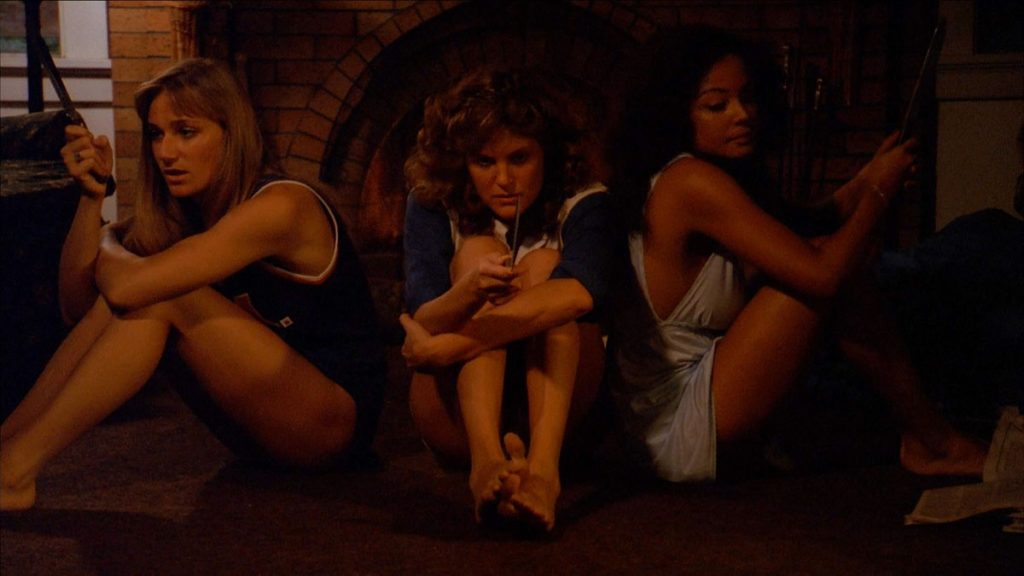
When you title a film The Slumber Party Massacre, you’re ruling out the prospect of much mystery, which doesn’t mean you can’t still be clever. Rita Mae Brown’s initial screenplay, titled Sleepless Nights, was a satire of the slasher genre from a feminist perspective. Horror cinema goes to sociology class. Or gender studies. Instead, quite a bit of that was shunted aside in favor of making an out-and-out slasher, though it still bore traces of the enlightened perspective and, alas, some heavy-handed symbolism that wouldn’t cut it in Feminism 101. The film was its own rite of passage, a staple for horny 14- and 15-year-old boys having slumber parties—not that they called them that—and wanting to see some skin on-screen for lack of seeing any in real life.
It’s easy to conceive of a movie like this being proposed by someone saying, “I know, we’ll have hot chicks getting drilled,” and then someone else, believing they’d had the epiphany to end epiphanies, adding, “Literally.” For that’s what happens here: escaped serial killer and definite non-feminist Russ Thorn (Michael Villella) employs a drill as his weapon of choice for his latest murderous spree. And before we forget: this drill is meant to symbolize a penis, which will eventually be cut down to size. Woeful is the misogynist with the tiny drill.
The school aspect is what keeps The Slumber Party Massacre enjoyable over repeat viewings. It’s a film that you spend a nice hour-plus with every few years, like getting lunch with a teacher or guidance counselor you kept in touch with after graduation. Trish (Michele Michaels) is the well-liked, non-mean girl who thinks it’d be a groovy idea—wait, wrong decade—to have a slumber party. She invites new girl Valerie (Robin Stille), who is pretty and athletic, and you know how that can shake out—especially at first—in the kill-or-be-killed environment of teen-girl cliques (read: backbiting bitches). Valerie assesses the situation and declines; besides, she has to watch her little sister (Jennifer Meyers).
Director Amy Holden Jones was aware of 1980s slasher and teen film tropes even as they were still developing, which in turn means that she thankfully doesn’t throw her lot in with them. The byplay between the kids—within the locker room, at the slumber party, outside of the slumber party doing some peeping, as with two boys hoping for an eyeful of breasts like the boys who rented the picture—is what pulls the film together. Think of the ostensibly meaningless stuff you did in high school. Riding with your buddies to practice. No one said anything particularly witty, but you recall and cherish the memories of those rides as if everyone did.
The Slumber Party Massacre makes for a nice feeling in the manner of watching Dazed and Confused or Freaks and Geeks, or April Fool’s Day, to an extent. The disemboweling doesn’t dim the mood too much, and the people we most want to see pull through do just that, so it’s very win-win, like having your favorite class with your best friend or study hall as last period.
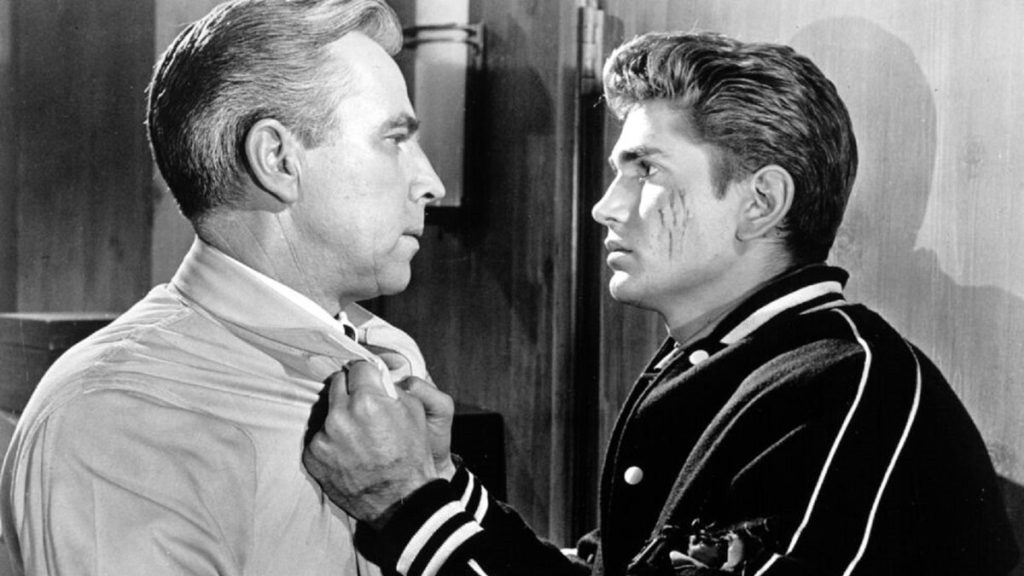
In the late 1950s, Michael Landon was akin to a junior James Dean for the tween set, which made him ideally suited for the role of Little Joe on Bonanza, the youngest of the Cartwright boys with a temper and an eye for the ladies who had to be pried out of the jams his tempestuousness had gotten him into by his father and brothers. Landon had appeared on The Rifleman before Bonanza, but it was his horror-star turn in 1957’s I Was a Teenager Werewolf that established him as a just safe enough, just dangerous enough heartthrob for sixth graders.
Gene Fowler Jr.’s directorial debut doesn’t stint on the silliness. Some of its scenes—like a Halloween party organized by the “hep” high-school kids with cringe-inducing hijinks/pranks—must have caused the actors to shake their heads between takes and hope their real-life friends didn’t make fun of them too bad. We can think of these passages as a middle schooler’s idea of what high school is like. But there are also moments of stark ferocity. For example, best friends fighting like they’ll keep at it until the death if someone doesn’t stop them.
Landon’s Tony Rivers has an issue. Well, two. He has a hard time fitting in, so there’s that. He’s meant to represent teenage angst. We all knew that mysterious, broody kid. Likely had impeccable taste in music. He wasn’t “popular,” but he was also too cool to care. Tony is the sportier version of that guy. In a different time, he’d have conceivably been diagnosed as bipolar.
These inner demons are given external form when Dr. Brandon (the always excellent Whit Bissell) decides to do some experimenting in addition to his doctoring and injects Tony with a serum that brings out the primitive nature in people. The kid who had a hard time fitting in now has an even harder time fitting in. There are doubtless plenty of teachers who think some students aren’t that different from wild animals, and here’s a mascot/symbol from the 1950s for the pedagogical frustrations of the next century.
I Was a Teenage Werewolf is no classic, but it’s touchstone horror and quintessential 1950s fare, and you’re a square (to dip into the pertinent argot) to miss it. If you haven’t seen the movie, your horror-screening career isn’t complete. Like The Blob, this is terror threaded through the pop-culture zeitgeist it was then in the process of adding to and later could be seen as representing.
We aren’t in some remote European forest with I Was a Teenage Werewolf. Horror was so often “throwback.” Storybook. Once upon a time that we can’t really pin down in this castle, there was a… Or, by 1957, sci-fi-infused. I Was a Teenage Werewolf is of the time and place of the malt shop, hamburgers, the drive-in, Elvis on the radio, I Love Lucy, neon, outsized tailfins, Blackboard Jungle, leather jackets. But this was itself a time when it could feel like the world had gotten up to proper speed because of assorted advancements (or “advancements,” depending on where you stand), unlike ye olden days, hubristically mooting anything prior. In this regard, there’s a chunk of the 21st century to be found in the 1950s.
We do have a janitor hailing from the Carpathians who knows the signs of a werewolf when he sees one, which makes for an old-school nod, but this movie wasn’t about the past then, and it’s not about the past now. The themes remain relevant. Tony is hunted down, everyone seemingly after him, which is how it can feel for a kid who’s spiraling. Yes, I Was a Teenage Werewolf is a YA form of movie horror, but it also presents a nice and juicy throat for an adult to sink their teeth into and do that rip-this-way, rip-that-way headshake move.
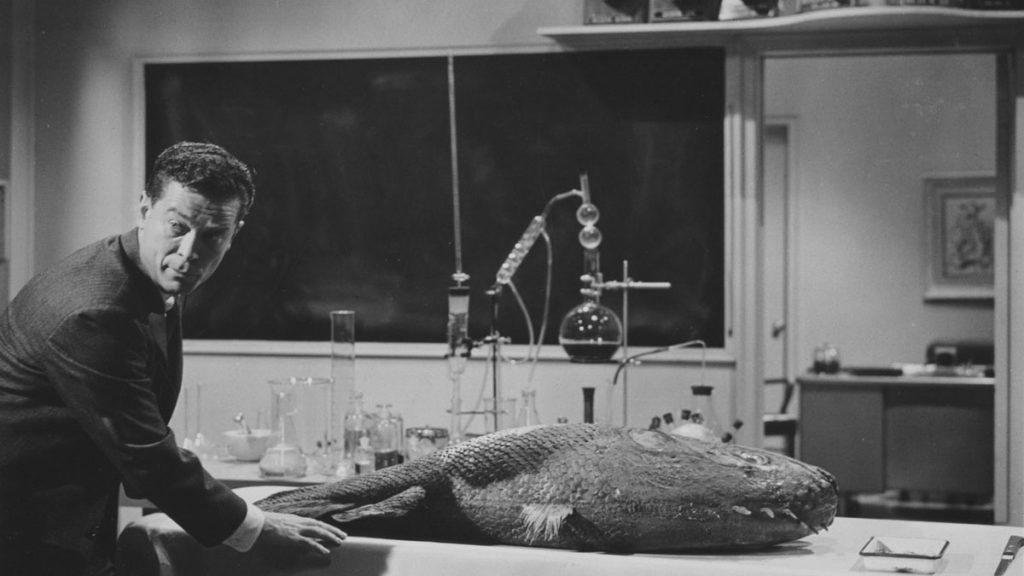
A horror-film maxim that bears repeating: if Jack Arnold is involved, you’re going to want to see that picture. Not that Arnold was limited to horror (1959’s No Name on the Bullet is a core-collection Western), but the genre would look much different without Arnold’s contributions in the 1950s. Remember: that’s the decade when horror became a mainstream fixture, a staple of popular culture, all electric, jolty, modern. Like science fiction, with which it so often memorably paired, this horror looked forward rather than back. It was less cadaverous than the horror of the past, and more razzle-dazzle, with Arnold being one reason why.
Monster on the Campus is among those 1950s horror films populated by sympathetic characters, none of whom do anything wrong, per se, with death and destruction ensuing nonetheless. College campuses are prime spots for horror and mystery. They can be similar to an English village in a Father Brown story, but with manicured greens and Gothic architecture. In theory, betterment is the goal at the locales. One goes to college to progress and develop. There’s an ostensible honor of intention. The notion of the bolstering enclave. After one’s four years are up, the beast that is the real world takes over, but that is then and this is now, and who knows, that beast needn’t be so bad if we’re ready for him thanks to college (but no thanks to college debt).
Dr. Donald Blake (Arthur Franz) teaches in the science department at Dunsfield University. He’s pumped to have received a coelacanth, a species of fish that’s been around for a million years, on ice. Blake is popular among his students. The ladies dig him, and he likes the ladies, but he’s no creep. And he’s got a theory that seems bang on: man is the only species that can consciously decide to evolve or devolve. Hard to quibble with that in the 21st century, as we take another daily collective step down the ladder to becoming a species less capable of thinking. Blake accidentally rakes his hand over the teeth of the specimen, which blood plasma has been preserved by gamma rays, and let’s just say this is the piscine, college version of being bitten by Bela Lugosi outside the gypsy camp in The Wolf Man. Sadly, the transformed doctor goes rampaging, realizing afterwards what he’s become and done.
We’re conflicted as we watch Monster on the Campus, whose cinematographer was Russell Metty, the fellow responsible for shooting Orson Welles’s Touch of Evil and its famous opening sequence just a year earlier. The personal human element is at the movie’s fore. We don’t want the doctor to suffer—which, let’s face it, will involve his slaughtering—but nor do we desire to find additional limbs of coeds in the quad en route to that early class.
Films like these are analogous to those perennial Twilight Zone episodes like “Will the Real Martian Please Stand Up?” and “The Monsters Are Due on Maple Street” because we’re always ready for a rewatch on account that their strengths lie in their interpersonal aspects. They’re stories of place and people. If we like the place and connect with the people, we’re going to like being there with them. It’s a winning approach. Same as hitting those books and keeping your hands clear of the mouth of large, dead, toothy fish.
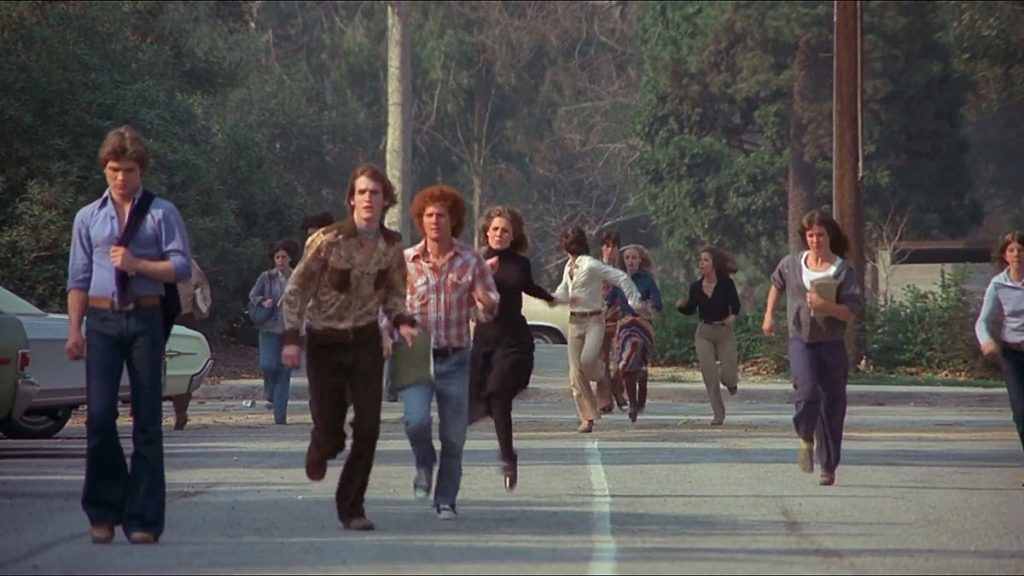
David (Derrel Maury) is the new boy at Central High, which his old pal Mark (Andrew Stevens) already attends. They were once together somewhere else, where David helped Mark out. This is a reunion of friends, and Mark wants to make David feel welcome. At Central High, this means ensuring school is as easy as possible, with the cool kids able to do whatever they want to the less cool kids. Mark endeavors to bring David into the fold of his clique of the types of guys you suspect will later be rather date rape-y in college (if they get there), hangers-on posing as head honchos, puffing out their chests, a veritable circle of suck.
But David is his own man. Mark knows his friend’s background like we, the audience, never do, but suffice it to say, being his own man has gotten him into trouble in the past, which could have meant the dishing out of some comeuppance at the mortal level, though in the name of justice. After all, there’s a vast difference between sitting atop one’s bed following a horrible day of 10th grade, cranking The Who’s Quadrophenia with the headphones on and wishing your tormentors would suffer, and systematically going around and bumping them off in admittedly ingenious fashion.
Agatha Christie would appreciate David. He’s a Robin Hood figure who doesn’t know when to stop. Or, one could counter, he knows exactly when to stop, and that’s when there isn’t anyone left to punish. This is a strange, compelling film. Part And Then There Were None, A Clockwork Orange, Lord of the Flies, and Peanuts specials. Yes, you read that right, Peanuts specials, especially the early ones without even the muted trombone of an adult’s voice. There are solely kids. It’s Lucy who fetches a shivering Linus from the pumpkin patch, not a parent who may as well have left him out in the cold to be assaulted by a guy wearing a gourd on his head.
In Lord of the Flies, there was the island, which in Massacre at Central High is the school. Realism and satire mix. This is a hard blend to get right, but the film does. David acts with kindness to those less fortunate. Which, in high school, means the bullied. The shunned. Mocked. He is a sincere listener and a natural-born problem solver. Alas, this includes being an inventive ender of lives as well. Behold his creative means of dispatching. There’s a power failure, a diving board, and an unbeknownst emptied swimming pool. A detonated cliffside that comes crashing down on a fun-in-the-sun threesome. A roller-coaster ride of death in the back of a van for a student who looks as though he was otherwise destined to be Dauber on Coach. A hang-gliding barbecue. Technically, a massacre is a single event rather than a series of slayings, but that wouldn’t have been as punchy, and perhaps the people responsible for the title also went to a school without teachers.
Mark isn’t a horrible person. His loyalty to David is touching. Including when David goes skinny-dipping with Mark’s girl (Kimberly Beck), who then tells him how much she desired David physically. Mark takes it in stride. He continues to be kind to this person who remains his girlfriend, and to his friend. Maturity? Or someone who can’t roll the boulder any further and has come to grips with being crushed by it?
With the bullies on the run, a calm descends on Central High (the generic name meant to signify that this is effectively Anywhere High School), and people get along, thrive with newfound confidence, and plan for a better future, until former victims start to become the new assholes-in-residence.
Life is like that, isn’t it? One of the most depressing realizations for an adult is how much adulthood is similar to high school. It can be 40 years later, and if the people you went to school with were assembled in the same spot, day in, day out, you’d find that little had changed. Surroundings change. Responsibilities. But people? Come on—you already have the answers to that test. 🩸
is the author of eight books, including the story collection, If You [ ]: Fabula, Fantasy, F**kery, Hope, a 33 1/3 volume on Sam Cooke’s Live at the Harlem Square Club, 1963, Meatheads Say the Realest Things: A Satirical (Short) Novel of the Last Bro, and a book about 1951’s Scrooge as the ultimate horror film. His work has appeared in Harper’s, The Atlantic, Rolling Stone, The New York Times, Vanity Fair, The Daily Beast, Cineaste, Film Comment, Sight and Sound, JazzTimes, The New Yorker, The Guardian, and many other venues. He’s completing a book called And the Skin Was Gone: Essays on Works of Horror Art. His website is colinfleminglit.com, where he maintains the Many Moments More journal, which, at 2.7 million words and counting as of autumn 2023, is the longest sustained work of literature in history.

 FRESH BLOOD
Upon initial considerations, lovers of horror films might not strike us as romantics.
BY COLIN FLEMING | February 10, 2025
Would hope spring eternal if it were eternally spring? So many of us talk about winter as though it were this vampire with ice in its veins. We blame it for our lethargy and depression, complaining we can’t go anywhere…
BY COLIN FLEMING | May 7, 2026
Before Thanksgiving became a speed bump on the capitalist road between Halloween and Christmas—because there’s not much to be...
BY COLIN FLEMING | November 26, 2025
RAVENOUS
This pre-Code offering packs a lot of story into its typically brisk running time, with several plot threads weaving together a (not always successful) tapestry of spooky and criminal doings.
READ MORE >
BY ANN OLSSON | Month 00, 2021
In what could be the fastest-resulting rape revenge movie, a drunken lout brutally forces himself on Ida, the young woman who doesn't return his affections, during a party over Labor Day.
READ MORE >
BY LAURA KERN | Month 00, 2021

Beast is a lot of movies in one package - fractured fairy tale, belated-coming-of-age story, psychological drama, regional horror film - but above all it's a calling card for its leading lady, Jessie Buckley.
READ MORE >
BY LAURA KERN | Month 00, 2021
 JustWatch