
Would hope spring eternal if it were eternally spring? So many of us talk about winter as though it were this vampire with ice in its veins. We blame it for our lethargy and depression, complaining we can’t go anywhere, as if Jack Frost had locked us inside our homes, where we’re forced to make like Bob Cratchit and coerce every degree of heat from a potbellied stove that isn’t up to the task. But if only it were spring! Life’s problems wouldn’t seem so insuperable, our gloom assuaged. Spring as rescuer. Thank God, we’re saved.
One wonders if the horror-film fan feels conflicted in these matters. Most look forward to autumn and the eldritch “Christmas” that is Halloween. The days grow shorter, but the sun remains prevalent, less dimmed than dappling. We know what’s coming, though. In following, it’s an uncommon person who doesn’t welcome the end of winter and the inception of spring. It serves as a seasonal new year, the same as January 1 functions as a calendrical one. We make promises to ourselves about the activities we’ll do, the plethora of runs soon to be undertaken on neighborhood streets.
So how is it, then, that we’re apt to find ourselves planted on the couch, wondering what to watch next, and thinking, “There’s always tomorrow”? Which is true, until you’re dead. We’re free to do it all, of course—hit up a roadside antiques store, tour a working farm, and attend a home horror festival curated by none other than yourself. Horror needn’t diminish because the world outside looks brighter. As most of us realize, horror in real life isn’t tethered to what day of the year it happens to be. Christmas, so festive, right? That’s when you’re likeliest to have a heart attack, and then there you are, unresponsive in the driveway, presents you’d been carrying scattered at your side.
The charming example of Arnold Lobel’s Frog and Toad aside, spring won’t prove a problem-solver for you, and that includes your emotional state. Those solutions come from within. The rebirths we make happen of our own accord, through will, commitment, vision, perspicacity, and strength.
But horror helps, because horror is both grounding—dealing as it so often does with mortality—and imagination-boosting. That which is imaginative asks us to imagine along with it. The best works of horror-related art are boon companions in this regard. And wouldn’t it be nice to get together with some special friends now that spring is here and the days are longer, but the nights still keep it real?
Which isn’t to say that horror isn’t apportioned differently depending on the time of year. The witches and their black cats have a flair for autumn, the ghosts gather for the holidays, the fish may bite in more ways than one in summer, whereas the brute and oft-haunting power of nature and the ancient rituals of the folk, both long dead and atavistically living, hold sway in spring.
Think of the first shot of Piers Haggard’s The Blood on Satan’s Claw (1971): the camera is literally set in the dirt of a farmer’s field. We are one with the earth. It’s a vernal image from what’s technically an autumn day, but with an eye toward warmer months and growth for the plowman. Or what he hopes will be growth, much the same as we do when winter’s attire is pushed to the back of the closet and we tell ourselves we made it through again.
But do you ever really, in the big sense? Sorry. That’s grim. Let us instead allay that grimness by discussing works of horror-film art inclined to make life better with their watching. A sunny stroll down some spring horror-film lanes behind the foreboding veil of the verdant vale.
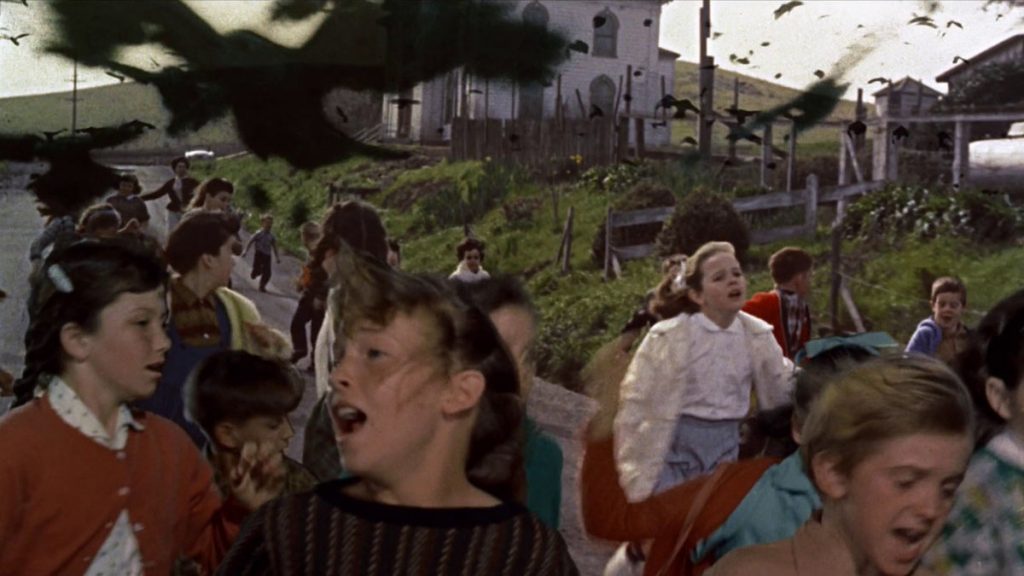
As spring is the season of folk horror—or the season marking the start of folk horror’s new year—what better way to kick off a spring horror-film extravaganza than with The Birds, Alfred Hitchcock’s lone folk-horror creation, and arguably his sole true talkie horror film?
Unlike Psycho, which feels like an experiment in horror, a culture stored within a refrigerator in a cinematic laboratory, The Birds is horror au naturel. Hitchcock’s movies belonged to their own genre, dating back to his days in England. The thinking person’s Hitchcock fan knows the director’s Stateside vehicles never eclipsed the likes of The 39 Steps (1935) and The Lady Vanishes (1938), but whatever he created, there wasn’t likely to be anything resembling it. “Thriller” never seemed to properly define a Hitchcock film, nor did “mystery” or “suspense.” Hitchcock had few imitators in his own time, which is telling; it was as if directors who had no compunction aping other directors to make a buck or a reputation knew they’d look foolish in comparison to this particular one, so they kept their distance (until Brian De Palma came along).
The Birds feels grand—sweeping—in the Biblical sense. The parabolic is meant to hold a place for us all, while also not generalizing any of us. The best parables resonate as exactingly specific and individualized. Tailored and inclusive. Hitchcock’s vision of pure cinema worked best in silent sequences, and that includes within sound films. Think of how the camera moves at the start of 1954’s Rear Window, providing all the backstory we need sans spoken words. Hitchcock was a showman who simultaneously understood the value of economy. The Lodger (1927), a silent horror film, stylizes that idea of narrative-thrifting to fine-tune our fear receptors, the pure cinema concept executed at feature length.
The Birds is as close to the undiluted state as Hitchcock ever got in a talkie. It’s a love story—if you wish—between Rod Taylor’s Mitch Brenner and Tippi Hedren’s Melanie Daniels, or a love triangle, should we include Suzanne Pleshette’s Annie Hayworth… though she knows the score without needing to look at the scoreboard. The scene with the birds massing on the playground structures outside of the little schoolhouse to the diegetic sounds of the children singing (which may have been influenced by the oddball 1957 film, The Big Caper, with a bomb in place of birds) is a virtuosic piece of editing, ranking alongside the creation sequence in James Whale’s Frankenstein. The playground scene defines “unforgettable.” If you walk outside on a spring morning and look up to see a dozen birds on a wire, you’re bound to think, “Oh shit.” The Birds is why.
The film is set in April in a California coastal town. We can all but feel the still-chilly sea spray against our cheeks. July or August wouldn’t have the same resonance. Spring is the season of seasons for birds, when morning songs follow from the hush of winter, nests are built, eggs laid. The winged mustn’t dwaddle. The film’s effects are bound to induce titters in people who can’t watch movies with their imaginations as well as their eyes—which is what Hitchcock asks of us—but that’s no more indicative of anything consequential than saying a film is good because of its blue-screen prowess.
The birds retain their birdness. That is, we don’t think of them as agents of evil acting with a plan. They’re just doing bird stuff in a new manner on a different scale, for some presumably natural reason that we don’t happen to know. The movie strikes us as something that could happen and, let’s be honest, maybe should happen. A fresh start for the world wouldn’t be the worst thing ever. Don’t need you, don’t need you, can do without the lot of you… After all, what’s spring-cleaning if not a type of cull?
Fall is the most aromatic season, but spring is the runner-up. We know the smell of spring well enough, suggestively enough, to experience it through our memories as we do each year in real time, only differently. The petrichor, the dampened earthiness of the soil, that waxy budding of the leaves, the many flowers, even a sort of musk carried on the breeze from animals we don’t see. To cast your mind back to grammar school is to engage your olfactory sense as it functions in the remembered past. There you were, looking out the window at the rain before heading off to get the bus, practically able to experience the bemisted pungency of the front lawn with its earthworms breaking through the surface before you’d gotten out there in the flesh. The same as how years later, a recalled memory returns us to this place we’ve physically departed.
Spring is an intensely somatic season. We taste it by breathing it in. It gets to the mouth in ways winter doesn’t unless there’s snow or a preponderance of rock salt dust in the air, which doesn’t count. Simple spring moments that actually aren’t so simple—like waiting for a bus, sliding in the grass and spraying mud, forgoing a jacket for the first time that year—become embedded in our psyches for replaying at a date TBD because of what we feel we need, or are missing, in relation to that stage of our life.
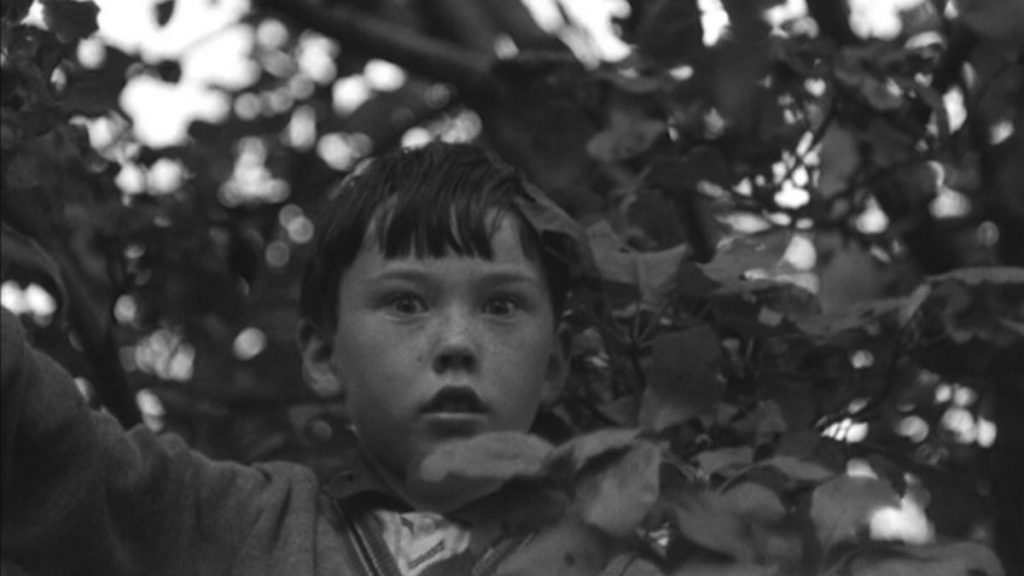
David Gladwell’s nine-minute An Untitled Film is the cinematic equivalent of the above: an eternal spring moment, which is what spring moments, after a fashion, are. It’s also folk horror at the root. A young man working on a farm burns brush—slowly—as the film, a beat in time, begins. This is a moment being made to last, the eidetic power of cinema conceptually fusing with memory’s own time-delayed, dilatory power, but rather than nibbling at Proust’s madeleine, we’re out in nature, with the disclaimer that this is a portion of it in which man is the sovereign shot-caller.
An earthly paradise for someone can be someone else’s—or something else’s—earthly hell. We’re often lax in our definition of nature, thinking it solely that which occurs out of doors pertaining to flora and fauna that isn’t us. But the workplace is nature. The home is nature. The relationship is nature. Rearing is nature. Marriage is nature. Sex is nature. Reaping is nature.
An Untitled Film suggests James Agee’s 1952 short story, “A Mother’s Tale,” in which a cow relays a story about what really happens at slaughterhouses. For their human minders and eventual executioners, the cows represent a part of the job and money in the pocket. Business booming for one is worse than a nightmare for the other.
This concurrency, a staple of nature, is the heart of Gladwell’s film. The smoke from brush burning at the piece’s start is sufficient to make us feel like we’re standing beside a crofter’s fire or else been plunged into the witchy doings of 1960’s The City of the Dead. The individual versed in Shakespeare may be reminded of the three weird sisters and the vapors emanating from their cauldron on the blasted heath. We’re peering through the mists of passed and passing days. A dog plays. A boy watches. A cat skulks. Chickens feed and squawk. Additional vegetation is consumed. The cat leaps. The boy falls from his perch in a tree. A chicken is killed and dropped to the ground, this act having been observed by the boy.
How do we quantify these actions? How effective are our measurements of time in attempting to do so? What does a second really mean, given everything that can occur within it? For this boy, the routine farm scene is the horror film. He’ll shake it off and go about his life, just as we shake off The Birds and set about ours.
A horror film, though, like our memories of spring, has an ability to lodge within us. To be toted around over the duration of our journeys. Which is how both the first whiff of newly mowed grass in May takes us back to a place we also never truly leave and the opening fanfare of Tod Browning’s Dracula restores us to a broken battlement in Transylvania as another version of home.
The seasons that follow spring are essentially different stages of spring before it—and life—comes full circle. What is summer but fully ripened spring? What is autumn but withering spring having become wiser than it was six months ago? And what is winter but the fallowing of spring before she comes alive again? And what is An Untitled Film but a timeless spring horror movie that happens to have a running time but no real ending?
It stands to spooky reason that viewings of George Romero’s horror game-changing film Night of the Living Dead spike during the Halloween season. Is there a better non-Universal monster movie to watch on an October evening beneath a blanket on the couch with a gusting autumn wind having at the house? Pass the peanut butter cups.
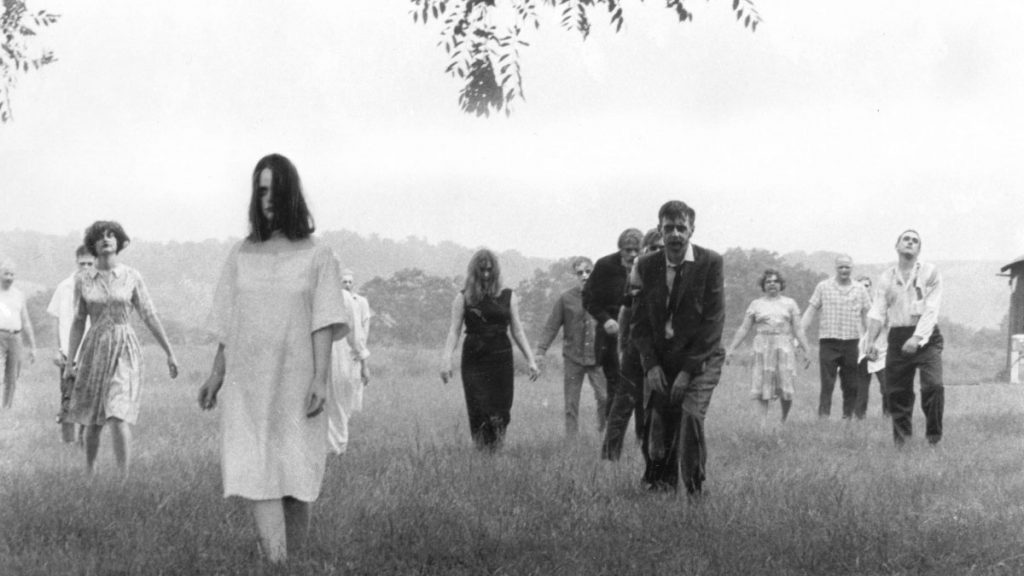
And yet, Night of the Living Dead takes place in spring, the season of rebirth, and involves a most literal rebirth; a coming back to life, after life has ended. Night of the Living Dead surprises us from its outset and then certainly at its true end, which isn’t the same as what we take for its end on initial viewing. The film is instantly creepy prior to anything being discerned as wrong or “off.” We open with a shot of a patch of (oddly?) barren Pennsylvania land, like some terraced baseball field minus grass, a ridge of trees suggestive of an arboreal grandstand. Romero’s camera lingers on the stillness of the scene in the manner of Beethoven’s Fifth Symphony, commencing with a rest, only here the quietude is also loud. We wish for it to be encroached upon.
Finally, a car carrying siblings Johnny (Russell Streiner) and Barbra (Judith O’Dea) enters from the back of the frame. We watch as the vehicle winds its way to the foreground and thus to us. This technique—utilized for the start of Howard Hawks’s Rio Bravo as well—is most efficient. From this first sequence, we’re engaged, active viewers, part of the proceedings, as we’ll also soon be inside the besieged farmhouse. Within minutes, Johnny does his Boris Karloff impersonation for the last time, and Barbra’s brain is as good as gone, though at least uneaten.
The Karloff nod is significant. If we wanted to get reductionist—but still mostly accurate—we could say that the history of film horror has two halves to it. The first began with Dracula and Frankenstein—and therefore Bela Lugosi and Boris Karloff—in 1931, the second kicking off with Night of the Living Dead and its shambling reborn cadavers in 1968. Johnny will come to have a foot neatly on each side of this historical line, as we discover if we’re brave enough to stick around and meet his other self.
Ben (Duane Jones) is the doomed (but not as expected) leader of the pre-dead humans who keeps his head in this battle against the reanimated. Unfortunately, the living are the real bitch of everything. There isn’t a more claustrophobic-feeling film than Night of the Living Dead. It doesn’t look like any other movie. That’s partly to do with its needs do as needs must DIY nature, but also Romero’s intended and realized design. The farmhouse strikes us as almost hopelessly remote. A home without neighbors. And yet, it makes sense to us how this assortment of people came to be here, which speaks to the quality of Romero and John Russo’s screenplay.
Horror doesn’t need to scare to be successful, but Night of the Living Dead is truly frightening. It’s sociologically frightening as well, thanks to Karl Hardman’s Harry Cooper (a far less lovable horror-film version of Archie Bunker crossed with the miserable prick that is Juror #10 in 1957’s 12 Angry Men) and given what ultimately happens to Ben. This was, after all, 1968. Then again, does the specific year matter regarding race in America?
Harry’s idea for the group to lock itself in the basement is a conceptual shudder-inducer; we only need imagine how that could go to jump in our seats without the scene needing to happen. We get a taste (apologies) thanks to the unforgettable images of the child (Kyra Schon) with the garden spade and then feasting on mommy. It’s enough to send our wits packing, the same as Barbra’s, a piece proving more effective than a whole.
Night of the Living Dead infiltrated the popular culture—which, for a time, seemed like the only practically applicable culture in America, before it was superseded by brain-dead culture—as Jaws would seven years later. There’s an old Lester Bangs essay that has someone remarking to the hungover writer that he looks like Night of the Living Dead. Horror metonymy indicative of cultural sticking power. And speaking of brain-dead culture: how terrifying is it that we became a world of people who only happen to be pre-dead but might as well be tag-’em-and-bag-’em dead? Zombies of the screens, rather than a radioactive event, closer in nature to the uninvited dinner guests outside the farmhouse doors than the sentient humans within.
Again, sticking power. Again, unfortunately.
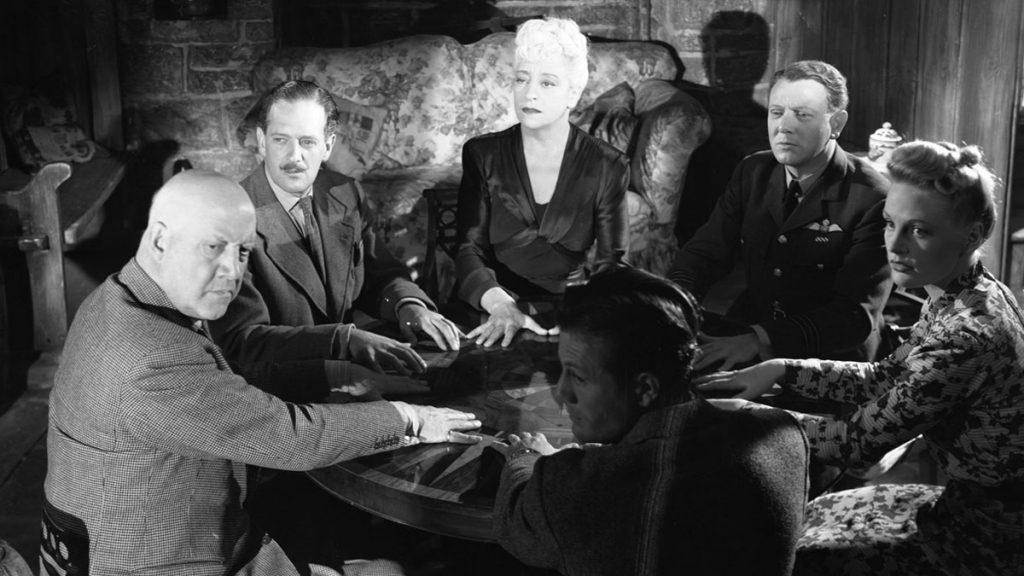
If the Archers, that is, Michael Powell and Emeric Pressburger, the pair responsible for A Canterbury Tale (1944) and A Matter of Life and Death (1946), had made a horror film, it could have looked and felt a lot like Basil Dearden’s The Halfway House. This was the mid-1940s and a war was on, which meant no official horror films in England, but that didn’t mean horror films didn’t find a way to happen by being something else as well. Enter, then, The Halfway House.
Prior to their foregathering, we meet people from various walks of life who are struggling. Life has taken a bad turn for each. Some of them have helped author this turn, others through no fault of their own. A thief (Guy Middleton) is booted out of the military. A couple (Richard Bird and Valerie White) are in the process of divorcing, with their chipper, can-do daughter (Sally Ann Howes) facing disillusionment as she consciously tries to cling to her own innocence. An older couple (Tom Walls and Françoise Rosay) attempt to deal with, and argue about, the pain stemming from the loss of their son in a U-boat attack. An orchestra conductor (Esmond Knight) in intense service to his art is facing a health crisis.
They and others repair to the Halfway House, an inn in the Welsh countryside run by Rhys (Mervyn Johns, who had a knack for playing in this type of picture during this period, as further evidenced by 1945’s Dead of Night) and his daughter Gwyneth (Johns’s real-life daughter, Glynis). One haunting bugaboo, though: the inn was obliterated by a German bomb a year ago. Oh well—guess it’s been rebuilt, the guests try to make themselves believe, because when you gotta get away, you gotta get away.
Problems will be worked out at this hostelry that no longer ordinarily exists, run by these people who don’t either. Other problems can’t be solved, for this is life. The ghostly inn serves as a reminder about the importance of seeking, vision, and embodying peace regardless, which is impossible without acceptance, as is growth.
This makes The Halfway House a film about regeneration. We must always be coming back to life if we are to be alive. Once is never enough. We repeatedly smile and nod in pleased, but humbling, agreement while watching The Halfway House, which is something only special works of art induce. This is a ghost story that “catches itself up.” That is, the German planes from a year ago fly overhead once again, to blow the place to atoms a second time. Flight is of the essence, but it’s the flight back to life, and not away from it, that is paramount. The ghost story as vision of spring, and spring as specter of life and the life force itself. 🩸
is the author of eight books, including the story collection, If You [ ]: Fabula, Fantasy, F**kery, Hope, a 33 1/3 volume on Sam Cooke’s Live at the Harlem Square Club, 1963, Meatheads Say the Realest Things: A Satirical (Short) Novel of the Last Bro, and a book about 1951’s Scrooge as the ultimate horror film. His work has appeared in Harper’s, The Atlantic, Rolling Stone, The New York Times, Vanity Fair, The Daily Beast, Cineaste, Film Comment, Sight and Sound, JazzTimes, The New Yorker, The Guardian, and many other venues. He’s completing a book called And the Skin Was Gone: Essays on Works of Horror Art. His website is colinfleminglit.com, where he maintains the Many Moments More journal, which, at 2.7 million words and counting as of autumn 2023, is the longest sustained work of literature in history.

 FRESH BLOOD
Before Thanksgiving became a speed bump on the capitalist road between Halloween and Christmas—because there’s not much to be...
BY COLIN FLEMING | November 26, 2025

When it comes to ghost stories—the foundational texts, be they written or oral, of horror—the Irish are tough to beat. Fear is a spirit. A ghost may take the form of what we’ve allowed ourselves...
BY COLIN FLEMING | March 17, 2025

Upon initial considerations, lovers of horror films might not strike us as romantics.
BY COLIN FLEMING | February 10, 2025
RAVENOUS
This pre-Code offering packs a lot of story into its typically brisk running time, with several plot threads weaving together a (not always successful) tapestry of spooky and criminal doings.
READ MORE >
BY ANN OLSSON | Month 00, 2021
In what could be the fastest-resulting rape revenge movie, a drunken lout brutally forces himself on Ida, the young woman who doesn't return his affections, during a party over Labor Day.
READ MORE >
BY LAURA KERN | Month 00, 2021
Beast is a lot of movies in one package - fractured fairy tale, belated-coming-of-age story, psychological drama, regional horror film - but above all it's a calling card for its leading lady, Jessie Buckley.
READ MORE >
BY LAURA KERN | Month 00, 2021
 JustWatch