Thank God for cameras—otherwise, how would we know what water really looks like? Call it an evolutionary blind spot, some quirk-memory of coming up from the shoreline slime all those years ago, but anytime I’m on a beach facing the line that separates surface and ocean, I want to be—at the same time—on and under the line. The former is, of course, the stuff of travel, industry, and pleasure. We’ve never been able to truly master the latter. “Most of the pain involved in drowning comes from breathing in water,” the critic and poet Zefyr Lisowski writes in Uncanny Valley Girls. Considering her own urges through the filter of Hideo Nakata’s Dark Water (2002), Lisowski cites a study of people who’ve had near-death experiences with drowning: “Those for whom water entered the lungs described the intense pain, an ‘awful struggle’ that went on for minutes. But those who didn’t breathe all the way in felt comparative comfort the whole way through.”
By his own admission, Mark Jenkin lingers on the way of water. Unlike a James Cameron, though, Jenkin’s water is no post-human, un-understandable element to be rendered sublime with a movie camera. It is water, a discrete combination of rhythm and balance that, when put to film, reveals how rhythm and balance means water. It is just water, and in our observance of it, it exposes every iota of how we observe it. In the features Bait (2019) and Enys Men (2022), as well as in a panoply of short films, not least of which includes the recent work I Saw the Face of God in the Jet Wash (2025), Jenkin has traced his relationship to water, which is to say, to our bodies, the nature we call home or wilderness, and the way some systems seek to drown us.
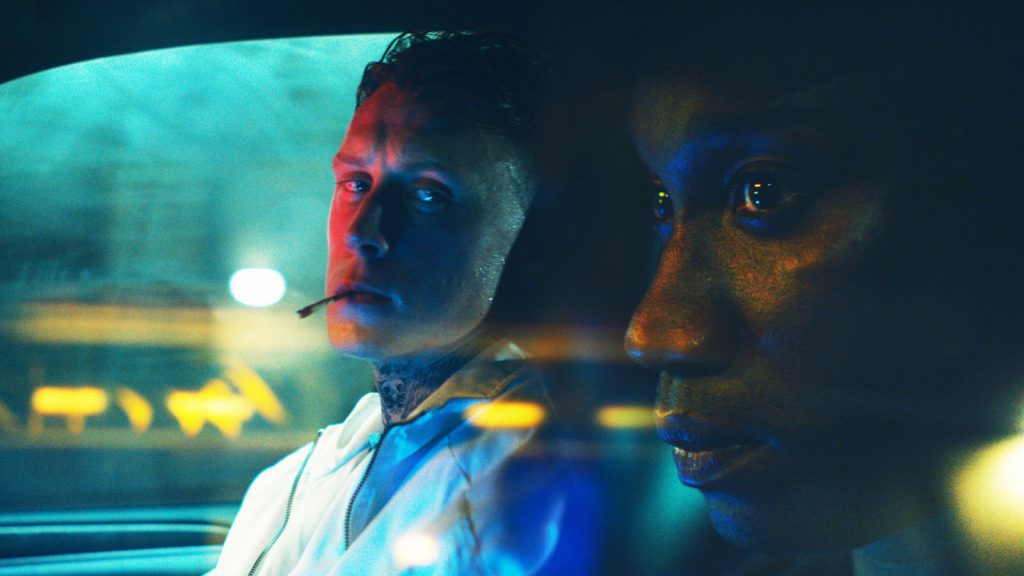
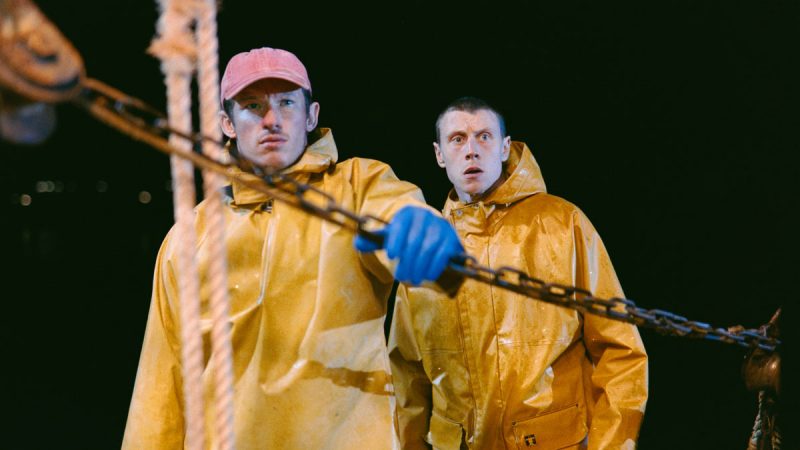
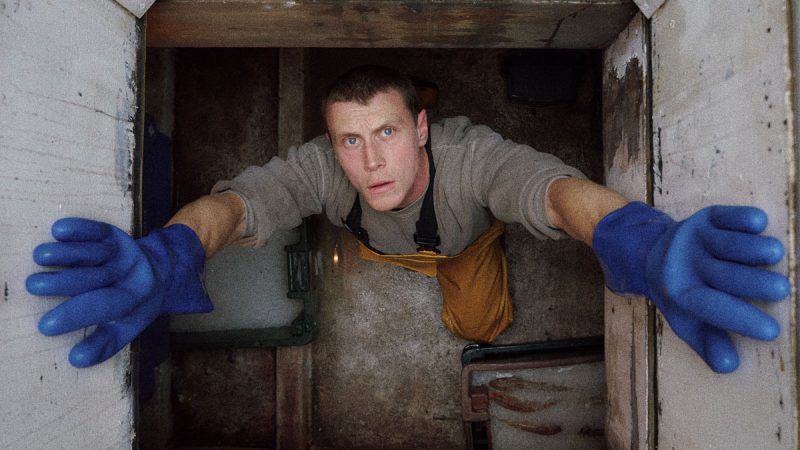
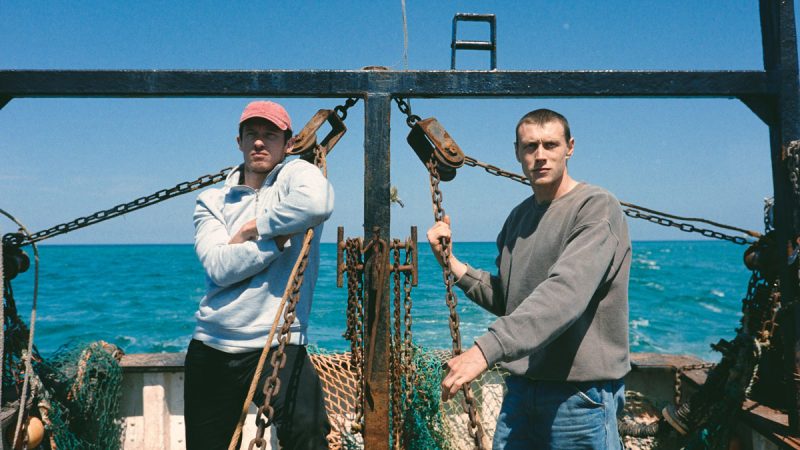
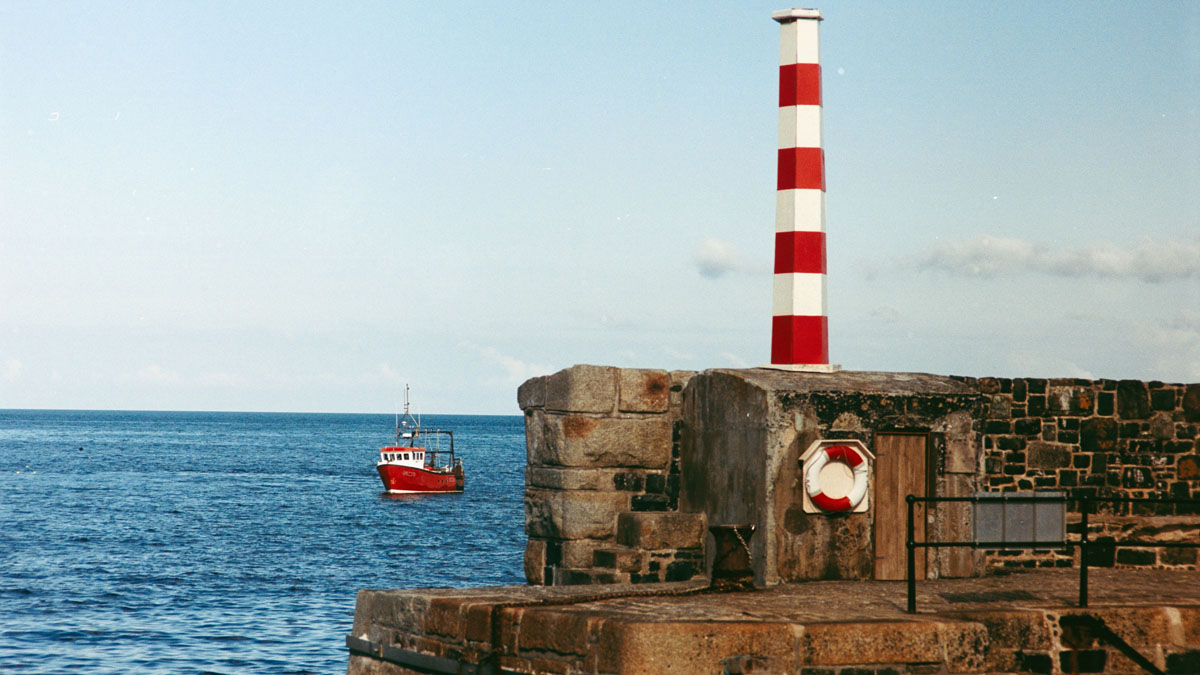
Rose of Nevada (2025) nudges Jenkin’s fugitive 16mm eye from the Nigel Kneale–inspired eco-horror of Enys Men closer to Serling’s Twilight Zone. Three decades out of time, the eponymous trawler mysteriously reappears in a Cornish fishing harbor. Two men—the louche Liam (Callum Turner) and the laborer Nick (George MacKay)—beg onto the little crew and somewhere off the coast, mired in fish guts and whitecaps, come unstuck in time. Returning ashore (“home to mother”), they realize that they’ve stepped into lives and a time not their own. No anthological time-travel trifle, the film finds Jenkin and his close-knit crew of collaborators (including his partner, the actress Mary Woodvine) scrutinizing the horror of losing control over your life, whether to supernatural forces or the more sinister reality of the day-in, day-out grind.
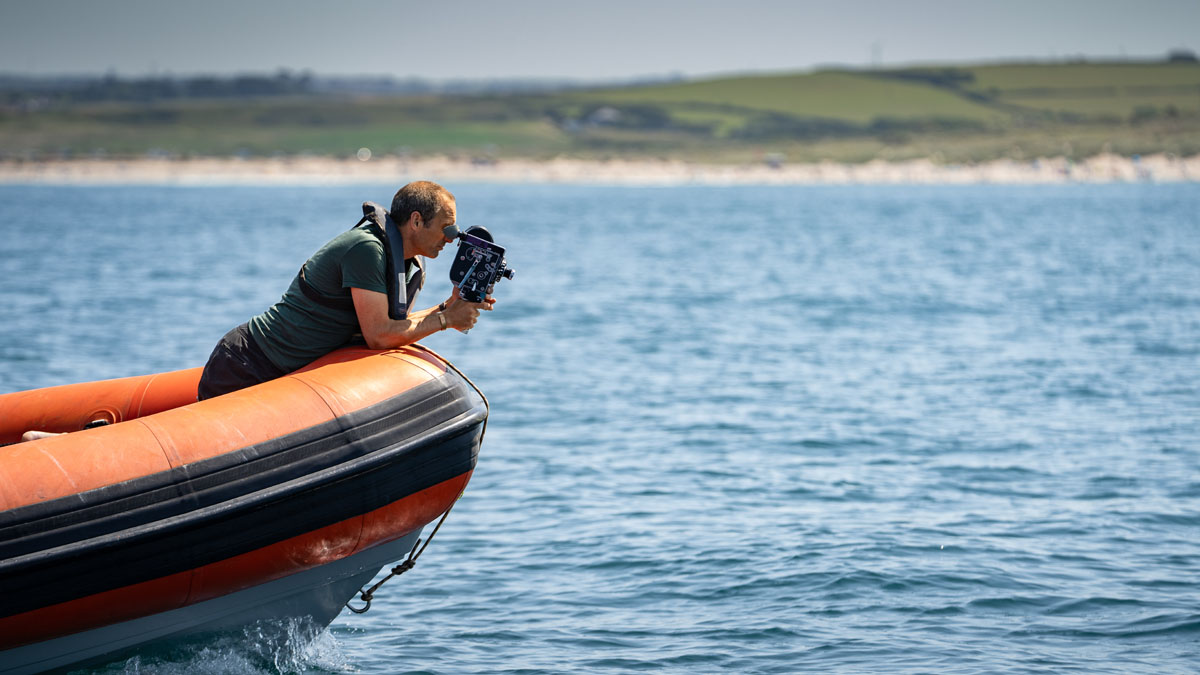
On the occasion of Rose of Nevada’s U.S. release, I spoke with Jenkin via video chat on a mid-June midday. Numerous interviews have seen the director generously account for his process—variably: a predilection for the hand-crank Bolex, an ensuing preference for shooting without sync sound, a Carpenter-esque instinct for soundtracking his own movies—and so we lingered on some less-technical elements of filmmaking: water, industry, time. Happily, we began and ended by talking about jellyfish.

If I’m getting this right, the first three entities we see in Rose of Nevada are a jellyfish, then lichen, and then rust, all centered around and on this ghost ship bobbing in the harbor. This is another film you’ve made with a lot of water in it, and I wonder if you could speak a little about your relationship to water.
I was over in New York in March. A program of my shorts was shown at MoMA, and there were about seven or eight films, and as I’m watching, I’m thinking, Jeez, I really love filming water. Every film had water in it. And at the very end, somebody in the Q&A said, “You’re a…” and then she said this sort of medical term. And I was like, “What’s that?” And she said, “It’s somebody who’s obsessed with the surface of water. I know you’re one of them because I’m one of them.” I’ll have to look it up and see what it is. God knows…
I come from Cornwall. It’s about 90 percent surrounded by water, including the big river that almost cuts us off from England and turns us into an island. I grew up and lived around fishing communities. I surfed when I was younger. I’ve always been in and out of the sea. It’s just part of me, really. I don’t want to sound too New Agey about it. But also, as a filmmaker who works with limited resources, quite often out of choice, the free production value that the sea and the coastline gives you is just such a massive bonus. I shoot everything quite close because I can control the frame. The bigger the frame, the more you have to spend—time or money—to control what’s in that frame. Whereas Mother Nature can give you these big, free vistas. I’m drawn to that. My films are kind of obsessed with time and the past, present, and future all existing at the same time. And the sea doesn’t date. You can film the sea, and especially if you shoot it on 16mm, it could be the ’30s, could be now, could be the ’70s, could be any time.
I think that’s the two things, really. One is because it’s where I’m from. I’m surrounded by jellyfish, lichen, and rust. But also, just the opportunity it offers aesthetically, thematically, and narratively.
My next film may very well be in America and may not see any sea. It’s a road movie set between Upstate New York and Wisconsin. You might get a bit of lake, but there’s not a great deal of ocean in it.
Doing a bit of research for this conversation, I was exposed to some frankly unnerving tourist videos about the village of Newlyn. Lots of the phrase “boutique bungalows” being thrown around… it helped contextualize Bait for someone across the ocean.
Bait is a direct reaction against the expression “boutique bungalow.”
That’s what it feels like. Do you see many fishermen in your day-to-day life?
Yeah, I mean, we’re up the hill from the harbor here. We’ve got fishermen who live in Newlyn, which is down the bottom of the hill from us, a couple of kilometers over the hill. That’s still one of the biggest fishing ports in the UK. Newlyn, Brixham, and Peterhead are the three big ones. So there’s still a huge fleet, and—if you pardon the pun—you could walk down the hill, throw a net, and you’d catch multiple fishermen. It’s still a fishing place. It’s not only got the soul of the fishing, but it’s got the fishing. And actually, I don’t think you can have the soul of the fishing without the actual fishing. People try—you’re in theme-park territory there.
The last thing I want to do is interpret your film back to you live…
No, please do!
I mean, I was reminded—while rewatching—that fishing is an industry. And Rose of Nevada is as much a film concerned with how industry runs and pools and stagnates as Bait is. It’s just working through that concern in a different way.
“Industry” is a really important word. The change that’s been happening in Cornwall has been happening for decades, and it’s a switch from fishing, farming, and mining—which are the traditional three industries in Cornwall—into something that’s much more visitor/tourist-based. And people say, Well, it’s just one industry being replaced by another industry, but I think the distinction to make is that fishing is an industry and tourism is a trade. And the tourism trade just means selling. You sell your environment, you sell your history, you sell your culture, your language, whatever you’ve got as a commodity, until it’s gone. Whereas an industry works in a completely different way.
A tourist trade depends upon selling industry back to you, except as an idea of fishing, as an idea of this place that somehow excerpts the place itself.
Yeah, because you want a sanitized version of the industry. If you were looking at tourist videos or still images of Newlyn, you get a beautiful, beautiful view of the harbor, with these little picturesque fishing boats and the sun out. But what a photo doesn’t convey is sound and smell. Newlyn stinks of fish. And it’s definitely loud. So you have people who’ve basically been sold a lie, like in Bait, the Airbnb visitors who get woken up at six in the morning because the tide’s in, that’s when the fishing boats are going out. That’s the reality. You can have a theme-park version of it that doesn’t smell and doesn’t make any noise, but you won’t have the soul of it.
It’s not as black and white as that, because plenty of people come to Cornwall on holiday, and that’s what they love. You know, they go down in the harbor and they want to see real life, they do. And a lot of people who move to Cornwall end up being more Cornish than the Cornish people. Because actually, they see that and they get it, and they want to be part of it and they embrace it. Whereas some people who are just, by accident of birth, born here, take it very much for granted. So I don’t want it to sound like it’s locals versus outsiders. I’m not proposing we build a wall or anything like that.
It sounds like a more sinister version of the phenomenon you described earlier, about how important control of the frame is. The tourist trade can sell the notion of what’s in frame, and leave out what’s beyond those edges. Do you ever feel any undue responsibility as someone who, in some folks’ imagination, seems to be speaking for Cornwall to a lot of people who are not from Cornwall, or maybe don’t know this place?
No. Well, responsibility as in sort of publicizing it? Maybe in some ways, but hopefully I can counter that by making most of my characters quite hostile and the place miserable. Somebody said to me the other day, Why do you always make Cornwall so bleak? And I said with a straight face, “I’m trying to destroy the Cornish tourism industry.” And there was a moment where they thought I was being serious.
But I know what you mean. There is a danger that you can do that, and I don’t know what the answer is. I think the thing is, Cornwall kind of goes in and out of fashion. That’s how perilous the tourism trade is. You’re just selling something, and you can either run out of the thing that you’re selling or you destroy the thing. People may come to Cornwall because it’s like Cornwall, but then if you start catering to what you think people’s expectations are, then they might as well not come here, they might as well stay at home because you’re creating this thing. Cornwall can go out of fashion, the climate might change… the climate probably will change. I mean, if we lose the Gulf Stream, I think we’ll end up with the same sort of climate as Newfoundland. And then we’ll have a different tourist trade by then.
It’s perilous. And I think it’s a good problem to have—if my films are influential enough to drive people here. But then, the next one’s not going to be about Cornwall, so I can take a break from my sophisticated anti-pro tourist promos.
It’s about displacement and time…
Yeah, come to Cornwall, but come in the 1970s.
Or 1993. Speaking about time slides—and I promise I’ll let up about the water eventually—but this wonderful song, “Water,” by Polly Money, is in Rose of Nevada, right before the story starts to time-slip. How did you go about setting what the film would sound like, both in terms of the diegetic songs from these different periods, but then also your own compositions?
It was our music supervisor [Becca Gatrell] who picked that tune. She gave me a short list to choose from, and I picked that one. It never crossed my mind, the title, or the fact that she’s called “Money” and this exchange of money takes place when the song’s playing, in the pub scene. Coincidences, yeah. But I think there are certain things that I want to set up in the contemporary first half an hour that are kind of called back to or reinforced or contradicted later on. And that’s really fun, because the film plays out chronologically, or chronologically based on the conceit of the narrative. But the way you write it, you don’t write it chronologically. The beginning’s not locked. And then I write the end, and think, Oh, I could see that in the beginning.
I was recording the Blu-ray commentary for Rose the other day. And Mark Kermode—who I was doing the director’s commentary with—was saying that when you see the bit on the boat where George’s character Nick finds “GET OFF THE BOAT NOW” carved into the side, you know you’re going to see him write that later on. And I was like… do you? And he said, Yeah, of course you do. Even on an unconscious level, the audience will know that’s how that works. I was like, Oh right, okay. I thought that was going to be a big sort of surprise. But he said, No, no, no, you put that there knowing that the audience is clever enough that they’re going to know, on some level, that he’s going to write it later on. That’s the fun thing about making films: you kind of play God to this kind of stuff. But something like that, you don’t realize how it works until a critic tells you about it a couple of years later. But I’ll still take the credit for it.
It’s more complicated than “I meant to put that there” or “I didn’t mean to put that there.” You felt something, and that feeling is part of what puts it there, right?
Exactly. What I’m always determined to do when I’m making a film is to not think about anything, just feel it. I’m a big believer in you’ve got your brain in the head, and your brain in the gut, and your brain in the gut is the one to follow. Because that’s the one that keeps you alive, the one in your gut. The brain in the head is the one that fucks everything up. Because it overthinks everything. In filmmaking, if you started using that one, the game’s almost gone. So yeah, just feel it.
I think that’s what’s so interesting about this period, this bit of the filmmaking process. Somebody said to me the other day—I’ve done about three and a half million Q&As—and they said, You must be sick of this. I was like, no, this is my favorite part of the filmmaking process. It’s easy: I get flown around, I get put in a nice hotel, I get to meet people who all seemingly like the film. But also, I’ve got all these really hyperintelligent people who are watching the film, telling me what I’ve done. And I can then make sense of it. And that’s not to say it’s not what I meant to do, it’s like, you know, I was following my gut. And rhythm is the other thing. When I was in New York for the New York Film Festival, I was at a Q&A with Kent Jones, because he was showing Late Fame, and he said, Film’s just rhythm. That’s all you do when you make a film. All you’re doing is rhythm. And I thought, finally, somebody’s articulated it. That’s what it is, it’s just rhythm. And that could be the rhythm of ideas, it can be the rhythm of performances, it can literally be the rhythm of music, but it’s all about rhythm. It’s more than that; it’s like balance and rhythm. I always think if everything’s in balance and in rhythmic step, then the film will work.
And that’s why you can have the best script in the world, the best director, the best cast, the best cinematographer, the best musicians, and you make a film, and it’s shit. And you go… Why? Because it’s out of balance or rhythm. Whereas you can create something seemingly accidentally that does totally work. And that’s because the people who are making it are just following their gut and feeling it rather than thinking about it.
It seems to me that following your gut brain is a good way to put pleasure back in film viewing as well. All the textures we talked about at the beginning—the jellyfish, the rust—if you sort of feel them instead of just investigating them, it’s really a pleasurable encounter with something terrifying and something beautiful.
See, nobody’s ever asked about what the jellyfish means. It doesn’t mean anything. It’s just earned its right to be in the film. And actually, it was going to be the background—the titles were going to run over that sequence. And Denzil [Monk], the producer, and I just looked and said, No, let’s not put anything over these pictures. They’re great. Let’s not put text over them; they’re not background, they’re foreground. We just felt it. We never had a discussion, we never used that brain to think about why it should start with a jellyfish. Of course, it starts with a jellyfish.
Of course, it starts with a jellyfish. We’re running out of time, so I’ll use that: is it a scary thought to you? As the film says, “There’s no time.”
The scariest thought in the world. Time’s scary, you know? Time hangs over us. We’re born into this world with one thing, and that’s time. And when we’re born, we have no idea how much of it we’re going to have. So it rules everything we do in life. We formulate our life around how much of our time we own, how much of it we’re willing to sell to other people. It’s the only thing we have. I think it’s the center of everything for me. I remember the first night of the pandemic—a time I took great solace in having family there—my partner, Mary, and I had to reassure my youngest stepson, who was 11 at the time. “You know, nobody’s lived through this before. And we’re going to live through this together and apart. We’re going to be together, but we’re apart from most other people.” It helped that it was a really beautiful spring. I don’t know if it did in the States, but spring really came early that spring. As soon as the pandemic started, nature gave us flowers. Everything came out and bloomed, and it was so uplifting in the context of what was going on. I remember that first night, thinking, This is bad. And it could get worse and worse and worse, but at some point it’s going to get better. Every night, I’ve got to think this, to stay positive. And that’s like such a beautiful thing, you know? That’s evidence of the time we’ve been given. Tomorrow we wake up. Fingers crossed, it will be a new day.
The flip side of that is what if you wake up in the morning and it’s not a new day? Maybe it’s the same day, or it’s still night. The sun didn’t come up, or it’s 1993. That’s true horror for me. Everything else you can kind of make sense of, but time not making sense is the thing that’s terrifying. That’s true horror. 🩸
is a New Jersey–based writer. He’s an Associate Editor at Bright Wall/Dark Room, and his writing has appeared in Reverse Shot, MUBI Notebook, the Los Angeles Review of Books, and elsewhere.
 FRESH BLOOD
BY JOSÉ TEODORO | March 28, 2023
At this crazy moment, when film history is caught in the grip of multiple clichés that grind on and on and on...
BY KENT JONES | September 10, 2023
BY LAURA KERN | March 29, 2024
RAVENOUS
This pre-Code offering packs a lot of story into its typically brisk running time, with several plot threads weaving together a (not always successful) tapestry of spooky and criminal doings.
READ MORE >
BY ANN OLSSON | Month 00, 2021
In what could be the fastest-resulting rape revenge movie, a drunken lout brutally forces himself on Ida, the young woman who doesn't return his affections, during a party over Labor Day.
READ MORE >
BY LAURA KERN | Month 00, 2021

Beast is a lot of movies in one package - fractured fairy tale, belated-coming-of-age story, psychological drama, regional horror film - but above all it's a calling card for its leading lady, Jessie Buckley.
READ MORE >
BY LAURA KERN | Month 00, 2021