
Joe Buchanan has come unstuck in time. He is a scientist in New Los Angeles, and the year is 2031. He is a narrator in Frankenstein Unbound, and the year is 1990. He speaks with Victor Frankenstein, Mary Shelley, and the computer in his electric car, which sounds a lot like Dr. Cathy Frankel, the alien biochemist from the brief-but-fondly-remembered Fox TV series Alien Nation.
It is, as it were, the voice of Cathy Frankel from Alien Nation. Terri Treas got her start as a dancer on Broadway in the mid-’70s, in revivals of Pal Joey and My Fair Lady and the brief-but-weirdly-remembered musical based on Studs Terkel’s Working. Treas was a dancer in All That Jazz (1979) and the Chicken Ranch Girl in The Best Little Whorehouse in Texas (1982) before transitioning to the kind of low-budget, high-affection movies summed up in a title like Deathstalker III (1988). On-screen dalliances with mutant cockroaches in The Nest (1988) and mutant gargoyles with The Terror Within (1989) placed Treas squarely in another tradition: that of horror films produced by Julie and Roger Corman.
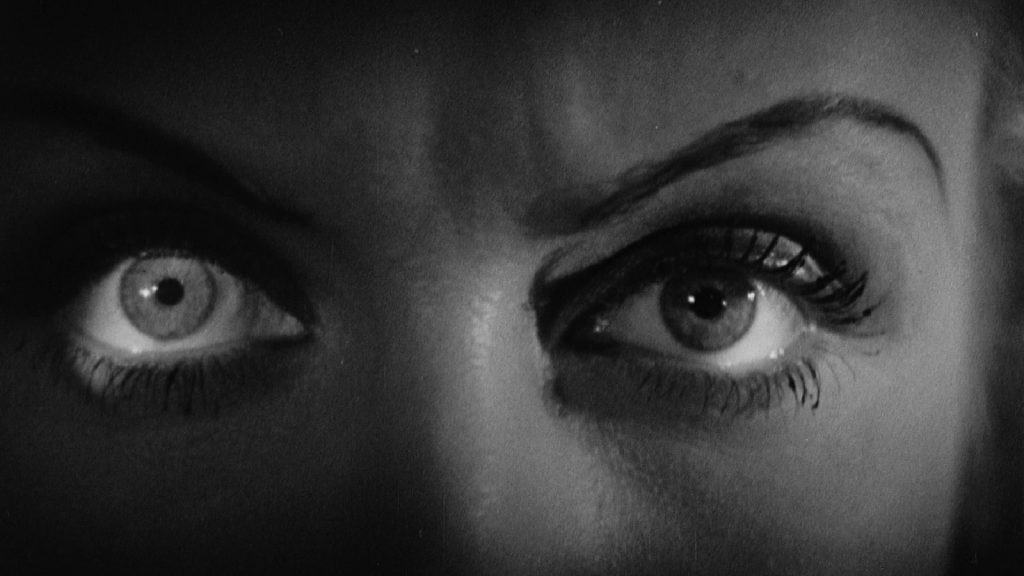
This is the way Frankenstein Unbound moves. You have to account for a lot at once: detours, languishing, disparate parts, and slapdash (which is to say, instinctive) editing. It contains so many limbs in its exquisite corpus that it’s best symbolized in its poster depiction of an eye composed of many irises, its myriad colors sewn together impossibly. Adapted by screenwriter F.X. Feeney from Brian W. Aldiss’s 1973 novel of the same name, Frankenstein Unbound remixes Shelley’s own 1818 novel with a generous sampling of James Whale’s metafictional prologuing in Bride of Frankenstein (1935). It marked the first time that Roger Corman—always a busy producer—would occupy the director’s chair in nearly 15 years. It would be the last film he directed.
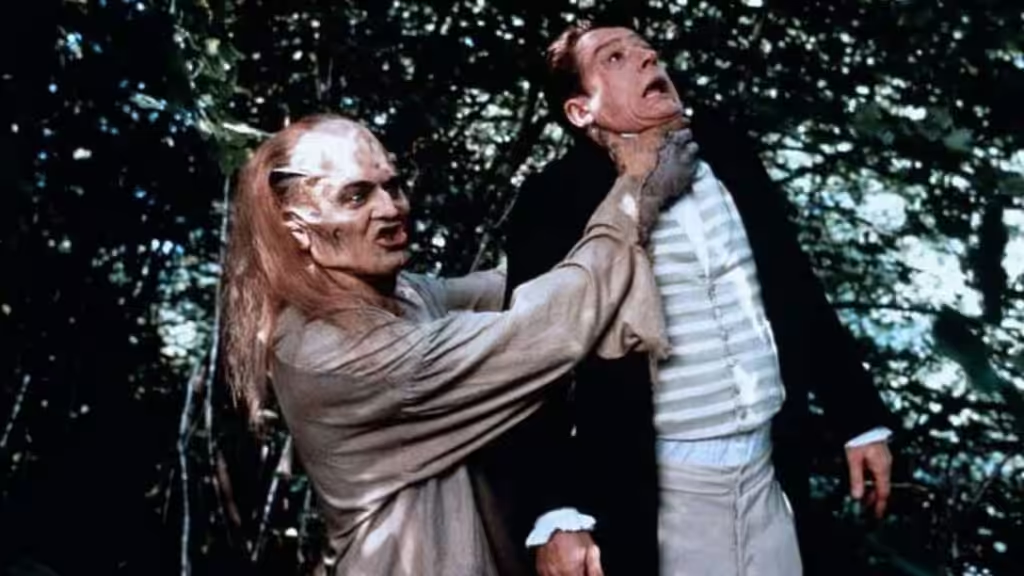
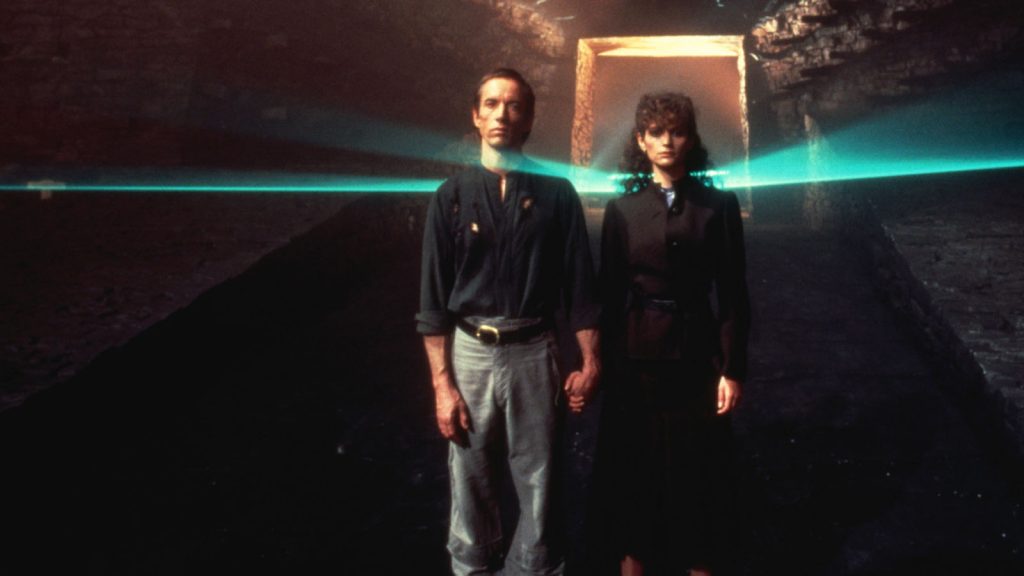
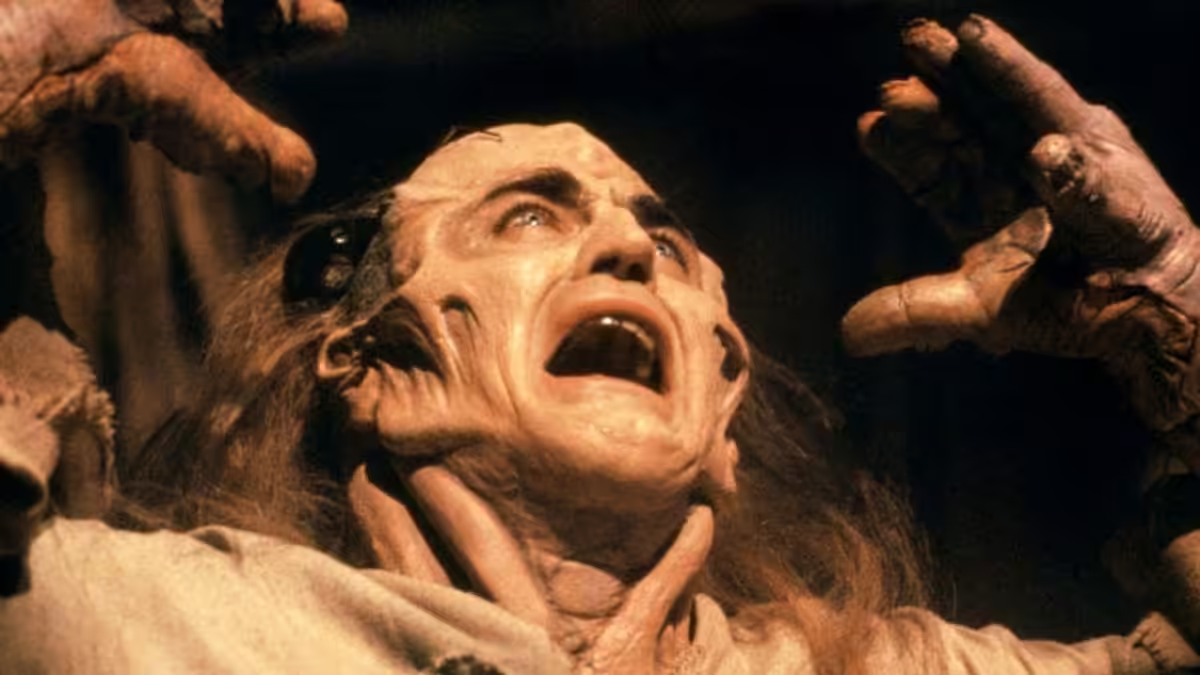
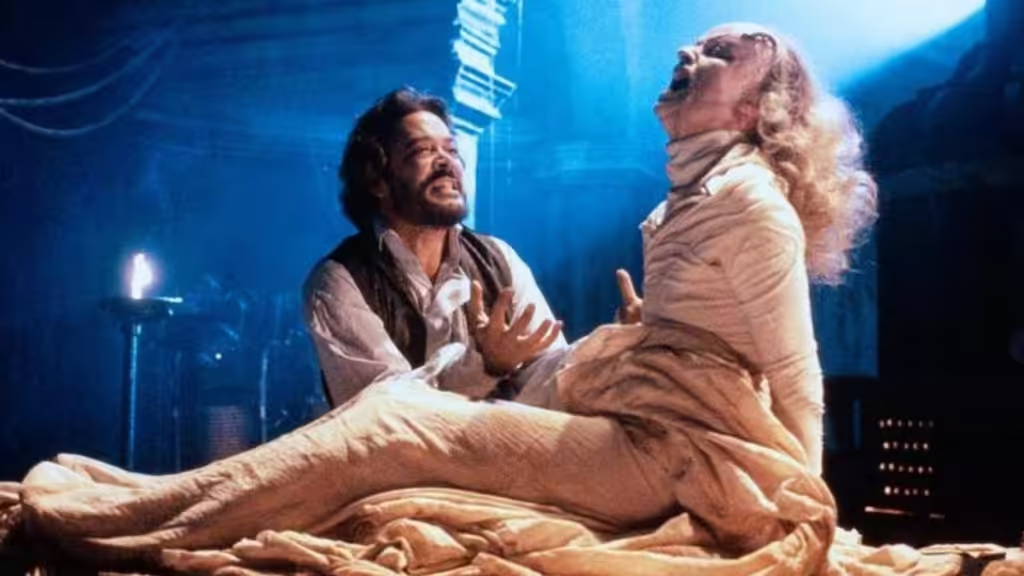
How fitting, then, that it so fully embodies the Corman-esque, a mode as definable by its thrifty tactility as by its clear-hearted conscience. Joe Buchanan (John Hurt) is a scientist from the future. Charged by his president to create a weapon so fearsome as to deter any other’s apocalypse, he has invented a laser beam. During a test of the weapon, the beam “implodes” a model of the Statue of Liberty, ripping open a vast purple gash in the sky. This time-slip of a portal promptly sucks up Dr. Buchanan, throttling him and his robot car back to Switzerland circa 1817, a place and time eerily similar to the plot of Shelley’s novel, where Victor Frankenstein (Raul Julia) attempts to manage his guilt over a young servingwoman’s murder trial, knowing full well that the victim—Frankenstein’s younger brother—wasn’t killed by her but the hulking grotesque known in this movie as “Creation” (Nick Brimble). The wrinkle of it all comes when Buchanan observes a young woman taking notes at the trial—Mary Shelley (Bridget Fonda). Echoing Frankenstein’s own shock at being recognized by Buchanan earlier, Shelley demurs. “You must be confusing me with someone else… my work has never been published.”
In Aldiss’s novel, all these braided authorships make for a compellingly low treatise on the responsibilities of fiction in a world choked by climatic collapse and edged by nuclear winter. Crack it up to the differences between written fiction (ontologically bound, sprawled in front of us) and the moving image (projected, onto a screen then into the eye) or simply having too much of one’s skin in the speculative game, but as with A.I. Artificial Intelligence (2001)—adapted from the Aldiss short story, “Supertoys Last All Summer Long”—Corman’s Frankenstein Unbound reveals more about its maker than the rhetorics or aesthetics of fiction. It’s all here for Corman as auteur, from the spontaneous poetry-through-frugality—an insert of supposedly gored sheep is brief, but not brief enough to hide that the animals are still breathing, nightmarelike—to a middle sequence that sees Buchanan wooing Shelley that’s tonally closer to the slurry of nurse-sploitation films Corman produced in the early ’70s than to anything like the Gothic. A set of woozy, woggled “dream shots” haunt Buchanan whenever he’s knocked unconscious, beamed into 1990 straight from House of Usher (1960), all purple cellophane and crème de menthe liqueur masking an ably, admirably DIY set.
Despite his interest in countercultures and integration pictures—see The Trip (1967) and The Intruder (1962), respectively—the progress Roger Corman most purely pursued was a cinema made for humans by humans. Despite a set of nested author avatars bemoaning their complicity in apocalypse, Frankenstein Unbound is a bracing and joyful example of moving images freed from the weight of meaning beyond itself. Unlike the Creation or his variable creators, Frankenstein Unbound is not lusting after definition from outside. There is none of the dull literalism of Guillermo del Toro’s Frankenstein or the leveraging of film history for stale polemic à la The Bride!, two recent films that attempt to demonstrate the gravity of creation and the responsibility for modeling a vision while forgetting the spiritual truth Corman breathed: cinema—and art itself—needs no justifying reason nor permission from backers to exist.
One needn’t bad-mouth boring movies in the present to praise Frankenstein Unbound. So let me end like this: there is a sequence near the film’s conclusion set in a laboratory from a future after the future that the film starts in. A monster montaged from special effect and memory chases a maker (a director) around a maze of lasers. It’s an oddly lyrical rhyme to the film’s earlier lab sequence, full of lightning flash and fogging beakers. With every splash and beam of light, all I see are outlines of Karloff and Kier, Elsa Lanchester’s Cheshire grin, and Kenneth Branagh’s hammy mane. Not every movie contains every movie anymore—this is the amnesia of a present moment saturated with data and images to the point that nothing sticks. Every Corman film contained multitudes—his and Julie’s great grift was their ability to suggest plenty without plenty. Their gift, however, was always to see cinema (and a cinema of speculative shapes) as a place for plenty rather than less, for all the acknowledged who came before and all the dreamers looking in, who wanted nothing more than the liberty of a low budget and a bucket of blood. It is, to be vulgar, a theory of unbounding creation. I hope it never ends.
is a New Jersey–based writer. He’s an Associate Editor at Bright Wall/Dark Room, and his writing has appeared in Reverse Shot, MUBI Notebook, the Los Angeles Review of Books, and elsewhere.
The first thing we lay eyes on is… an eyeball! No enveloping head. Just an eyeball attached to an optic nerve, floating...
BY JOSÉ TEODORO | April 5, 2026
Edgar Allan Poe wasn’t exactly a lover of plausibility. He may not have been a lover of anything, despite popular culture’s love of him, preferring to wander dark streets at ungodly...
BY COLIN FLEMING | April 5, 2026
Smart, sinister, colorful (back to this in a minute), nuanced, expansive, repellent, beckoning, dastardly, placating, and inspiring...
BY COLIN FLEMING | April 5, 2026
This pre-Code offering packs a lot of story into its typically brisk running time, with several plot threads weaving together a (not always successful) tapestry of spooky and criminal doings.
READ MORE >
BY ANN OLSSON | Month 00, 2021
In what could be the fastest-resulting rape revenge movie, a drunken lout brutally forces himself on Ida, the young woman who doesn't return his affections, during a party over Labor Day.
READ MORE >
BY LAURA KERN | Month 00, 2021
Beast is a lot of movies in one package - fractured fairy tale, belated-coming-of-age story, psychological drama, regional horror film - but above all it's a calling card for its leading lady, Jessie Buckley.
READ MORE >
BY LAURA KERN | Month 00, 2021