The aim of slashers—at least in their early days—was to shock. They weaponized their newness and how they broke with films of the past, in which the gory details of riven bodies happened offstage after a fashion, even when those injuries were sustained in front of our very eyes. Strands of tissue weren’t shoved into our faces until the advent—and yes, in this instance we’ll consider that a Christmas pun—of the slasher.
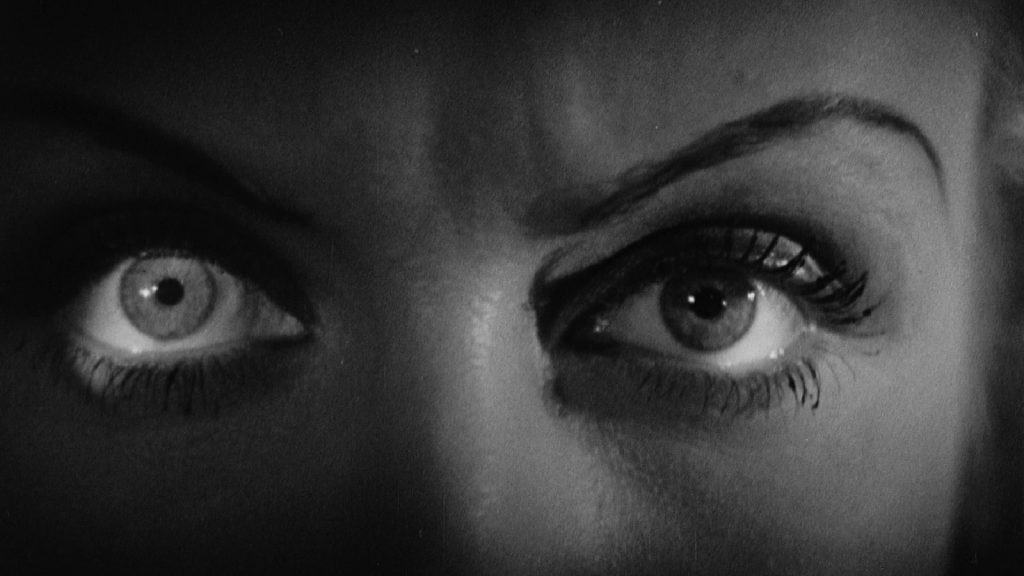
Having quickly displayed myriad methods of said slashing, those who made these films went on the prowl for further newness to shock us afresh. Christmas made for a ripe subject, given its holy factor. Black Christmas from 1974 is often affixed with the slasher label, but it’s also a film that could have existed in several of the previous decades, when the outright slasher wasn’t permissible. That’s because it’s as artful as, say, Georges Franju’s Eyes Without a Face (1960), which is no more or less a slasher as we perceive the term than the Bob Clark film. But what of the slasher that isn’t about who’s dispatched and how, and yet remains a slasher? How can that happen? And where do we, the viewers, fit in?
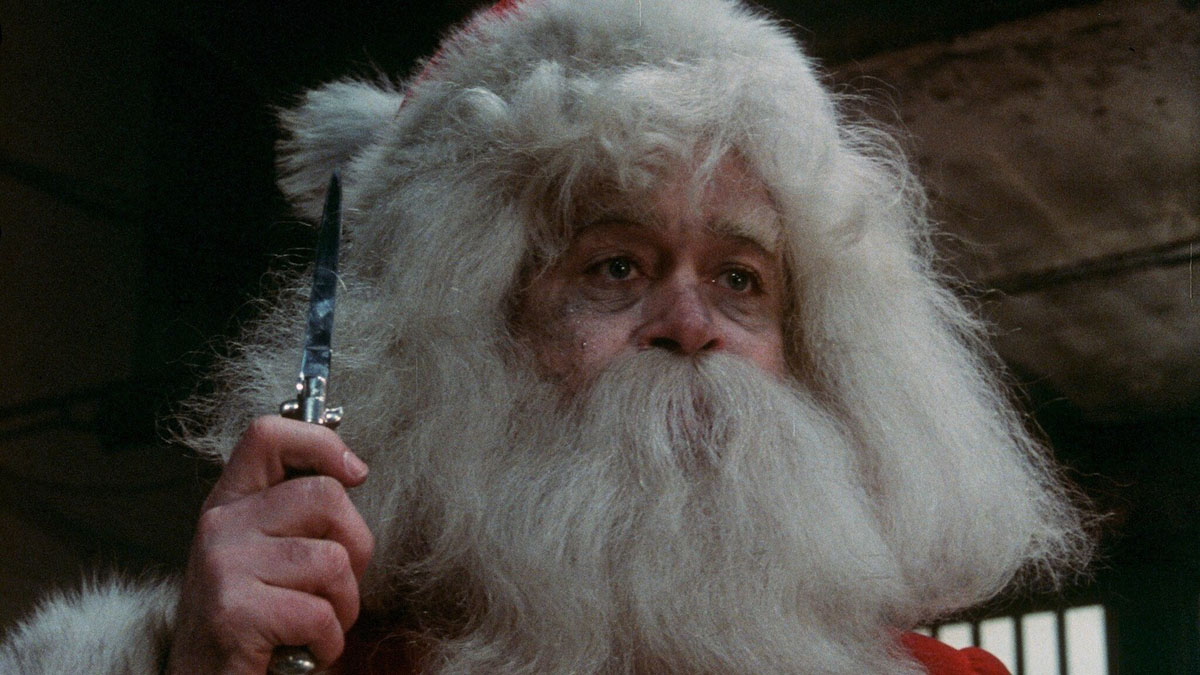
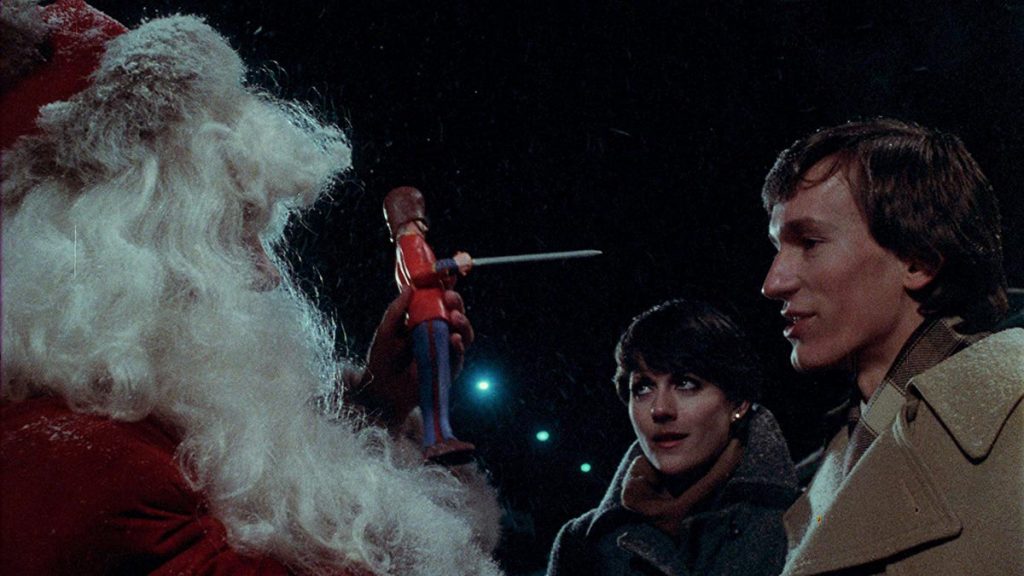
Murderous Santas have been around longer than you may think. Andrew Caldecott’s short story “Christmas Re-Union” from his 1947 collection Not Exactly Ghosts is subtly rendered, but it’s a work of St. Nick–based bloodletting regardless. We’re left to fill in various gaps for ourselves amid the score-settling, the same of which can be said about the 1980 film Christmas Evil from director Lewis Jackson.
This isn’t a movie that has fared well in the history books, such as they exist for films of the gore-speckled stripe, though you will see it termed a “psychological slasher,” which is a more favorable label than is typically applied to its carmined subgenre cousins. But Jackson’s film has, dare one say it, a Christmas soul.
Brandon Maggart—and yes, that does sound like “Maggot”—plays Harry Stadling, looking like a washed-out, middle-aged Greg Brady, who happened to observe his mother being orally serviced by Santa Claus near the tree as a boy. Call it the trigger point for what becomes a life of determining who’s naughty and nice, for Harry decides that this Santa Claus gig aligns well with his ability to accurately assess if you suck, figuratively or literally.
He keeps a voluminous tome in which he writes notes in elegant, large-form cursive about who deserves presents that year. Nothing excites him more than the Macy’s Thanksgiving Day Parade and the arrival of the jolly old elf in his resplendent red suit. Okay, Harry uses field glasses to look into the window of the little girl’s bedroom across the street, but she is very well-behaved and an inspiration to his work, unlike the boy with the smut mag who practices “negative body hygiene,” and we all know what that means to Old Testament–style Santas and Janus-faced priests alike. Unhand yourself, boy!
The film’s psychological aspect stems from Harry’s loneliness. He isn’t evil in that he’s kindhearted. He wants to do well and for people to be well—which is more than most of us, regardless of whatever we tell ourselves and the people we think are paying attention to us on our social media pages. We’re a race of self-obsessed breast-beaters; Harry seeks to be a guardian angel of Christmas, though it’s hard to picture him and Clarence from It’s a Wonderful Life at the same lodge function.
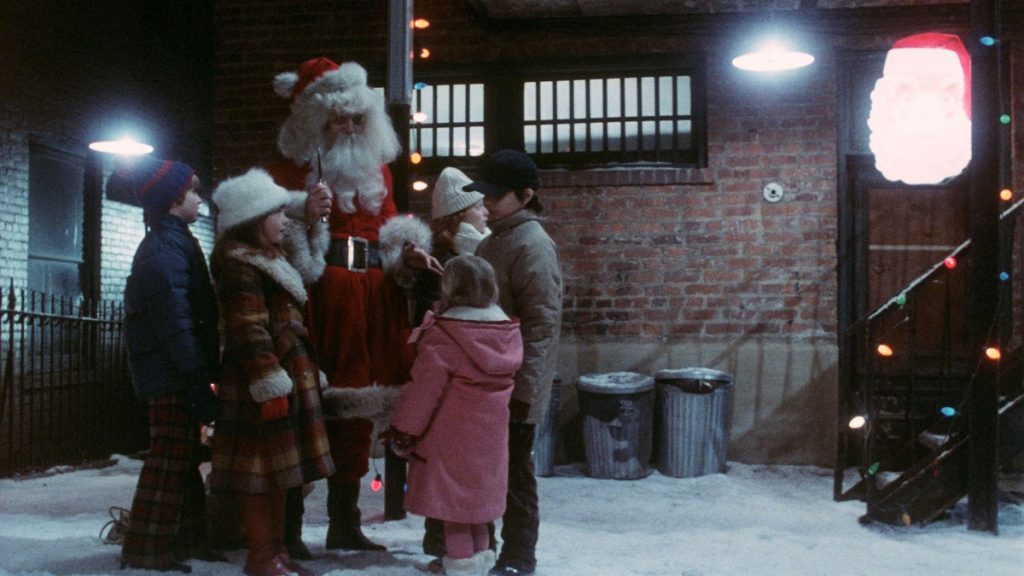
Harry is picked on, demeaned, laughed at. Unlike Hermey the elf from 1964’s Rudolph the Red-Nosed Reindeer, Harry is a stickler for a well-made toy. Toys that last, unlike happiness, which often seems like it doesn’t. Killing isn’t his motivation; it’s more like situations arise and killing occurs. But we won’t count it as a Christmas sin should you cry out, “Take that!” with the gusto of Santa urging on his reindeer when Harry shows some obnoxious, fake-as-a-metal-Christmas-tree rich people what’s what outside of a church while clad in his Santa attire, with his sleigh—that is, his van, where he sometimes sleeps—in position to spirit him away once again.
Then there’s the psychology of the film’s sibling dynamic between Harry and his brother Philip (Jeffrey DeMunn). The latter regards Harry as a lost cause. As do we. This isn’t cruelty—Philip doesn’t share this view with his brother and instead treats him as someone he loves who he, in turn, would love to see flourish, and whose own home is always welcome to his brother, regardless of how strange and difficult he is. You know it can’t be easy for Philip, but his devotion remains intact.
Almost everyone has felt like a lost cause at some point or other, and we all know loneliness. Rarely is a slasher relatable, but Christmas Evil has some overlap with the life of each person who watches it. In a slasher, we expect the doers of the naughty deeds to eventually be offed themselves, or else stalk off to slay again, be it in a future entry or in our imaginations. Harry gets the ending he has coming, though, which itself is sprinkled with some Christmas magic, as if the real Santa sat down with a higher-up of the universe and pleaded Harry’s case. Either way, he receives the gift he deserves. 🩸

is the author of eight books, including the story collection, If You [ ]: Fabula, Fantasy, F**kery, Hope, a 33 1/3 volume on Sam Cooke’s Live at the Harlem Square Club, 1963, Meatheads Say the Realest Things: A Satirical (Short) Novel of the Last Bro, and a book about 1951’s Scrooge as the ultimate horror film. His work has appeared in Harper’s, The Atlantic, Rolling Stone, The New York Times, Vanity Fair, The Daily Beast, Cineaste, Film Comment, Sight and Sound, JazzTimes, The New Yorker, The Guardian, and many other venues. He’s completing a book called And the Skin Was Gone: Essays on Works of Horror Art. His website is colinfleminglit.com, where he maintains the Many Moments More journal, which, at 2.7 million words and counting as of autumn 2023, is the longest sustained work of literature in history.
In theory—well, maybe—one is not supposed to laugh while watching the events of Silent Night, Deadly Night (1984) unfold, but damn does this feel cathartic and mirth-inducing.
BY COLIN FLEMING | December 25, 2024
There are horror movies in which Christmas is present, as if incidentally, and there are horror movies in which Christmas is the crux. The latter often feature a gimmick.
BY COLIN FLEMING | December 23, 2024
It’s quite likely that my first taste of narrative horror was provided by Tales from the Crypt, the luridly tongue-in-cheek anthology series that ran from 1989-96 on HBO.
BY STEVEN MEARS | December 22, 2024
This pre-Code offering packs a lot of story into its typically brisk running time, with several plot threads weaving together a (not always successful) tapestry of spooky and criminal doings.
READ MORE >
BY ANN OLSSON | Month 00, 2021
In what could be the fastest-resulting rape revenge movie, a drunken lout brutally forces himself on Ida, the young woman who doesn't return his affections, during a party over Labor Day.
READ MORE >
BY LAURA KERN | Month 00, 2021
Beast is a lot of movies in one package - fractured fairy tale, belated-coming-of-age story, psychological drama, regional horror film - but above all it's a calling card for its leading lady, Jessie Buckley.
READ MORE >
BY LAURA KERN | Month 00, 2021