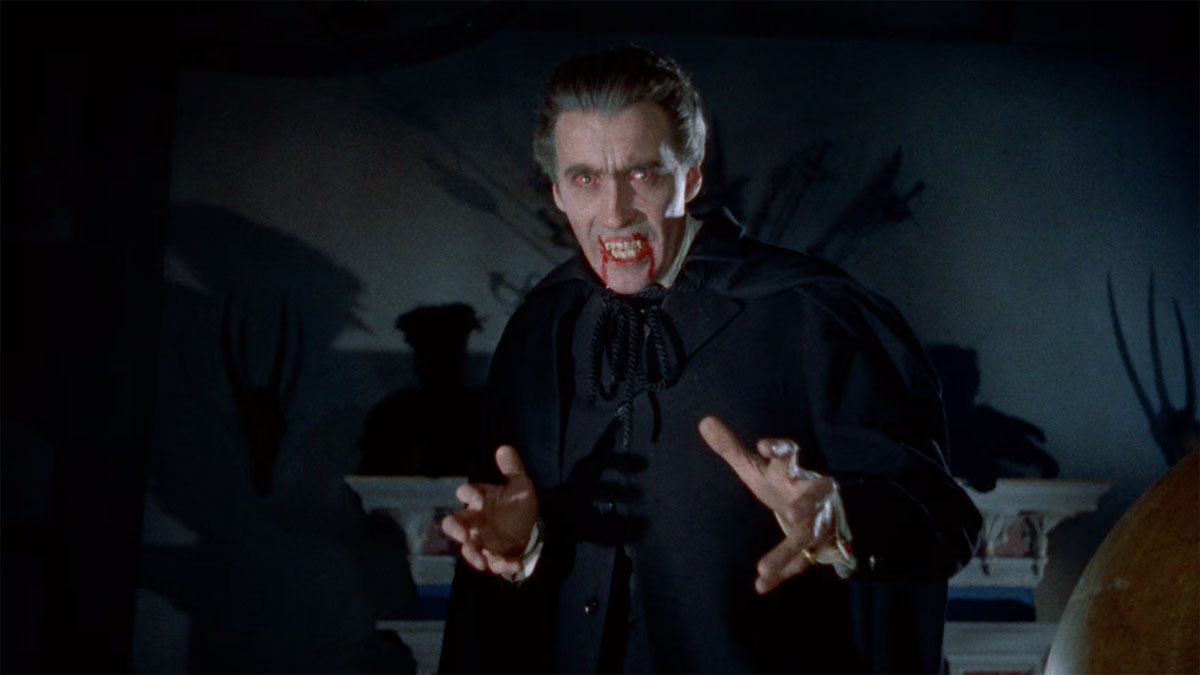
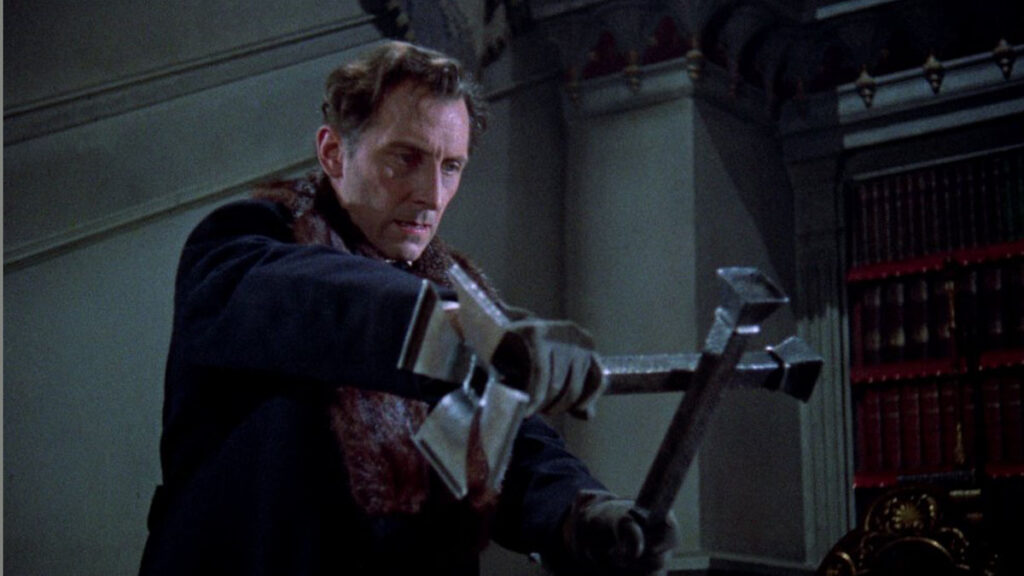
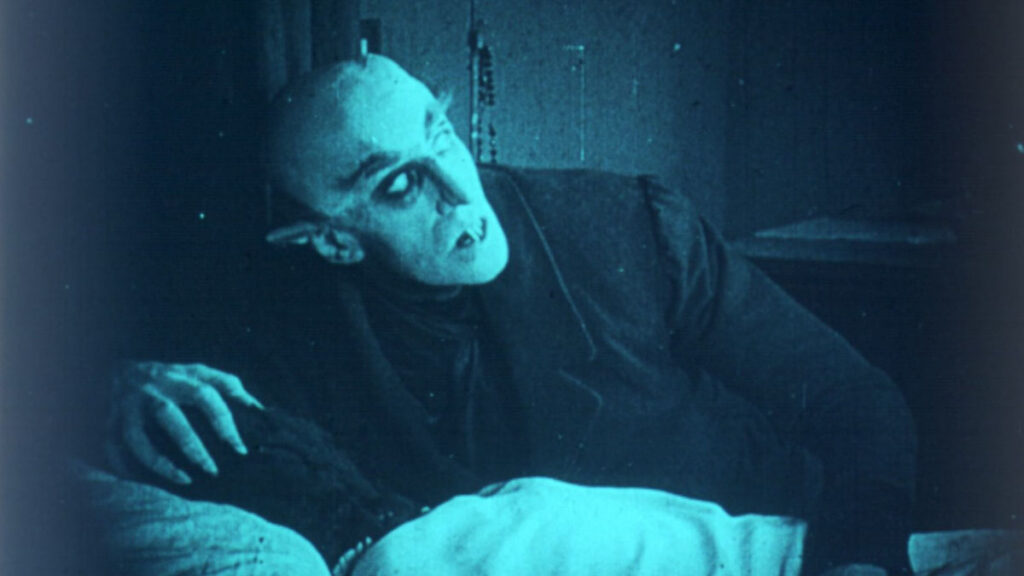
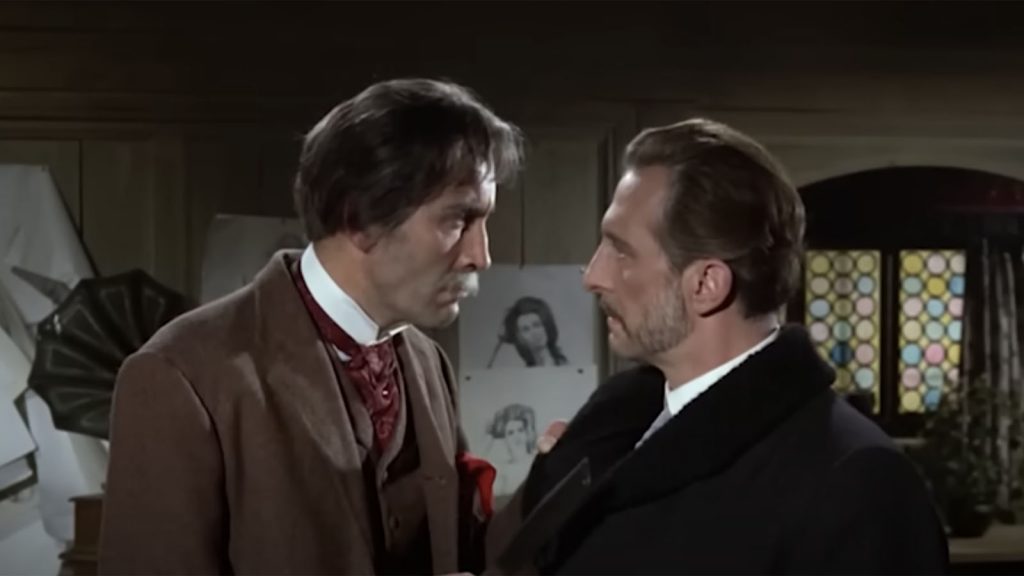
For all of the worthy vampire pictures that exist, there have been three game-changing works: F.W. Murnau’s Nosferatu from 1922, Tod Browning’s Dracula with Bela Lugosi from 1931, and Hammer’s Horror of Dracula from 1958, directed by Terence Fisher with Christopher Lee as the insatiable Count and Peter Cushing as Van Helsing, the pursuer pledged to slay him once and for all.
Horror wasn’t moribund between the early 1930s and the late 1950s, but it’d never had quite the same kick as when Browning’s picture and James Whale’s Frankenstein came out in the same year. Hammer changed that with Horror of Dracula, and what a goddamn jolt this was. Perhaps not a shock of the new, but a shock of the made-anew. The studio had issued its first horror effort with 1957’s The Curse of Frankenstein (starring Cushing as a particularly nasty version of the doctor, who’d become nastier in the sequels). It was a sobering effort of muted colors and moods. You could say the treatment was fairly literary compared to its Universal counterpart. A lugubrious film, but never a boring one.
Contrastingly, the studio’s first Dracula movie (originally titled just Dracula in the UK) is an invigorating breaststroke through a pool of blood that’s the richest of reds down to the bottom of the deep end. The colors explode. That blood runs hot. Normally, when we cite cinematic chemistry, we’re talking about a man and a woman, but there was an immediately supercharged synergy between Lee and Cushing. Textual liberties are taken in the name of pacing; a paradoxical strength of Bram Stoker’s novel was how prolix it could be. But we can’t bask in the afterglow of male friendship on the screen. Cushing’s Van Helsing is a hunter with a few helpers. Lee’s Dracula mostly only talks to charm the ladies so that he has sources of fresh blood near to hand. Jonathan Harker (John Van Eyssen) knows what the Count is before he arrives in Transylvania. He’s a man with a plan that doesn’t quite come off.
Lee, ever the purist, bristled (but did he show teeth?) at not being able to play the Count as Stoker wrote him, and later compensated for it by recording an abridged version of the novel on LP, which is one of the finest spoken-word documents you’ll ever hear. Lugosi’s Dracula was suave; Lee’s is dignified. Projects an air of culture. He’s read books and could talk on a range of subjects. Would make an ideal dinner companion in different circumstances.
This is the movie that established the Hammer formula, which had a knack for not feeling formulaic. It’s forever fall. Hammer avoids the other seasons. Summer doesn’t happen here. People are dying, and leaves are too. There’s an inn serving as a rustic communal center where woodsmen take the chill off with ales, plates of simple food, and hearth fire. These hostelry scenes always look exactly as you’d want them to in your imagination. They are to the Hammer film as the snug quarters of 221B Baker Street are to Sherlock Holmes adaptations. And while Fisher was no outright artiste, he was a master craftsman. You can craft your way to a masterpiece in horror with a well-designed plan, airtight design, a vibrant look, mood that essentially comes with an unlimited warranty, plus top-of-the-line materials (sets, actors), and it’s craft that renders Horror of Dracula Terence Fisher’s Citizen Kane.
Horror of Dracula has a heartier action component than The Curse of Frankenstein, which makes for a reversal of what Universal had done with the two properties. The Victorian fabric is brocaded with Romantic textures. There’s no Quincey Morris, which isn’t that unusual, but also no Renfield, which is. But they didn’t need him with the plot tweak of Harker traveling to the castle to dispatch the Count and Van Helsing subsequently going looking for his friend. Nor does Dracula transform into a bat or wolf. That was deemed unrealistic.
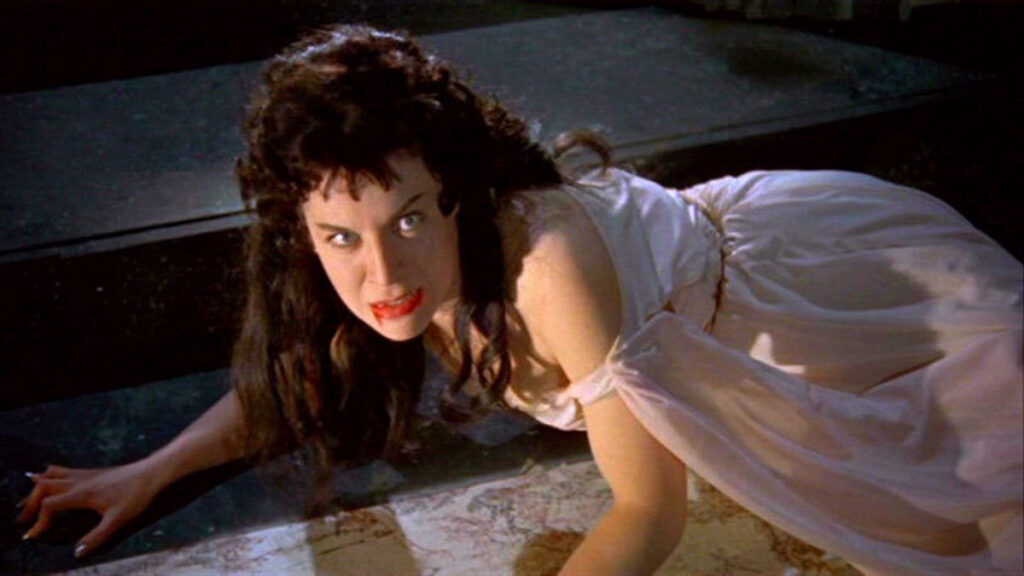
But the sexual aspect? Fisher wanted it in ample evidence. Dracula’s female victims were victims, yes, but also… satisfied victims. This was strange, dangerous ground. But what is Dracula the monster “about” if not conversion-via-rape? One may think of the British navy and its press gangs that would knock men out and drag them off to service at sea, with any of a number of those men then voluntarily making their living on ships after the fact, but with an orgasmic twist, going by the faces—as per Fisher’s direction—of Dracula’s coterie of brides.
Again, it’s a wallop of a picture, with a climax as thrilling as any in horror. Shooting ran from November 11, 1957, to Christmas Eve, which just feels retroactively right; here are the filmed proceedings of an English autumn through the ghost-story season of Christmas. James Bernard’s score increases the impact of everything else in the movie and can be listened to separately as its own work of terror art, like Bernard Herrmann’s score for Psycho or Franz Waxman’s for Bride of Frankenstein. The viewer is spent, but satisfied, at the conclusion. It’s hard to imagine what else one could have wanted. Hammer would never reach this height again, but that was fine, considering we’re talking the tippity-top of the castle battlements way up on the mountain. 🩸
is the author of eight books, including the story collection, If You [ ]: Fabula, Fantasy, F**kery, Hope, a 33 1/3 volume on Sam Cooke’s Live at the Harlem Square Club, 1963, Meatheads Say the Realest Things: A Satirical (Short) Novel of the Last Bro, and a book about 1951’s Scrooge as the ultimate horror film. His work has appeared in Harper’s, The Atlantic, Rolling Stone, The New York Times, Vanity Fair, The Daily Beast, Cineaste, Film Comment, Sight and Sound, JazzTimes, The New Yorker, The Guardian, and many other venues. He’s completing a book called And the Skin Was Gone: Essays on Works of Horror Art. His website is colinfleminglit.com, where he maintains the Many Moments More journal, which, at 2.7 million words and counting as of autumn 2023, is the longest sustained work of literature in history.
In movies, if not in life, what genuinely frightens us tends to change over time. Reports of terror-induced panic at showings of 1931’s Dracula leave its viewers incredulous nearly a century later.
BY COLIN FLEMING | October 29, 2026
To love Hammer horror films is to love the look of them and probably also have an abiding affection for the fall, given that it always seems to be autumn in the world of Hammer. The forest through which many a damsel and barmaid...
BY COLIN FLEMING | October 28, 2024
Just about everyone loves Halloween—and if someone tells you they don’t, you might wish to keep your distance—but few people are aware of the spring’s variant on All Hallow’s Eve.
BY COLIN FLEMING | April 30, 2024
This pre-Code offering packs a lot of story into its typically brisk running time, with several plot threads weaving together a (not always successful) tapestry of spooky and criminal doings.
READ MORE >
BY ANN OLSSON | Month 00, 2021
In what could be the fastest-resulting rape revenge movie, a drunken lout brutally forces himself on Ida, the young woman who doesn't return his affections, during a party over Labor Day.
READ MORE >
BY LAURA KERN | Month 00, 2021
Beast is a lot of movies in one package - fractured fairy tale, belated-coming-of-age story, psychological drama, regional horror film - but above all it's a calling card for its leading lady, Jessie Buckley.
READ MORE >
BY LAURA KERN | Month 00, 2021