
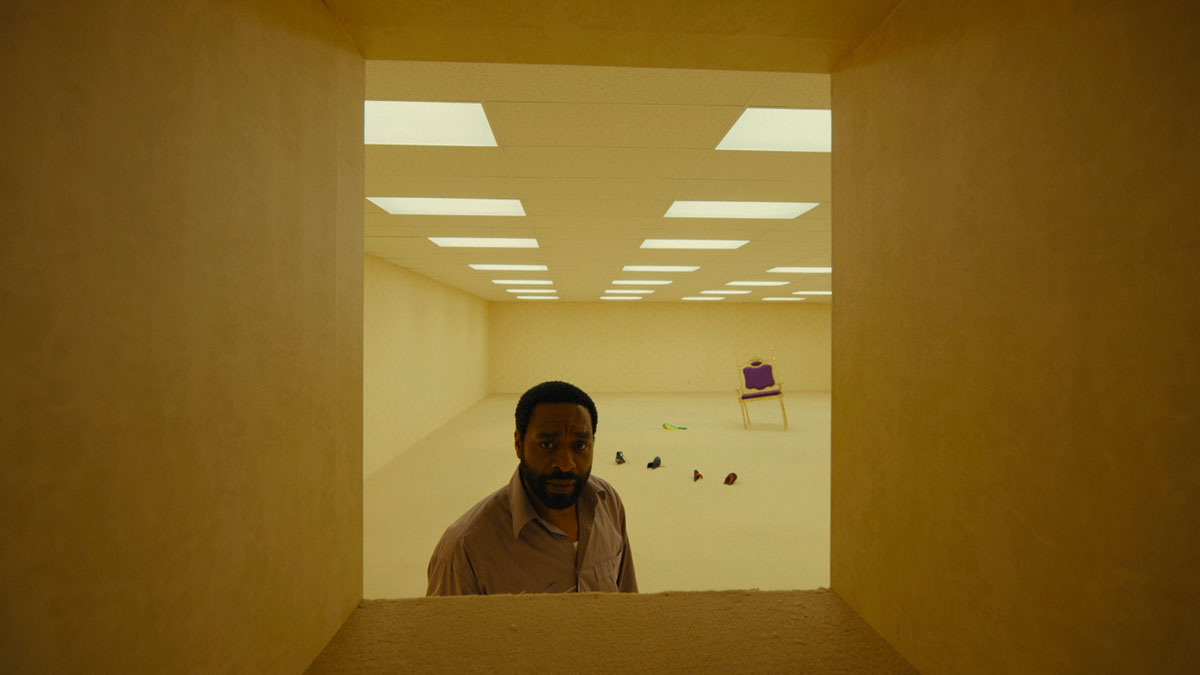
Kane Parsons inaugurated Backrooms as an adolescent, crafting ersatz VHS shorts for the internet that explored the eponymous shadow realm, a labyrinth of eerily bland rooms and corridors where every thing was at once known and made strange by sundry spatial distortions and inexplicable intrusions. These videos were like nightmares afflicting dreamers whose days were spent at dingy office jobs or suburban strip-mall outlets. They were fantastically successful, leading A24 to grant Parsons, an ambitious British-American wunderkind yet to reach legal drinking age, the resources to turn the premise into a theatrical feature—at least one. You needn’t get far into Backrooms, the movie, with its myriad teases, ostentatious easter eggs, and heavy-handed suggestions of a larger cosmology, to recognize the makings of a franchise. Can a YouTube sensation translate into cinema? In becoming a big-budget event film featuring Oscar-kissed actors, Backrooms forfeits the particular pleasure it once generated by allowing us to stumble across something online, choose which adventure to embark on, and tumble down one rabbit hole after another.
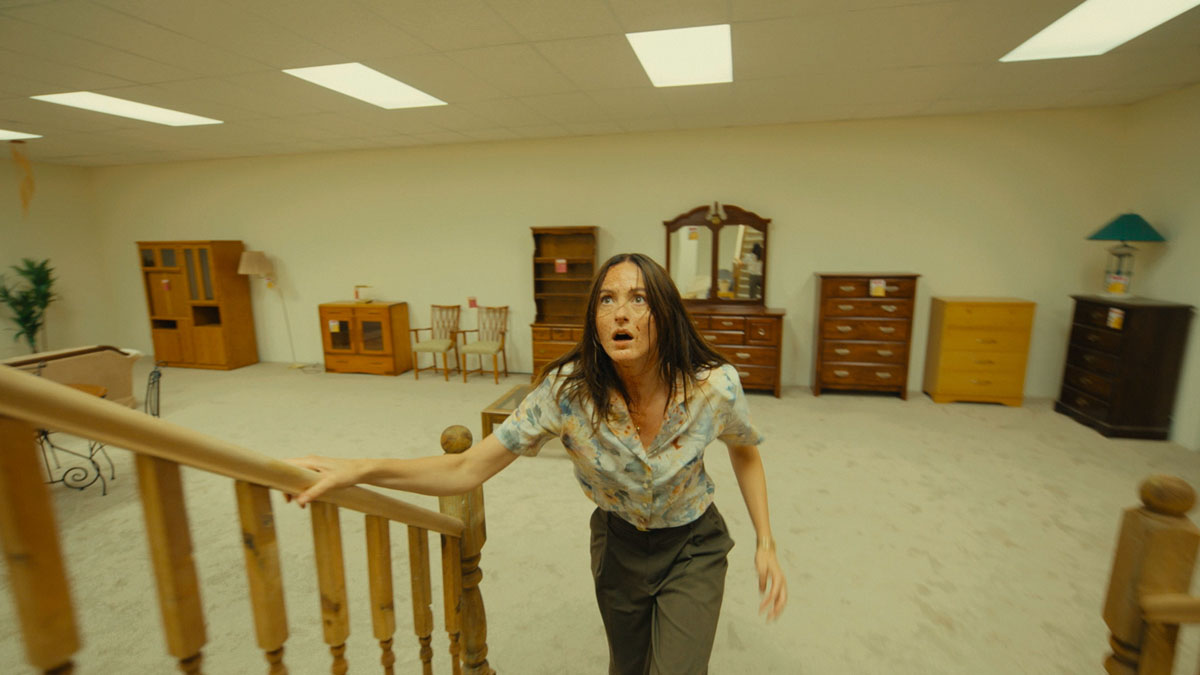
Set in 1990, Backrooms follows two protagonists: Clark (Chiwetel Ejiofor), a middle-aged architect stuck running a discount furniture store called Cap’n Clark’s Ottoman Empire, and Mary (Renate Reinsve), Clark’s therapist and author of a self-help book. Clark visits Mary to work through grievances regarding his career and marriage: his wife has kicked him out of their house, likely because of his alcoholism, workaholism, and generally shitty comportment. He now sleeps in one of the store’s bedroom dioramas. Mary, meanwhile, is haunted by memories of growing up with a mentally ill single parent and appears vaguely alienated in her everyday interactions.
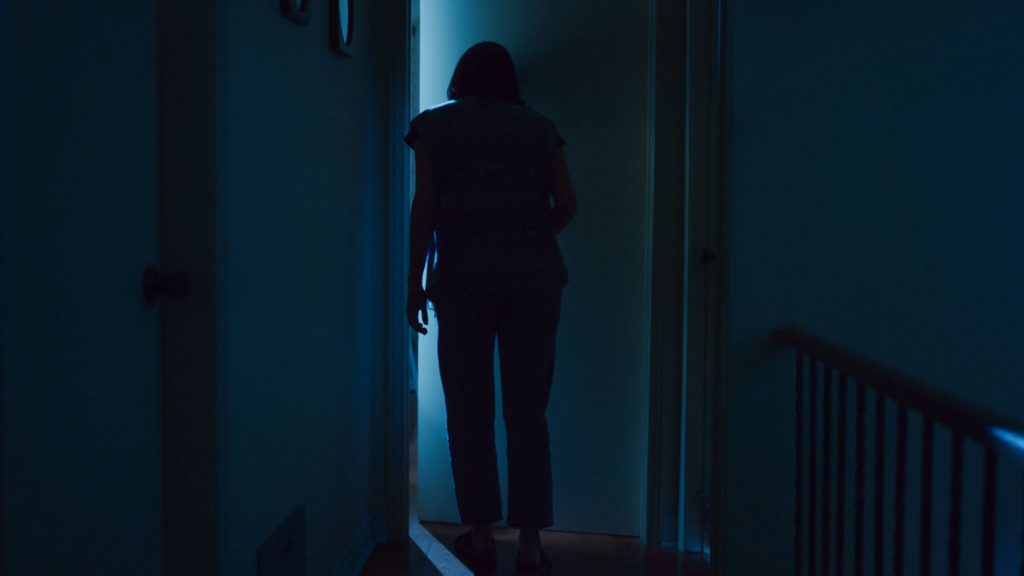
One night, Clark goes down to the store’s basement and discovers a patch of wall through which one can pass as though it were a hologram, ushering him into the backrooms, which kinda resemble the store’s front rooms, are littered with bizarrely arranged detritus—some of it setting-appropriate, some of it wildly incongruous—and seem to be drawing Clark into its endless annals with multilingual radio broadcasts. He eventually finds his way back out and eagerly recounts the experience during a session with Mary, who, understandably, is skeptical. Clark departs Mary’s office in a huff, and when he fails to appear for their subsequent appointment, Mary goes to Cap’n Clark’s to investigate. Both protagonists seem destined to penetrate the backrooms for different reasons: the frustrated architect has immersed himself in the greatest architectural mystery in history, while the therapist, whose psychological philosophy centers on the metaphor of windows, is about to become lost in a series of rooms whose few windows simply look onto more rooms.
Clark describes the backrooms as a place of misremembered things—and this thematic key is the film’s most resonant and alluring aspect. The backrooms seem to be permeated by the flotsam of the world, but amalgamated in grotesque ways, and populated by soulless figures resembling confused iterations of people from the outside world—including Clark’s clumsy Cap’n alter ego. As with artificial intelligence, the backrooms seem to draw upon everything that already exists in the world, but they aren’t capable of interpreting the world’s phenomena accurately. Things get lost in translation: the machine hallucinates. And the ways that the backrooms mirror AI may not be accidental: the story is set in the Santa Clara Valley, meaning all this paranormal activity is unfolding on roughly the same terrain as what we call Silicon Valley, where, a few decades after the events in Backrooms, artificial intelligence would emerge as the world’s spookiest innovation. The film itself possesses this amalgamated or mash-up quality, its antecedents overt and abundant; they include a few famous found-footage chillers, and works across various media by Daniel Clowes, Haruki Murakami, Charlie Kaufman, Salvador Dalí, and, above all, David Lynch, though its self-conscious weirdness lacks Lynch’s penchant for carefully graded atmospherics. While this may be coincidence, given the overlapping development periods, Backrooms will also inevitably remind viewers of Severance, with its seemingly endless maze of sunless corridors and conference rooms with fluorescent lighting and wall-to-wall carpet.
To be clear, there’s much about Parsons’s work in Backrooms, as creator, director, and the score’s co-composer, that’s seriously impressive for someone so young, particularly when you consider the film’s scale and willingness to embrace suggestion and suspend mystery. But, as alluded to in the above list of formative influences, the film leans heavily on pastiche, and I would argue that its strengths are not particularly cinematic. The script was written by Will Soodik, a veteran scenarist of shows like Homeland and Westworld, and the storytelling, with its enigmas destined to be explained later, and the opening teaser that immediately shows us the backrooms, as though the project’s stakeholders are concerned that we might lose interest, clearly draws from series television and doesn’t feel especially satisfying as a self-contained movie.
All of which will suit some spectators just fine. Perhaps now more than ever, with the horror and tedium of the world accumulating and often leaving us feeling helpless, there’s a longing to escape to a parallel ambit in which everything is the same but scrambled and our doppelgängers are zombified and edible; a space offering an oneiric odyssey that’s part sinister serial and part video game, turning potentially terrifying chaos into an oddly familiar adventure. 
 FRESH BLOOD
 RAVENOUS


 JustWatch