
GUIDE | MODERN SLAYERS

Wendigo

(Larry Fessenden, USA, 2001)

BY FRANK FALISI | November 9, 2026
SHARE:

Beyond their New York roots, the otherwise stylistically different Jordan Peele and Larry Fessenden share one formal peculiarity: making horror movies that aren’t very scary. Caveat: what’s considered “scary” is plenty subjective, but, at least in this instance, I mean to indicate a feature of their filmmaking rather than a bug. As literate as both artists are in the genre’s history and its vast Rolodex of maneuvers both shocking and schlocky, either could surely brutalize their spectator more acutely, if they were so moved. Instead, both directors’ films largely forgo jump scares or torture games, rendering America’s psychic joys and ills as realistically as supernaturally possible. “I love horror in the place that you get to, but I am less fond of when the credit music announces that you’re in a horror movie,” Fessenden said in 2015. “I prefer to creep in, the way it would in real life.” Real life, then—the family formation, our national appetite for conquest, our aversion to synthesizing the facts of history with how we materially live—becomes a backboard for fangs and sutures, alien angels and our darkest doubles. In Peele and Fessenden, we reckon again and again with improvisations on “the problem we all live with,” depicted as monstrously as is appropriate in our dreams.

In this manner, maybe, Peele and Fessenden are bound by another similarity: the less clear their metaphors become, the closer to ecstasy the images appear. Get Out (2017) and Habit (1995) present largely one-way configurations of bodily autonomy and addiction, to great, penetrating effect. But it’s in the free-flying texts Nope (2022) and Wendigo (2001) that meaning becomes opaque enough to truly vibrate. Is Nope’s Jean Jacket an eye or a mouth, a camera or a screen, surveillance anxiety or our need to document? An extra-human creature of insatiable hunger and uncertain origin that is as much real metaphor as it is false corporeality, the monster is a garbled Spielbergian echo of the sometimes-seen, always-felt phantom of Fessenden’s low-budget masterpiece, Wendigo.

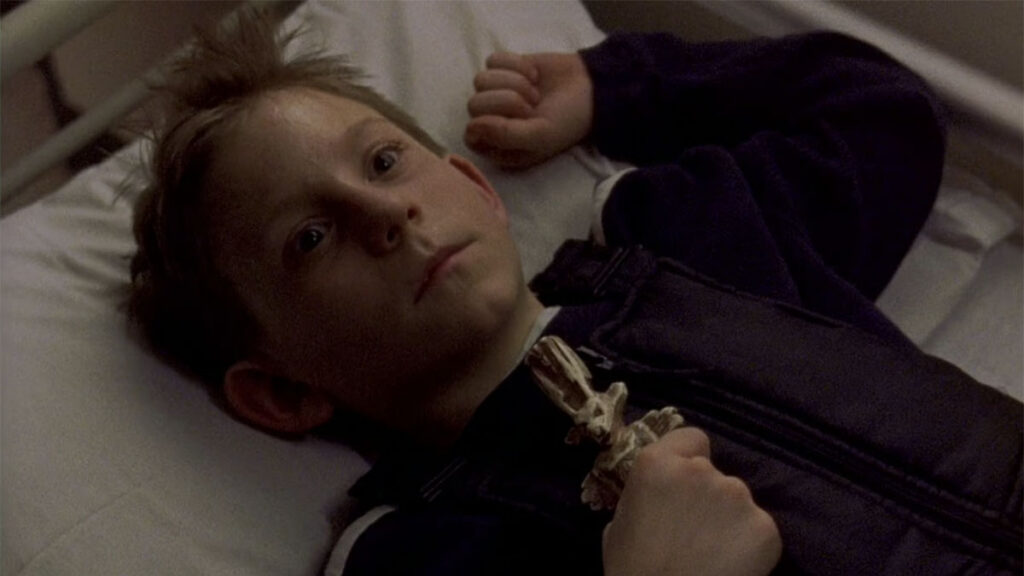
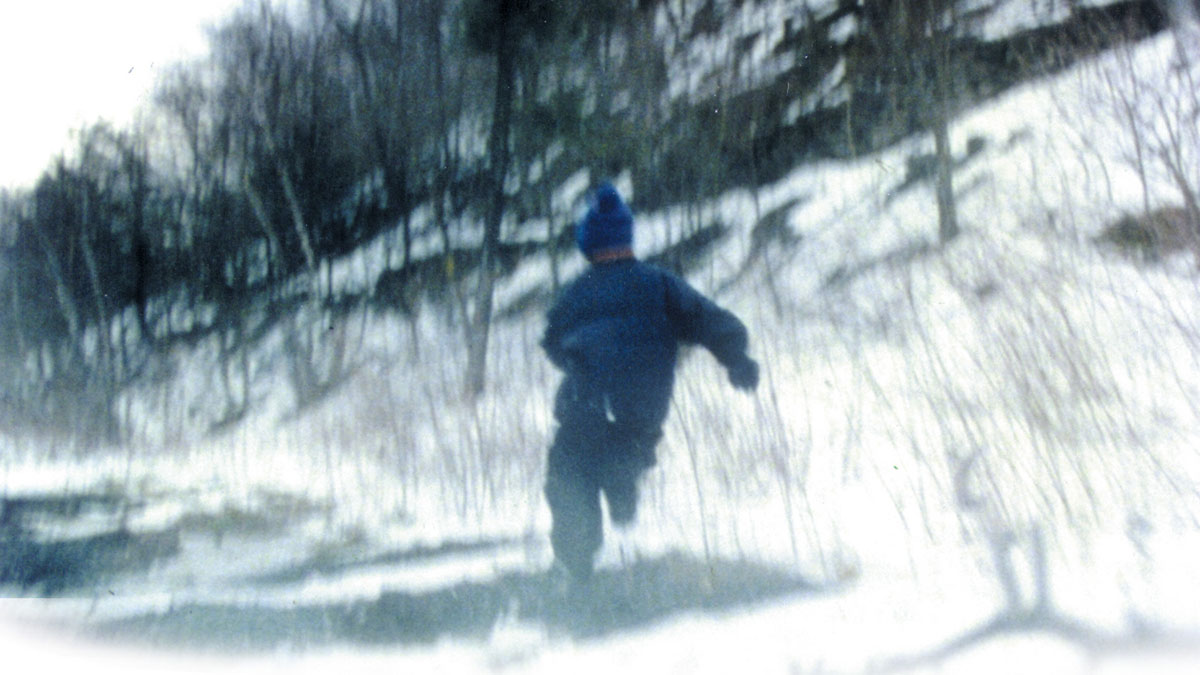
A chamber drama bundled up to survive fireside shadows, Wendigo sends a family of three—father George (Jake Weber), mother Kim (Patricia Clarkson), son Miles (Erik Per Sullivan)—upstate from their New York City home looking for something like respite. Contending with icy weather on the way, their car fatally collides with a buck scrambling over the frozen road, only to find out that a coterie of hunters—led by the wild-eyed Otis (John Speredakos)—had been tracking the deer for a long while. Robbed of his kill, Otis harangues George, inaugurating the first of Wendigo’s many morphing configurations: whether civilized from urban settings or let loose in the frontier, masculine rage unabated leads every soul to their own apocalypse. As the family settles into their temporary lodging, Miles feels something off in the air, and, in haunted bedroom shots that woggle Spielberg’s child seers in his own domestic drama, Close Encounters of the Third Kind, the boy becomes a spectator sensor for the monstrous metaphor assembling itself in midair. On a visit into town, an Indigenous shopkeeper (Lloyd Oxendine) clarifies what that monster might be: “A wendigo is a mighty powerful spirit,” he explains. “The wendigo is hungry, and its hunger is never satisfied. The more it eats, the bigger it gets, and the bigger it gets, the hungrier it gets. And we are hopeless in the face of it.”

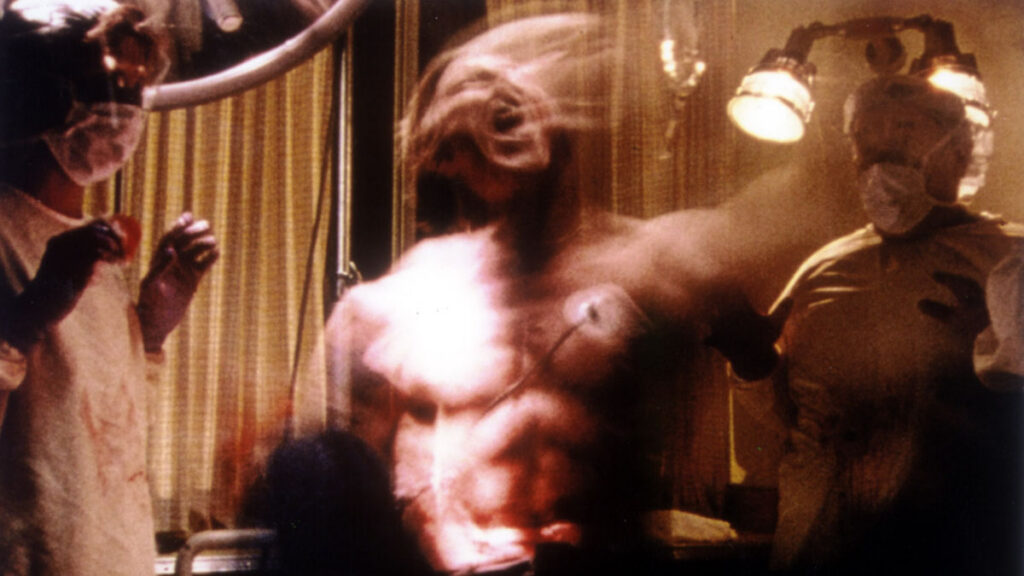
But what is it? Borrowed from Algonquian folklore, the wendigo (a collation, a loanword probably borrowing equally from Cree and Ojibwe languages) is a particularly turbulent metaphor-monster. In the folk tradition, it’s a possessing spirit that variably inspires gluttony, cannibalism, and homicidal thoughts in its victims. Less ethereally, though, the wendigo indicates imbalance, especially of an ecological sort: individuals afflicted with the wendigo exhaust resources, usually at their own expense. The wendigo can stand as a monstrous avatar for white land theft and our national American genocide as sure as it can be twisted by non–First Nations writers into a thing precisely indicating “savageness,” as in Algernon Blackwood’s 1910 novella, The Wendigo, or Stephen King’s 1983 work, Pet Sematary. Invoked as it is in Fessenden’s Wendigo as a multipart montage of varying monstrous forces, the wendigo both is and isn’t all of these things. Appropriately, the film’s writer/director/editor presents it as a creature of pure montage, a cacophony of 16mm photography and jittering still images and bones and antlers. It is purely in Miles’s imagination, and it is literally the cause of his family’s dissolution. It emerges from the haunted, genocide-struck land north of the civilized (which is to say, settler-stolen) New York City, and it is conjured in the angers, righteous and stupid alike, in Wendigo’s stunted men. An audience—like a starving man possessed in the wilderness—exhibits an appetite for meaning. Gracefully, Fessenden constructs the space for communicating such matters and elides it, leaving something scarier by way of this stillness. Like Miles by the film’s end, we are left without a guide, apprehending monstrous shapes in the dark, shoving them into our too-human containers in the cold sunlight. 🩸

FRANK FALISI

is a New Jersey–based writer. He’s an Associate Editor at Bright Wall/Dark Room, and his writing has appeared in Reverse Shot, MUBI Notebook, the Los Angeles Review of Books, and elsewhere.

How to see Wendigo:

RELATED CONTENT
    FRESH BLOOD
REVIEW
(Larry Fessenden, USA, 2023)

The premise, like the ambient air of fatalism, owes as much to film noir as it does horror. A man wakes in a place he can’t remember arriving at, his body bearing the ravages of some...

BY JOSÉ TEODORO  |  April 15, 2024

GUIDE | MODERN SLAYERS
(Larry Fessenden, USA/Iceland, 2006)

There is a deep sense of overwhelming sadness that pervades Larry Fessenden’s The Last Winter. Oil workers for North Industries, run by Ed Pollack (the perfectly cast Ron Perlman), join...

BY RUFUS DE RHAM  |  December 30, 2023

GUIDE | CORE HORROR
(Stan Winston, USA, 1988)

Pumpkinhead, a gnarled, horrible-looking monster, used to stare at me from the video-store aisle, daring me to get over my fear and rent the tape. Along with the Ghoulies cover art...

BY RUFUS DE RHAM  |  November 2, 2026

RECOMMENDED
    RAVENOUS
GUIDE | ORIGINS

Supernatural

(Victor Halperin, USA, 1933)

This pre-Code offering packs a lot of story into its typically brisk running time, with several plot threads weaving together a (not always successful) tapestry of spooky and criminal doings.

READ MORE >

BY  ANN OLSSON  |  Month 00, 2021

REVIEW

The Keep

(Michael Mann, USA, 1983)

In what could be the fastest-resulting rape revenge movie, a drunken lout brutally forces himself on Ida, the young woman who doesn't return his affections, during a party over Labor Day.

READ MORE >

BY  LAURA KERN  |  Month 00, 2021

REVIEW

We Need To Do Something

(Sean King O'Grady, USA, 2021)

Beast is a lot of movies in one package - fractured fairy tale, belated-coming-of-age story, psychological drama, regional horror film - but above all it's a calling card for its leading lady, Jessie Buckley.

READ MORE >

BY  LAURA KERN  |  Month 00, 2021