GUIDE | ORIGINS + UNEARTHED

The Legend of Sleepy Hollow

(Jack Kinney & Clyde Geronimi + Sam Weiss, USA, 1949 + 1972)

BY COLIN FLEMING | November 1, 2026
SHARE:
1949

Washington Irving’s tale, “The Legend of Sleepy Hollow”—from his 1820 joint story/essay collection, The Sketch Book of Geoffrey Crayon, Gent.—is such a remarkable ghost story that it doesn’t even need any ghosts. We can return to it repeatedly, as if it were a cherished song, “playing” it for the latest instance as we frolic amid falling leaves, the sheltered glen, the sun-flecked village green of the mind’s eye in October. If the story has a ghost, this may be it—a place that never truly dies/departs and works our imaginations over.

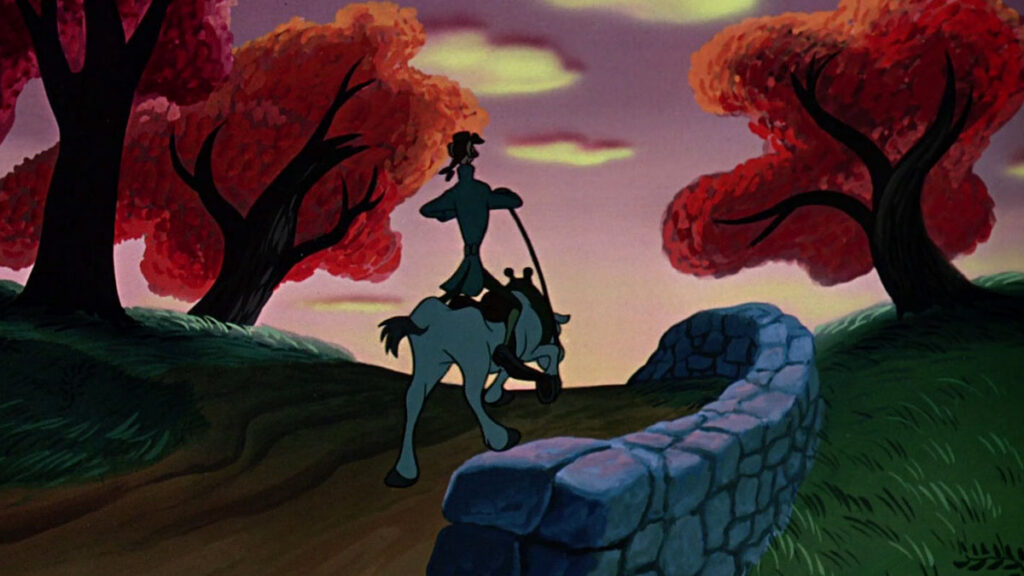
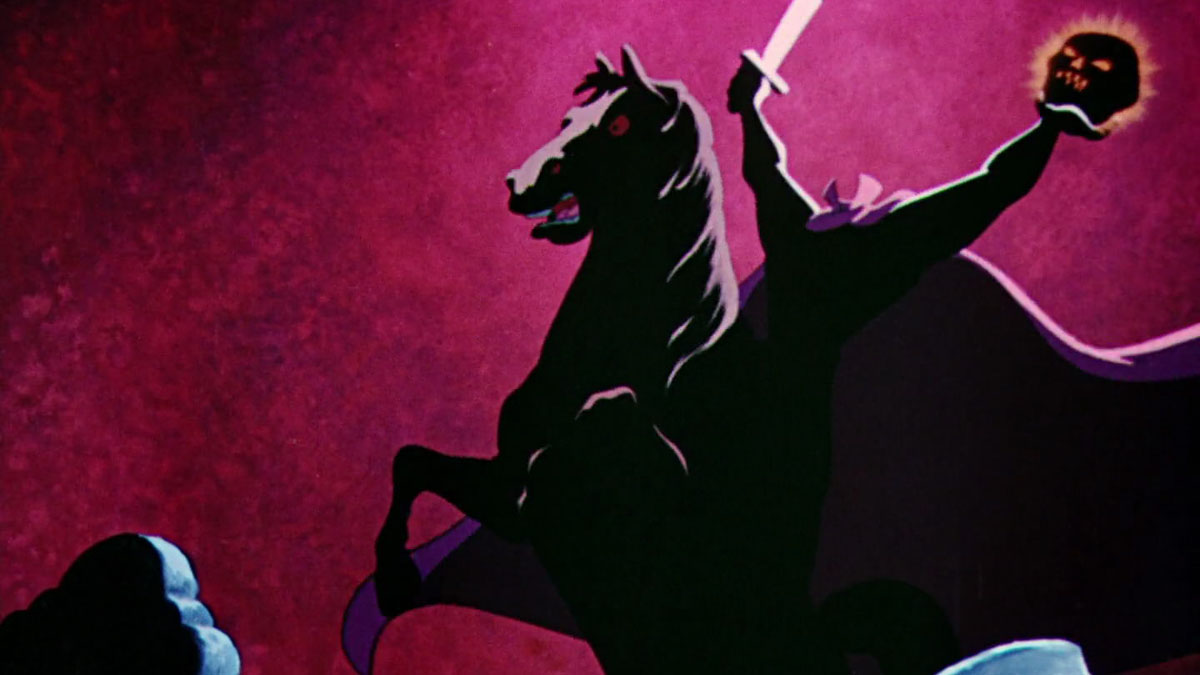
“The Legend of Sleepy Hollow” is a story in part about schoolchildren, given that it concerns a teacher—Ichabod Crane, of course—which for a long time was the cinematic fare of schoolchildren. The spooky season rolls ’round, and kids are treated to a classroom screening of Disney’s The Adventures of Ichabod and Mr. Toad. Half the program, as it were, involved the bumptious amphibian and his friends from Kenneth Grahame’s 1908 novel The Wind in the Willows (itself published in October). Normally you weren’t shown that part; this seasonal viewing treat was all about that headless fellow on horseback who launched a flaming Jack-o’-lantern at you after a midnight chase through the forest.

Jack Kinney and Clyde Geronimi co-directed. Bing Crosby narrates and sings. Wit is in abundance. Both in terms of the animation and the language. Brom Bones arrives on the scene, taps a hogshead of beer, serves his rustic mates, and then makes sure his horse and some dogs can get soused, too. The adaptation runs to 34 minutes. The extended setup to the famed chase renders the payoff possible. Ichabod is a cadger. This version emphasizes how much better he treats his pupils whose parents offer him the choicer repasts at their supper tables. He looks out for number one. As do most of us. He desires the fair maiden Katrina Van Tassel not because of some real love but because her father is rich. Katrina uses Ichabod to induce jealousy in Mr. Bones, with whom she was always going to end up anyway.

Such is life, and “The Legend of Sleepy Hollow” teems with it, which is why Irving’s story endures and reads so “modern” that it might as well have been written tomorrow. Don’t think that because this is Disney that the piece’s action sequence—Ichabod’s post-party trip home—isn’t frightening. Crosby speaks and sings less as fear mounts; we’re left instead with the sounds of the woods at night, a place where things may not be what they seem, may be exactly what they seem, and can be far worse than what they seem.

The third-grader who watches it at school on the Friday before Halloween isn’t apt to pick up on the social commentary and those truths of human nature. Their takeaway will be the horror component, and goodness knows how many of them it subsequently kept up at night, which is healthy. A kind of joyous fear. You understand the look and feel—the psychical signage—of timeless horror. The deathlessness of that Indian corn, pumpkin patch, steeple-against-a-blue-sky spirit of early Americana. You’re now a Sleepy Hollow boy or girl, the same as those forgathering—tarrying—residents who never die in this town, visited and conjured through imagination and the associative, shared memory (once entry is gained) of what’s both a freshly settled and primordial New World nestled along the banks of northeast rivers and harbors leading to sea. A land of shadows by the fire, pumpkins on the doorstep, cider barrels, covered bridges traversed by blown leaves and, if he’s lucky, a pedagogue escaping a Hessian straight out of hell—who could also just be someone having the best Halloween costume moment ever—by making it to that bridge in time. A bridge connects; connection saves. There’s a metaphor in there, as Irving’s tale also connects with us.

1949

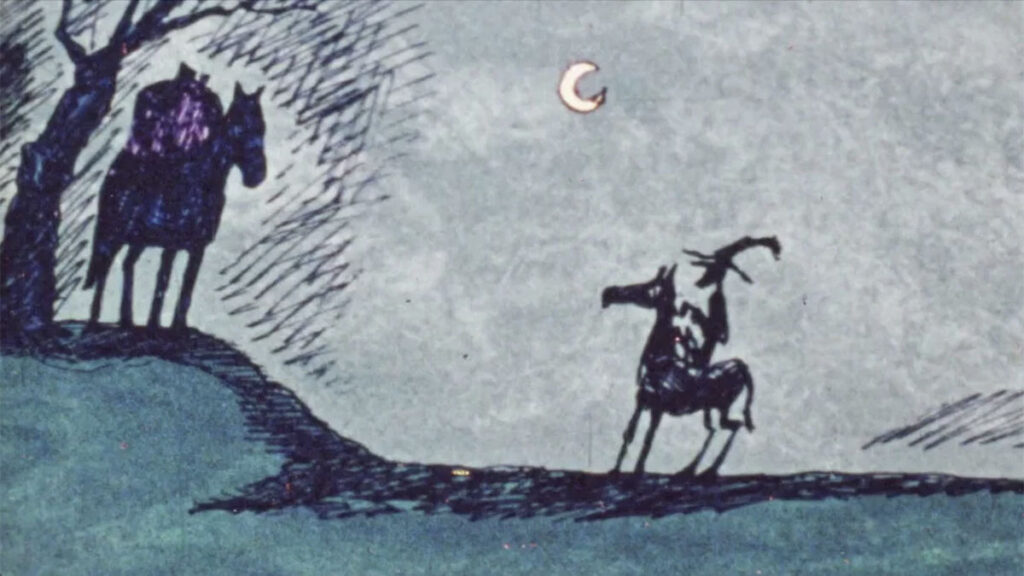
The Disney adaptation is a cornucopia. Think of the heaping table favored by Dickens’s Ghost of Christmas Present. No hollow horns in this sleepy hollow. Conversely, the 13-minute animated version from 1972, directed by Sam Weiss and narrated by horror veteran John Carradine (Bluebeard, House of Frankenstein, House of Dracula), is lean, angular, flinty, baked rather than bubbling, sharp-edged. It resembles cut-paper figures and scenes come to life. The Disney treatment was baroque; this is folk. Crosby’s voice is mellifluous; Carradine’s scratches and is itself incised. This isn’t recitative at the opera house; it’s an old-timer in a Colonial tavern, sawdust underfoot, leaning close to tell you a tale he’s told many times over to a traveler or new resident for the price of a foam-headed flagon of ale.

This Ichabod changes colors. He may be muted or charged. Sometimes he’s orange, blue, red, pinkish, and then green come the denouement. The art stuns like that of the opening scenes of It’s the Great Pumpkin, Charlie Brown when we have the presence of mind to pause and consider it as one would a work hanging in a museum. It’s as if the colors extend a mile deep into the screen and have leeched to the surface where they were once wet but now have the texture of pastels dried out and cracked by the still-hot sun. A burnishing of autumn.

Irving’s tale is the urban-legend variant of folk art, before urbanity existed in the nascent republic. Ichabod’s legs make the shape of two Zs when he sits at the piano in the Weiss film. He’s a seasoned Ichabod here; not quite a dirty old man, but less the callow fop of the Disney treatment. Then again, do people like that ever change? Does anyone? Or do changed circumstances (job, location, marriage status) obfuscate the hampering immutability—and resistance to growth—of all but the fewest of us?

A certain roundness prevails in the Disney version—a festal bulbousness. Whereas, in the 1972 offering, the world is a series of right angles. Ichabod doesn’t dine at the table—he feeds, with his lanky arms made to spin like pinwheeling spider legs. We’re watching diorama figures enact timeless rituals of human nature as colorful mill creations. The wisest among us know that the mechanized nature of human folly, displayed for the latest time, almost without the chance of alteration, as if it weren’t human, is cause of laughter, even if it’s the silent, inward sort. But to give up the ghost of that chance of change is perhaps to become one. No wonder Ichabod felt and feared as he did. 🩸

1972
COLIN FLEMING

is the author of eight books, including the story collection, If You [ ]: Fabula, Fantasy, F**kery, Hope, a 33 1/3 volume on Sam Cooke’s Live at the Harlem Square Club, 1963, Meatheads Say the Realest Things: A Satirical (Short) Novel of the Last Bro, and a book about 1951’s Scrooge as the ultimate horror film. His work has appeared in Harper’s, The Atlantic, Rolling Stone, The New York Times, Vanity Fair, The Daily Beast, Cineaste, Film Comment, Sight and Sound, JazzTimes, The New Yorker, The Guardian, and many other venues. He’s completing a book called And the Skin Was Gone: Essays on Works of Horror Art. His website is colinfleminglit.com, where he maintains the Many Moments More journal, which, at 2.7 million words and counting as of autumn 2023, is the longest sustained work of literature in history.

How to see The Legend of Sleepy Hollow (1949):

How to see The Legend of Sleepy Hollow (1972):

RELATED CONTENT
    FRESH BLOOD
GUIDE | ORIGINS
(Burt Gillett, USA, 1937)

Meet the right ghosts in your formative years—or help someone else to do the same in theirs—and a lifelong love of the stories and films in which they feature may be the result.

BY COLIN FLEMING  |  October 31, 2025

ARTICLE | STREAMING PILE
Movies ghoulishly suited for imaginative in-house Halloween viewing.

Anyone can watch a hearse-load of scary movies at Halloween—and lots of us do—but how many of those people try and seek out the films most indebted to, or representative of, the holiday...

BY COLIN FLEMING  |  OCTOBER 15, 2024

GUIDE | ORIGINS
(Sidney Lanfield, USA, 1939)

Arthur Conan Doyle’s Sherlock Holmes stories have never lacked for adaptations, with The Hound of the Baskervilles—novel number three...

BY COLIN FLEMING  |  October 23, 2025

RECOMMENDED
    RAVENOUS
GUIDE | ORIGINS

Supernatural

(Victor Halperin, USA, 1933)

This pre-Code offering packs a lot of story into its typically brisk running time, with several plot threads weaving together a (not always successful) tapestry of spooky and criminal doings.

READ MORE >

BY  ANN OLSSON  |  Month 00, 2021

REVIEW

The Keep

(Michael Mann, USA, 1983)

In what could be the fastest-resulting rape revenge movie, a drunken lout brutally forces himself on Ida, the young woman who doesn't return his affections, during a party over Labor Day.

READ MORE >

BY  LAURA KERN  |  Month 00, 2021

REVIEW

We Need To Do Something

(Sean King O'Grady, USA, 2021)

Beast is a lot of movies in one package - fractured fairy tale, belated-coming-of-age story, psychological drama, regional horror film - but above all it's a calling card for its leading lady, Jessie Buckley.

READ MORE >

BY  LAURA KERN  |  Month 00, 2021