
Emphasis on Camp. The myriad genre hooks in Jane Schoenbrun’s latest are ostentatiously framed by quotation marks—the title alone betrays the writer/director’s eagerness to make their reflexivity as legible as possible. Which isn’t to say that Teenage Sex and Death at Camp Miasma looks down on horror—on the contrary, Schoenbrun’s affection for slasher films in particular constitutes the film’s engine—it’s simply that by resolutely excluding itself from horror’s hoi polloi, the film presents as so meta that it asks to be scrutinized primarily for its ideas about horror. And those ideas are less than revelatory for anyone who thinks about horror movies (e.g., anyone reading this publication).
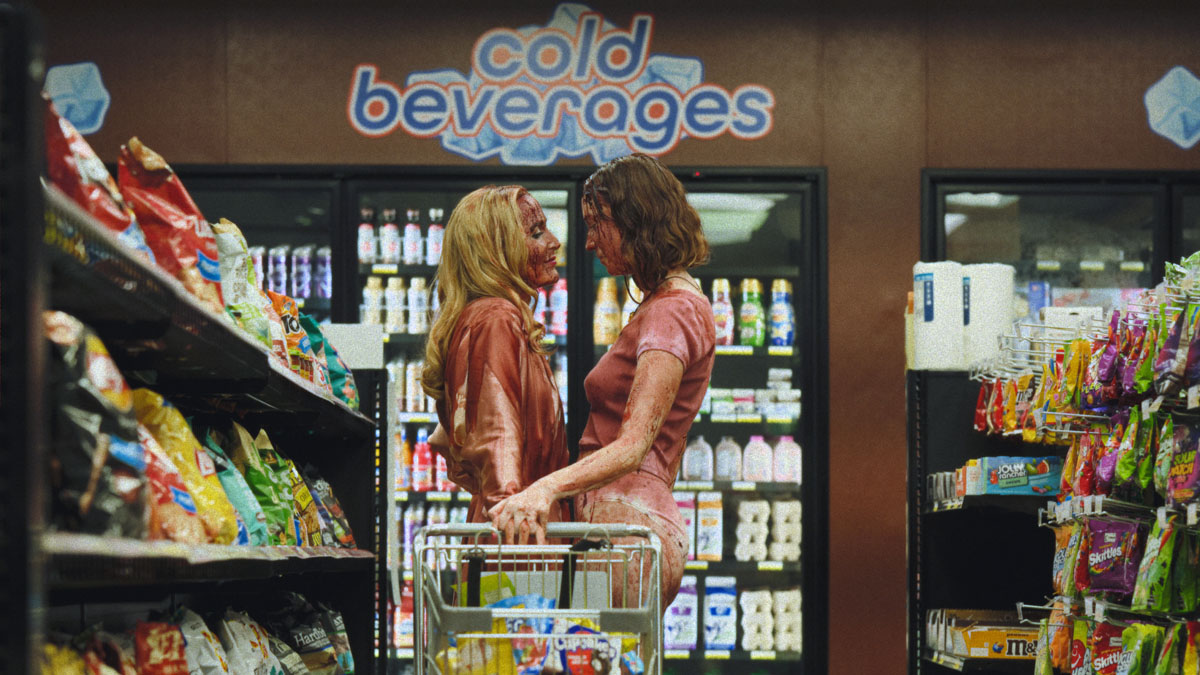
There’s a lot going on, story-wise, but here’s the skinny. A young filmmaker charged with devising a “woke” reboot of the weary Camp Miasma franchise, Kris (Hacks’ Hannah Einbinder) undertakes a wintry trek to Camp Tivoli, the long-shuttered Pacific Northwest sleepaway where the low-budget original was shot. Tivoli currently has but one occupant: retired actor and original Camp Miasma final girl Billy (Gillian Anderson), who purchased, maintains, and lives on the site. Kris has nurtured a parasocial relationship with Billy going back to her formative first experience of Camp Miasma, and meeting her idol does not disappoint: Billy is a direct-to-VHS Norma Desmond—swap the mid-Atlantic accent for a hazy Southern drawl—who welcomes Kris while wearing a fur coat and turban and lovingly lays out a feast of KFC. (Trash cuisine in abundance is a point of connection: Kris arrives with what looks like $200 worth of gas-station candy.) Smitten, our heroine begins conceiving her film with Billy at its center.
While Kris, an obvious Schoenbrun stand-in—her first feature was a Sundance darling that revisited Psycho through the perspective of the shower curtain—fumblingly expresses her interest in subverting tropes and announces her awareness of Camp Miasma’s transphobia and misogyny, no-bullshit Billy conveys little patience for responses she regards as “academic.” As Kris and Billy’s relationship evolves, it becomes clear that a) Schoenbrun has a healthy sense of humor about themself, and b) Billy possesses an intelligence that is, in many ways, more substantial than that of her prospective director. Both have spent their lives feeling alienated from broader conventions regarding sex and ardor; both experienced a private sexual awakening through the sublimated desires of slasher films. That Camp Miasma’s antagonist is a lake-dwelling, non-binary murderer of horny nubiles dubbed Little Death, whose spear attacks yield cartoonishly (and anachronistic) orgasmic geysers of digital gore, is a heavy-handed hint as to what Schoenbrun wants to say about teenage (and adult) sex and death.
Kris and Billy’s slow-burn journey toward embracing an eros that recognizes the problematic, champions kink, and inhabits a liminal space between terror and tenderness is the most impactful aspect of Teenage Sex and Death at Camp Miasma. And none of it would work without the film’s extremely game leads. Einbinder is endearing and pliant, deftly managing ratios of playfulness, vulnerability, and intellectual glee. While Anderson—whose previous forays into the dark fantastic or grotesque had been largely relegated to television (The X-Files, The Fall)—renders Billy at once glam-clownish, disarmingly frank, and absurdly seductive—you’ll never again utter the words “dipping sauce” without recalling her shameless flirting. It’s rare to see two actors so equally attuned to the particularities of a director’s vision while embodying characters who are, in many regards, opposite.
Less rewarding is the supporting cast, which brims with terrific actors in strictly one-dimensional, one-joke roles: Kevin McDonald as a sketchy innkeeper, Patrick Fischler as a Camp Miasma alumnus who’s nothing but an emblem from Mulholland Drive, Dylan Baker as a dunderheaded studio head, and Jack Haven (a star of Schoenbrun’s I Saw the TV Glow) as the cipher-like killing machine. These characters serve much the same purpose as the film’s excessively winky needle drops (a cover of R.E.M.’s “Nightswimming,” Counting Crows’s “A Long December,” Donna Lewis’s “I Love You Always Forever”), making sure we know that Schoenbrun is in the know, and that what we’re watching isn’t “just” a horror film. At one point, Billy suggests to Kris that there’s a hole at the bottom of the lake where the movies come from, which is an interesting way to metaphorize the id or instinct that underlies films, whatever a director’s more refined intentions. Perhaps the best way to approach Teenage Sex and Death at Camp Miasma is to regard what emerged from Schoenbrun’s lake not as a horror movie, or even a work of blood-spattered postmodernism, but as an unlikely love story between two misfits. 
 FRESH BLOOD
 RAVENOUS


 JustWatch