GUIDE | CORE HORROR

Night of the Demon

(Jacques Tourneur, UK, 1957)

BY COLIN FLEMING | October 23, 2026
SHARE:

M.R. James (1862-1936), master of the English ghost story, wrote three works that stand above his others: “Oh, Whistle, and I’ll Come to You, My Lad,” “Casting the Runes,” and “A Warning to the Curious.” The middle of these, from 1911, concerns Edward Dunning, a researcher for the British Museum who has a hex put on him by an embittered occultist named Karswell after rejecting his manuscript “The Truth of Alchemy.” This hex is passed via runic characters on a strip of paper that must be given to and accepted by the victim without the victim knowing that’s what has happened. You drop your wallet, the hexer picks it up, covertly slips the paper between a couple dollar bills, hands it back, you say, “Thanks, sir,” and you’re screwed.

James’s story is a masterpiece transcending genre that could amount to one of the great pleasures of a rich reading life. A film adaptation has much to live up to. Thankfully, the 1957 effort was helmed by Jacques Tourneur, who wasn’t a stylistic master so much as a stylistic definer. Tourneur’s pictures often serve as touchstone examples for a given cinematic subset. For instance, Out of the Past (1946) and noir. Does it get more representative than that? Similarly, Night of the Demon—as his adaptation of “Casting the Runes” was titled—is the showpiece model of English cinematic horror, mid-20th-century edition, a work to make you fall in love with horror, if you weren’t already.

Rather than encroach upon James’s textual territory, Night of the Demon—retitled Curse of the Demon for the U.S. market—occupies the spaces of its own particular shadows. James himself embodied the Victorian man, as he knew. That embodiment counts among his greatest strengths and greatest weaknesses, though those shortcomings never hold him back in the ways we might expect in his fiction, which is also paradoxically modern, in large part because of how well James understood people—including the kinds with whom he had little personal interaction (women, sporty types, the common man).

James was more of an English ghost story writer than any American is an American ghost story writer. Fittingly, Night of the Demon is among the most English of horror films with its garden parties, Stonehenge sorcery, and antiquarian pursuits, akin to a horror-film version of that outside-of-time, enclave world of The Kinks Are the Village Green Preservation Society (which is itself the attempted formulation/upkeep of a better, authentic, less soulless world). To Ray Davies’s litany of “God save little shops, china cups, and virginity,” could be added the works of M.R. James and their worthiest adaptations. And yet, it is an American—the visiting Dr. John Holden (replacing Edward Dunning from the short story), played by the ever-excellent Dana Andrews—in the film’s lead. The foreign body in English soil.

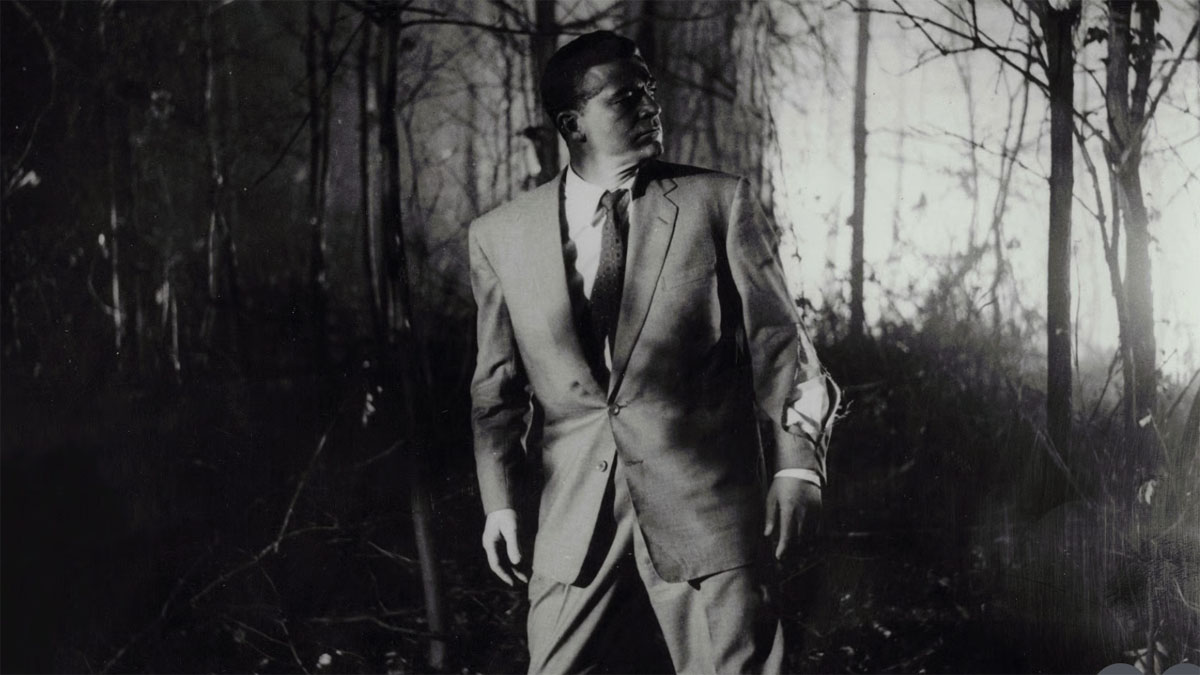
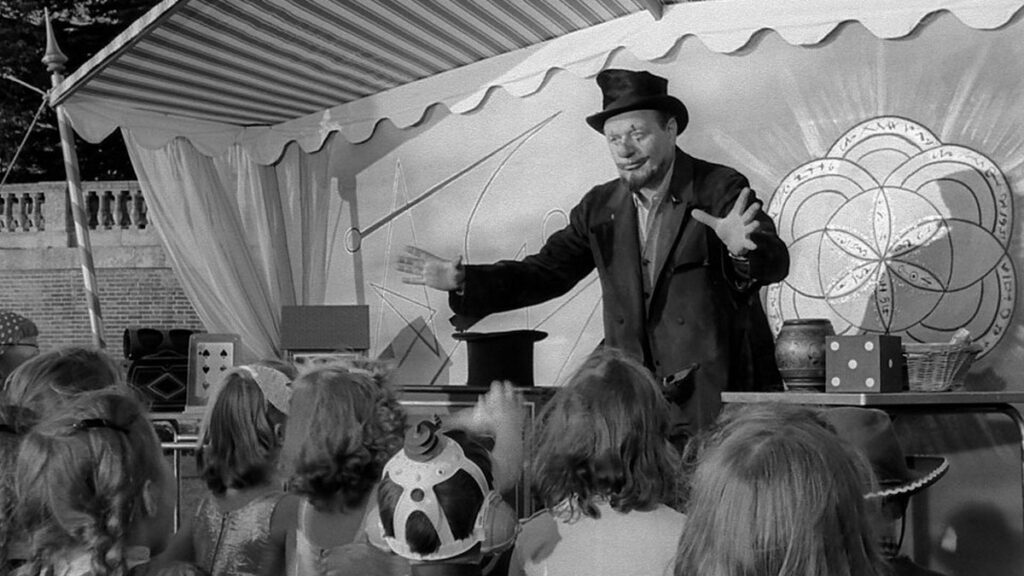
James cautioned against too much curiosity; we see the dangers carried to their grisliest ends—skin is sucked from faces—in a story like 1904’s “Count Magnus.” Holden is instead resolutely incurious, which courts its own fair share of problems. He’s the cynic’s cynic, as immovable as those megalithic structures on the Salisbury Plain. That is, until the choice of disbelief is taken from him thanks to Niall MacGinnis’s Dr. Julian Karswell. No actor better looks and plays his part than MacGinnis does here in perhaps the whole of terror cinema. He’s suggestive of Orson Welles—especially with Karswell’s fondness for magic, which in the story is used to scare children shitless and in the film to conjure a hell of a storm—but sinister in a manner Welles couldn’t manage. He charms all the same, though, and is such a pussycat in demeanor that it’s unsurprising he lives with his mother (Athene Seyler), and in much healthier fashion than Norman Bates did.

We have drama with a fireplace, screen, and floating piece of paper with its own agency that is as suspenseful as the famous “Lewton walk” scene in 1942’s Cat People, also directed by Tourneur. Some of the best villains are the pettiest. What they lack in a sense of proportion they make up for in dastardly focus. Karswell kills and wishes to kill further on account of being slighted—or so he feels—in a subculture of the tiniest numbers within the marginal subculture of academia. We’re talking potatoes small enough to jump-start a famine. No one outside of a handful of the most niche specialists would ever know his papers and books in the ideal scenario. But you’d think he’s being kept from the world, this guy who has an easy life, doesn’t need to work, and lives in a mansion atop picturesque grounds that could have been location-scouted for Downton Abbey.

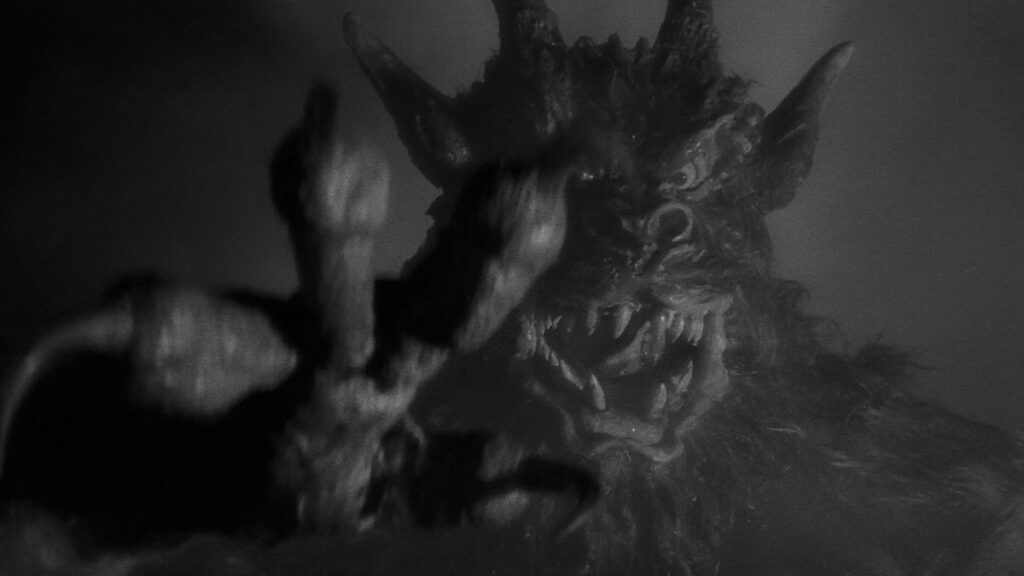
A long-standing criticism of Night of the Demon is that it shows us its monster. Tourneur was forced by writer/producer Hal E. Chester to include the beast, who gets a raw deal, because frankly, this is among the coolest-looking monsters you’ll ever see. If you were thumbing through an old horror-movie magazine before you’d had a chance to watch the picture and encountered a still of the demon from the Land of Runes, you’d scarcely be able to wait to witness it in action on the screen, big or small.

The film also gives us the eminently quotable line, “It’s in the trees!”—an English analogue to “You’re gonna need a bigger boat”—and boy was it ever. Night of the Demon is among those horror movies strong enough to be the all-time favorite for a considerable number of the most dedicated genre fans, scholars, historians, authors, and fellow filmmakers. Any professed nonbeliever likely has a Karswell-like agenda and deserves to be slipped some runes of their own. 🩸

COLIN FLEMING

is the author of eight books, including the story collection, If You [ ]: Fabula, Fantasy, F**kery, Hope, a 33 1/3 volume on Sam Cooke’s Live at the Harlem Square Club, 1963, Meatheads Say the Realest Things: A Satirical (Short) Novel of the Last Bro, and a book about 1951’s Scrooge as the ultimate horror film. His work has appeared in Harper’s, The Atlantic, Rolling Stone, The New York Times, Vanity Fair, The Daily Beast, Cineaste, Film Comment, Sight and Sound, JazzTimes, The New Yorker, The Guardian, and many other venues. He’s completing a book called And the Skin Was Gone: Essays on Works of Horror Art. His website is colinfleminglit.com, where he maintains the Many Moments More journal, which, at 2.7 million words and counting as of autumn 2023, is the longest sustained work of literature in history.

How to see Night of the Demon:

RELATED CONTENT
    FRESH BLOOD
GUIDE | ORIGINS
(Jacques Tourneur, USA, 1942)

On one level, this is a story of longing and projection, of strange love between opposites. The twosome becomes triangulated when opposition breeds tension and a third party spies an opportunity, only to right itself once...

BY JOSÉ TEODORO  |  May 7, 2026

GUIDE | ORIGINS
(Jacques Tourneur, USA, 1943)

A nurse leads a catatonic through an expanse of moonlit cane. They pass displays of sacrificed animals before encountering the towering, shirtless, dead-eyed Black man who grants them entry to a private outdoor religious ceremony...

BY JOSÉ TEODORO  |  March 17, 2023

BBC2’s Horror Double Bills paved the way for cherished father-son bonding and a lifelong love of the creepy unknown.

One of the earliest memories I have is of my father pointing to an abandoned rowboat in Dublin’s River Tolka and quite matter-of-factly stating that “a monster lives in there.”

BY GLENN McQUAID  |  October 31, 2021

RECOMMENDED
    RAVENOUS
GUIDE | ORIGINS

Supernatural

(Victor Halperin, USA, 1933)

This pre-Code offering packs a lot of story into its typically brisk running time, with several plot threads weaving together a (not always successful) tapestry of spooky and criminal doings.

READ MORE >

BY  ANN OLSSON  |  Month 00, 2021

REVIEW

The Keep

(Michael Mann, USA, 1983)

In what could be the fastest-resulting rape revenge movie, a drunken lout brutally forces himself on Ida, the young woman who doesn't return his affections, during a party over Labor Day.

READ MORE >

BY  LAURA KERN  |  Month 00, 2021

REVIEW

We Need To Do Something

(Sean King O'Grady, USA, 2021)

Beast is a lot of movies in one package - fractured fairy tale, belated-coming-of-age story, psychological drama, regional horror film - but above all it's a calling card for its leading lady, Jessie Buckley.

READ MORE >

BY  LAURA KERN  |  Month 00, 2021