Edgar Allan Poe wasn’t exactly a lover of plausibility. He may not have been a lover of anything, despite popular culture’s love of him, preferring to wander dark streets at ungodly hours and converse with ravens while dreaming up unique ways to die. Fanfare for the common dyspeptic man.
As a general, if not always reliable, rule, Poe’s detective fiction leans hard on the interiority, while his terror tales thunder with exteriority (which isn’t to suggest they lack for internal monologues). Old blood and guts Edgar is at it again, they said—well, they should have—when the Philadelphian’s short story “The Pit and the Pendulum” was published in a literary annual called The Gift: A Christmas and New Year’s Present for 1843, which is darkly funny in a “Hey, humans, fuck you” capacity. The story, concerning methods of torture utilized against a prisoner of the Spanish Inquisition, is all about the senses and overwhelming them. You hear, smell, feel this tale, and recoil therefrom. The first work of torture porn? One wonders what Poe would’ve gotten up to creatively if he’d been born in, say, 1970 rather than 1809.
There’s a lot of stretching in Poe’s fiction because he’s a mood man rather than a plot guy. This made his material ideal fodder for a coming-into-his-prime filmmaker like Roger Corman, who was looking to move into a tonier neighborhood regarding the perceived artistry of his work, but without leaving his old high-school chums behind, such that they couldn’t hang on the weekends, in a manner of speaking. Corman had been directing and producing movies for a while when he formally turned his Poe leanings into a developing cycle with an adaptation of The Pit and the Pendulum in 1961, but he’d never attempted a fusion of populist fare and lite art film. Stephen Sondheim for the horror-movie crowd.
Poe’s fiction oeuvre (don’t sleep on his inimical criticism) makes for prime pickings for filmmakers because there’s a central thrust—which can take the form of an oppressive mood or an implement of the macabre or a pain-maxed death—but plenty of room to insert what you please. You must. His fictions were prose-based trips to sensory overload. The movie theater itself is a geographical manifestation of this conceit. We’re bombarded by sights and sounds, to varying degrees, which is a construct Poe sought to render—and inflict—maximally. He took us into the minds of his characters as they suffered. Corman thought he’d have something special in creating a reverse imaging of these intense—we’ll call them torturous, too—brain waves denoting pain; something we could witness together on the screen quasi-palliatively on account of the community.
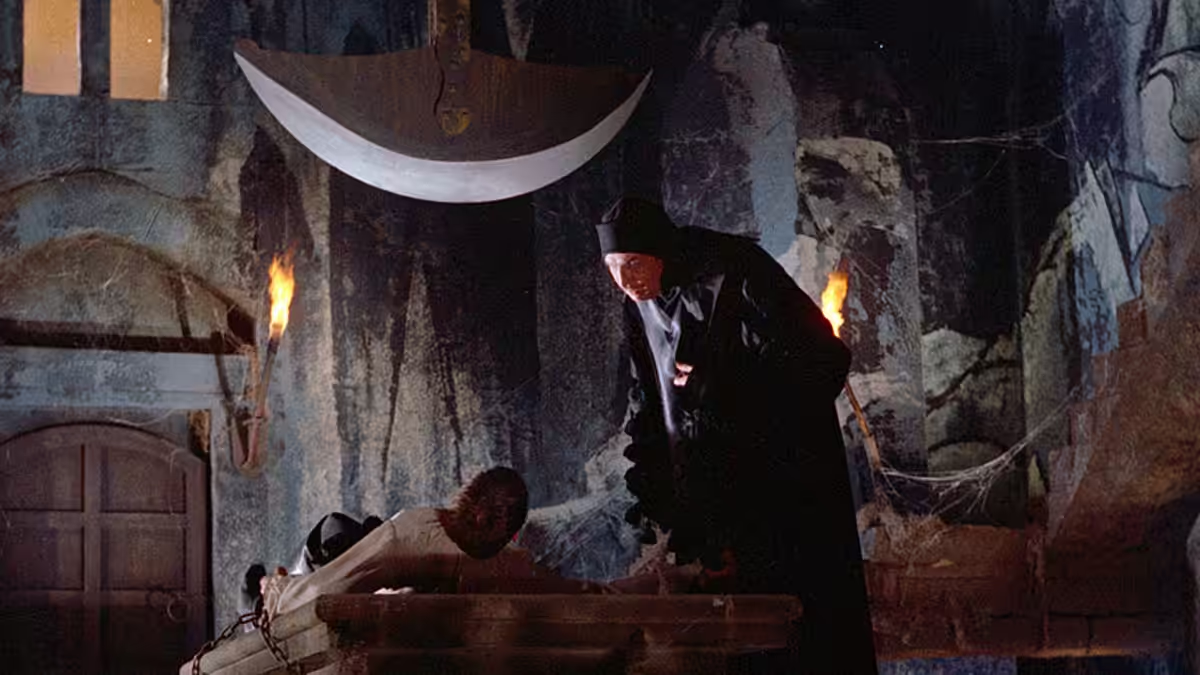
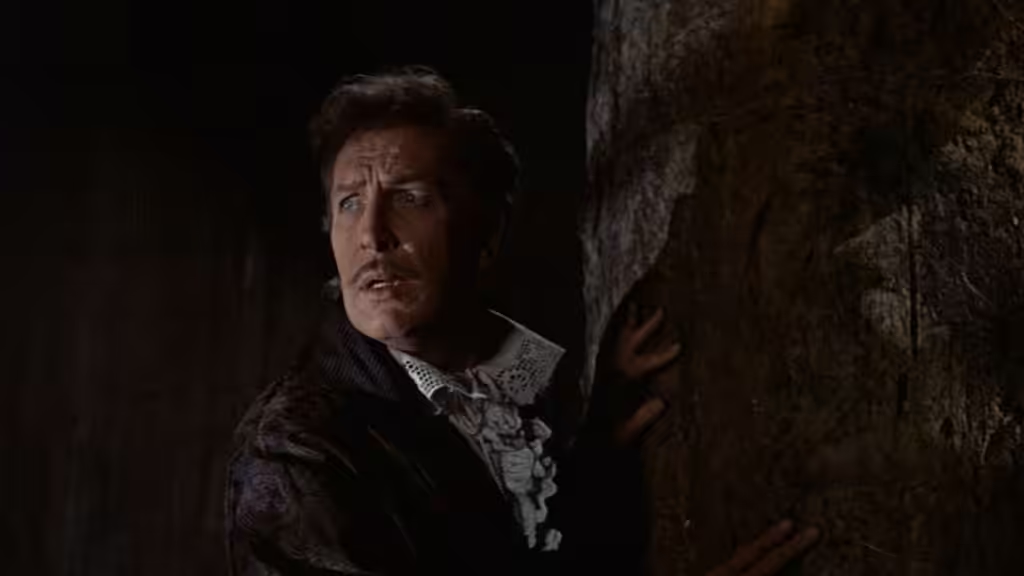
Corman didn’t have much money, but you don’t need much money with Poe. In A Christmas Carol, Scrooge loves darkness because it’s cheap, and that feels like grist for a maxim in adapting Poe to the big screen. He provides the scenario, the pitch; you go from there, and that’s what Roger Corman did. He made sure to cork the bat, enlisting Richard Matheson—who excelled with short forms, as his work on The Twilight Zone would attest—to write the script, and Vincent Price to star as Nicholas Medina, a descendent of a torture-chamber enthusiast (objects like belts beloved by old-school abusive dads would be scoffed at in this family) who inherited these implements and lives in a moody, seaside castle (roiling waves helping to boost atmosphere) where his newly dead wife, Elizabeth (Barbara Steele), haunts him.
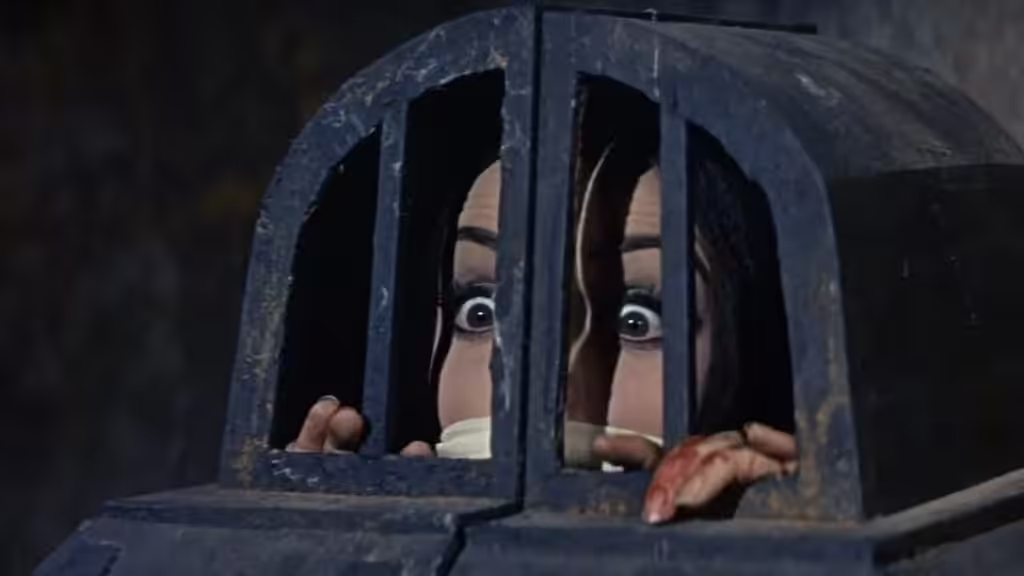
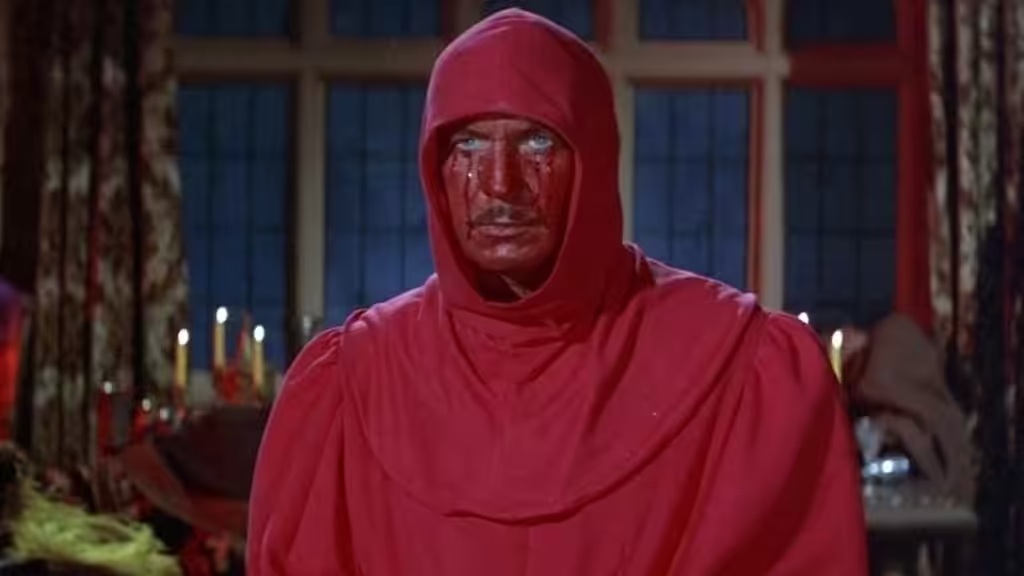
Or does she? You know what they say about history repeating itself, and hot damn does it ever across the Medina generations. Corman ranked “The Pit and the Pendulum” as a top-three Poe story along with “The Masque of the Red Death” and “The Fall of the House of Usher.” Adapting “Masque” was deemed too costly at first. Corman next pick was “Pit,” but “Usher” went first on account that it was thought less grisly, which would help audiences find their footing. Solid plan, given the grisliness to come. And though the titular showcase of The Pit and the Pendulum is kept under blood-soaked wraps until close to the end, it delivers, with special thanks to art director Daniel Haller. The low budget ensured that sets would need to be composited from what the team found, and this requirement of ingenuity served them well.
Sometimes with Poe adaptations, the filmmaker provides a tag with words to the effect of, “Inspired by a story from Edgar Allan Poe,” and while Corman forgoes the clarifying footnote here, the fevered mood of the piece makes these intentions clear.
Price was the ideal lead to hitch the Poe buckboard-of-death to; he’s erudite and sinister, cunning and a victim (or a convincingly self-styled victim). You’re never certain—until you are—whether he’s the monster in this picture or having monstrous things done to him, or a bit of both. In disposition and makeup, he aligns with the urbane fellow who leads Fortunato deeper into the catacombs with a promise of some Amontillado, but while also projecting the persona of a senile-before-his-time, defeated man. Don’t listen to anyone who tells you Vincent Price was a ham. Corman understood him to be a form of cinematic centrifugal force, and if there was to be a Poe cycle, it had to start with Vincent Price.
The tinted sequences look like they’ve been untimely ripped (let’s get some Macbeth in here, because Corman’s Poe films always had an element of the Bard as well, at his most thunderous) from the Nosferatu/Cabinet of Dr. Caligari/Häxan outtakes chest. Tension perpetually lurks around the corner of a darkened corridor in the film, much as it did in William Castle’s 1959 film House on Haunted Hill, which also had Price in the centrifugal-force type of role. We’re never at ease.
Wide-angle lenses are used to accentuate mental, emotional, and spiritual/moral distortion with corresponding visual versions. Corman rehearsed the troupe before the cameras rolled. And while he didn’t know yet that a series had been officially launched—after all, the thing could have bombed—it’s plain that Corman took the care to do this movie right. When The Pit and the Pendulum proved to be big box office, Corman had his foundation for a series that holds up as among the most impressive in horror-movie history and has also done a great service in furthering the pop-culture appeal and staying power of Poe, the idea, the brand, and the cinematic concept. 🩸

is the author of eight books, including the story collection, If You [ ]: Fabula, Fantasy, F**kery, Hope, a 33 1/3 volume on Sam Cooke’s Live at the Harlem Square Club, 1963, Meatheads Say the Realest Things: A Satirical (Short) Novel of the Last Bro, and a book about 1951’s Scrooge as the ultimate horror film. His work has appeared in Harper’s, The Atlantic, Rolling Stone, The New York Times, Vanity Fair, The Daily Beast, Cineaste, Film Comment, Sight and Sound, JazzTimes, The New Yorker, The Guardian, and many other venues. He’s completing a book called And the Skin Was Gone: Essays on Works of Horror Art. His website is colinfleminglit.com, where he maintains the Many Moments More journal, which, at 2.7 million words and counting as of autumn 2023, is the longest sustained work of literature in history.
The first thing we lay eyes on is… an eyeball! No enveloping head. Just an eyeball attached to an optic nerve, floating...
BY JOSÉ TEODORO | April 5, 2026
Shot over roughly one week in a converted supermarket decked out with makeshift forest foliage and an overload of (toxic) fake fog for about $75,000 of Roger Corman’s own...
BY LAURA KERN | April 5, 2026
Smart, sinister, colorful (back to this in a minute), nuanced, expansive, repellent, beckoning, dastardly, placating, and inspiring...
BY COLIN FLEMING | April 5, 2026
This pre-Code offering packs a lot of story into its typically brisk running time, with several plot threads weaving together a (not always successful) tapestry of spooky and criminal doings.
READ MORE >
BY ANN OLSSON | Month 00, 2021
In what could be the fastest-resulting rape revenge movie, a drunken lout brutally forces himself on Ida, the young woman who doesn't return his affections, during a party over Labor Day.
READ MORE >
BY LAURA KERN | Month 00, 2021
Beast is a lot of movies in one package - fractured fairy tale, belated-coming-of-age story, psychological drama, regional horror film - but above all it's a calling card for its leading lady, Jessie Buckley.
READ MORE >
BY LAURA KERN | Month 00, 2021