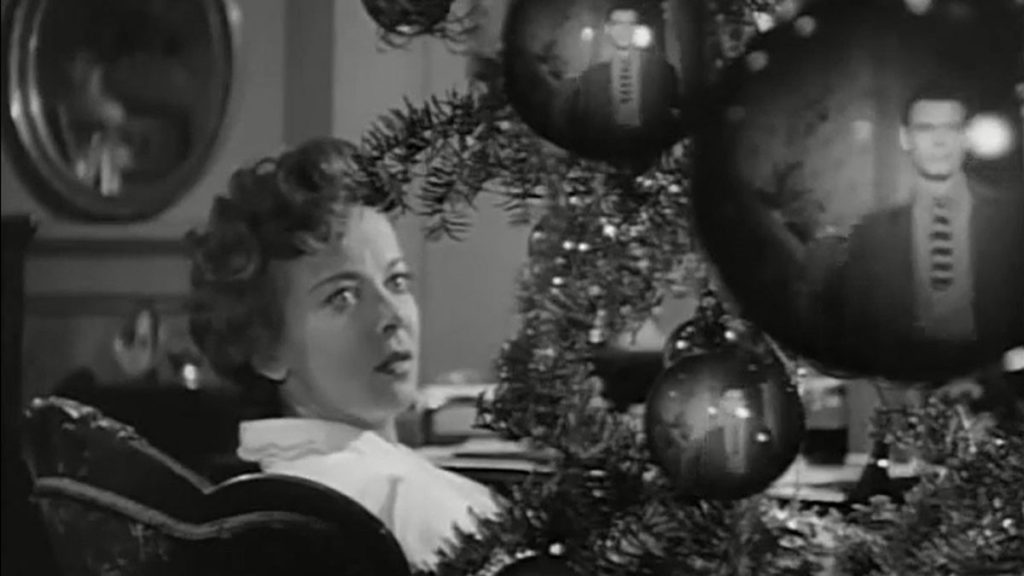
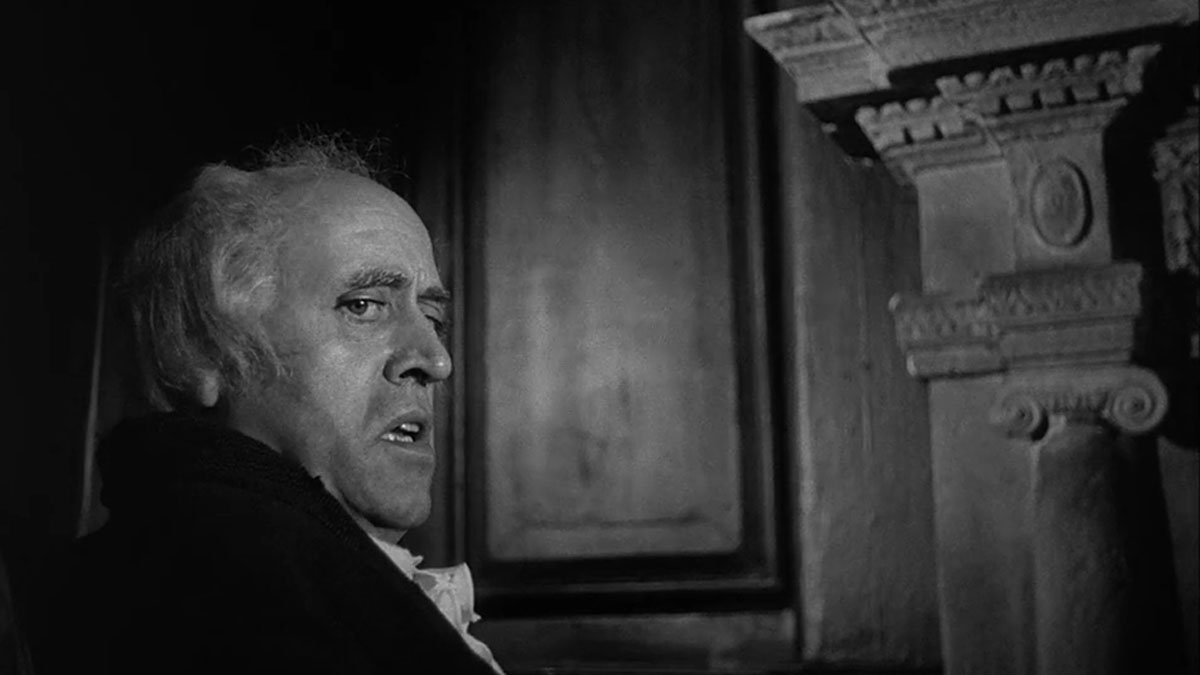
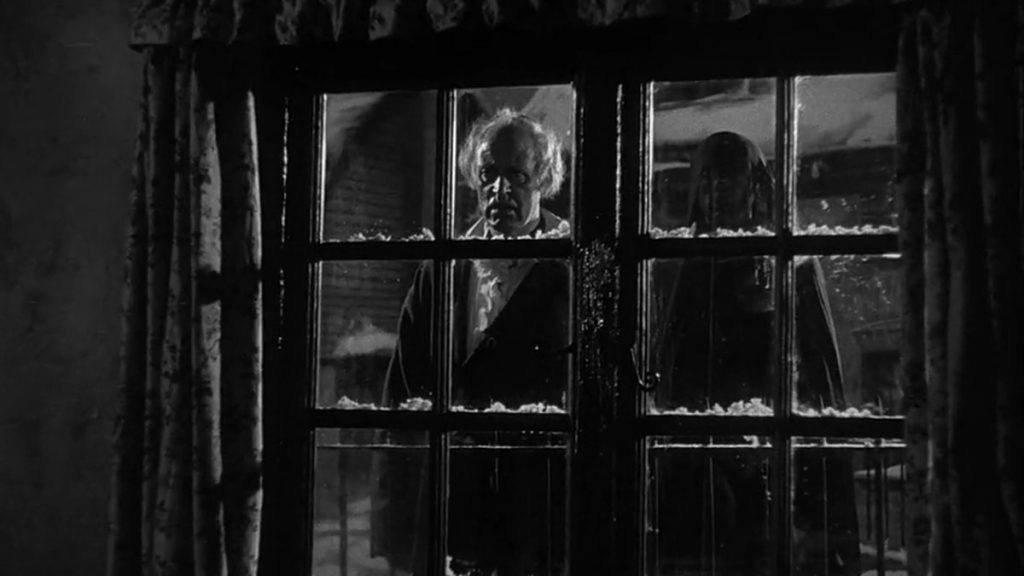
Like the old cuss himself, Scrooge (1951) is a mix of the sentimental and the horrific. It gives us the ultimate Christmassy London of plum pudding and cheer, but cut through by icy streets full of ghosts and beggars—streets with an eerie, dollhouse artificiality, winding right out of the Berlin of Fritz Lang’s M. Director Brian Desmond Hurst made one of the earliest Poe adaptations, 1934’s The Tell-Tale Heart, and one of Britain’s earliest noirs, 1939’s On the Night of the Fire, aka The Fugitive, and brought those aesthetics to Dickens’s story. Hurst came from the mean streets of East Belfast, the son of a poor iron worker, and had fought through the bloodbath of Gallipoli in World War I. “I am the empress of Ireland!” he once declared to a group of construction grunts who called him a “fucking old queen” as he was sashaying into a London pub. By the time he started work on Scrooge, he had experienced the horrors of this “world of fools”—Ebenezer’s phrase—but drove a Rolls-Royce, threw extravagant parties, and knew exactly what a good ghost pageant or ball at Mr. Fezziwig’s should look like. He was immensely proud of the film, and the deft balancing of the grim and the feel-good makes his the richest of the many adaptations of the “Ghostly little book,” as its author called it. Along with an astonishing, near-crazy performance by the mop-headed, doe-eyed Scotsman Alastair Sim, it features one of the wildest, scary-funny Jacob Marleys in the Christmas Carol movie canon—and certainly the best ghost scream—in Michael Hordern. The soundtrack mixes horror with holiday lyrical—developing a beautiful leitmotif around the ballad “Barbara Allen” as Scrooge journeys toward redemption. And the tale is all told through flickering, shimmering, spectrally translucent black-and-white cinematography.
The horror often works in hints and half-tones. Scrooge’s home—formerly Marley’s—is a deathly space even before the ghosts arrive, as if Scrooge were living in his friend’s sepulcher. The foyer—with nothing but one lone bust on the windowsill—has the cold formality of a funeral home, and the expansive rooms are barren: here is a wealth gripped by stinginess. The lacquered, embalmed shine of its walls—and other Scrooge-infected spaces: his “money-changing hole” and the street where he shoves a little caroling girl—reminds me that another master of narration through atmosphere, Andrei Tarkovsky, was said to walk around set with a heavy brush and bucket of bitumen varnish, obsessively applying layer after layer onto interiors—like the bedroom in Stalker—to give them an otherworldly patina. Deliberate or not in Scrooge, the snakeskin surfaces work on you as you move through the film.
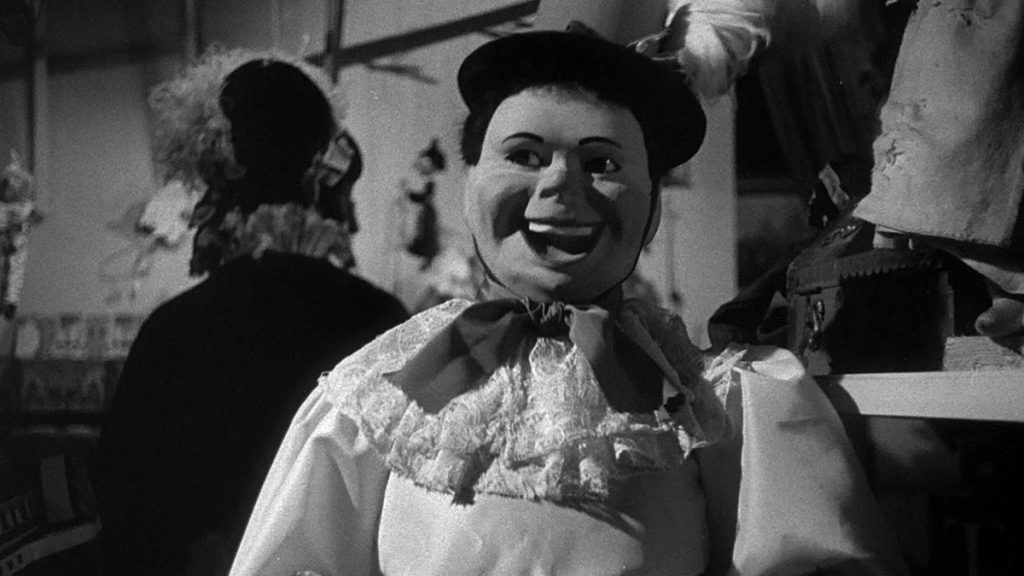
As do other ambiguities. Tiny Tim looks in from the street at a display of Victorian mechanical dolls. Bouncy music and his Norman Rockwell smile say it’s a scene of childhood wonderment, but the camera glides over an unsmiling monkey playing a harp, a scowling harlequin, and a nasty boy in a top hat with a joker smile. And there’s the Ghost of Christmas Past, with his stringy white hair and garlands of flowers, who seems androgynous—are those breasts under his white tunic? While the Ghost of Christmas Present, a hairy-chested Burt Reynolds type, looks like he’s wearing nothing under his Santa robe. This makes his last gesture before disappearing all the more uncomfortable, when he says: “Learn this!” and flings open the robe as if to flash Scrooge, revealing two emaciated children—Ignorance and Want. Whether these strangenesses are accidental, a misreading by this skewed modern viewer, or part of the filmmakers’ plan, they somehow only make the Christmas nightmare more convincing, and Dickens’s text is full of them too.

 JustWatch
 FRESH BLOOD