ARTICLE | EMBODIMENTS OF EVIL

Rutger Hauer in The Hitcher

The inimitable Dutchman brings an icy stillness and layers of depth to the role of a psychopathic drifter who rides with us down the road to hell.

BY TOM PHELAN | March 2, 2026
SHARE:

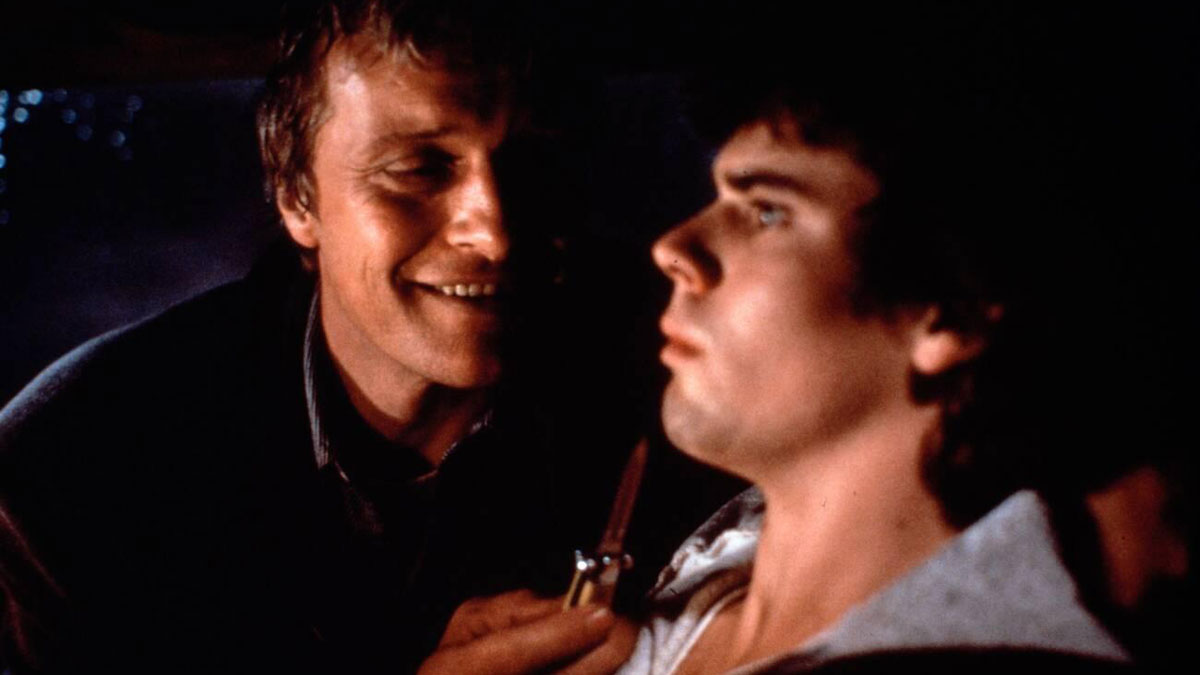
Four years after playing a killer desperate to dodge extinction—Roy Batty in Blade Runner—Rutger Hauer played John Ryder in The Hitcher (1986), a killer courting oblivion. A Dutch actor with near-flawless English, Hauer nevertheless brought an unnerving, alien quality to his roles. He is especially effective here in Robert Harmon’s film, which begins like a conventional ’80s slasher whose title fairly shouts its narrative contours. Five minutes into his ride with Jim Halsey (C. Thomas Howell), Ryder tells the boy he’s going to cut him into pieces, and we buckle up for the body count. But Hauer’s detailed performance transforms the film into something powerful and strangely meditative, providing a counterpoint to screenwriter Eric Red’s tight, relentless pacing. While this quintessential American road movie screams by like a truck rushing to deliver nothing to nowhere, Hauer fills its dusty metal carapace with a soft body, rendering a sensitive portrayal that combines camaraderie, sadism, and bone-deep exhaustion. He plays the reaping highwayman less as a villain and more as a cursed wandering soul—call him the Driving Dutchman—charged with enforcing life’s cruel moral physics.

On his way from Chicago to California to start a new life, Jim is trying to stay awake, hypnotized by the road and the monotony of the passing desert. When he sees Ryder hitchhiking, he stops to pick him up out of kindness and boredom. But in the moral world of this story, the greatest sin is generosity, and Jim will realize too late that he has broken the rules. Appearing at the side of the road, Ryder is a dark shape bent over like a hunchback in the rain. Inside the car, he manages to be both companionable and frightening as he refuses to answer questions or divulge a destination. It becomes clear he doesn’t have one, but the boy will become his destination. Hauer controls the scene, beginning it like a tired tradesman, done in and broody after a long day’s work, then slowly coming to life as the boy’s fear grows. He feeds off it, flickering between joy, lust, and anger, somehow managing to stay scary without veering into camp. Although Jim succeeds in ejecting him from the car, Ryder is hooked—like a vampire who cannot be disinvited, he attaches himself to Jim, determined to destroy everyone and everything that comes between them. This includes easygoing Nash (Jennifer Jason Leigh), a waitress who commits her own sin of hospitality when she lets Jim into the Longhorn Restaurant, a diner off the highway, before it opens. Her medieval punishment—being strung up between a truck cab and its trailer—becomes the object lesson that hurries Jim along on a path of damnation forged by Ryder. 

We sometimes equate evil with excess: think of all those movies where the villain capers about, mugging for the camera and farting gales of hysterical laughter. In reality, goodness is the excess. Evil is pure economy, and Ryder manifests this by setting up a mousetrap of cause and effect designed to turn Jim into a murder suspect. All it takes is a little nudge—a planted switchblade, a helicopter one-shotted from the sky—and the cops, reliable as WD-40 when righteous violence requires a little oil in its mechanism, are only too happy to hunt Jim down and kill him without a trial. Ryder’s real goal is to remake the boy in his own image, to force him into despair so that he slowly abandons his principles. Driving from station to station, Jim absorbs the central lesson: anywhere you stop is a crime scene or an atrocity waiting to happen, and no one is coming to save you. It isn’t long before he turns to the gun, bullets provided by Ryder. Nash, by contrast, drops a gun when she is asked to use it, preserving her optimism and trust in people until her grim end. Therefore, Ryder trims her from the story like so much “waste,” the worst thing that a person can be in his world.

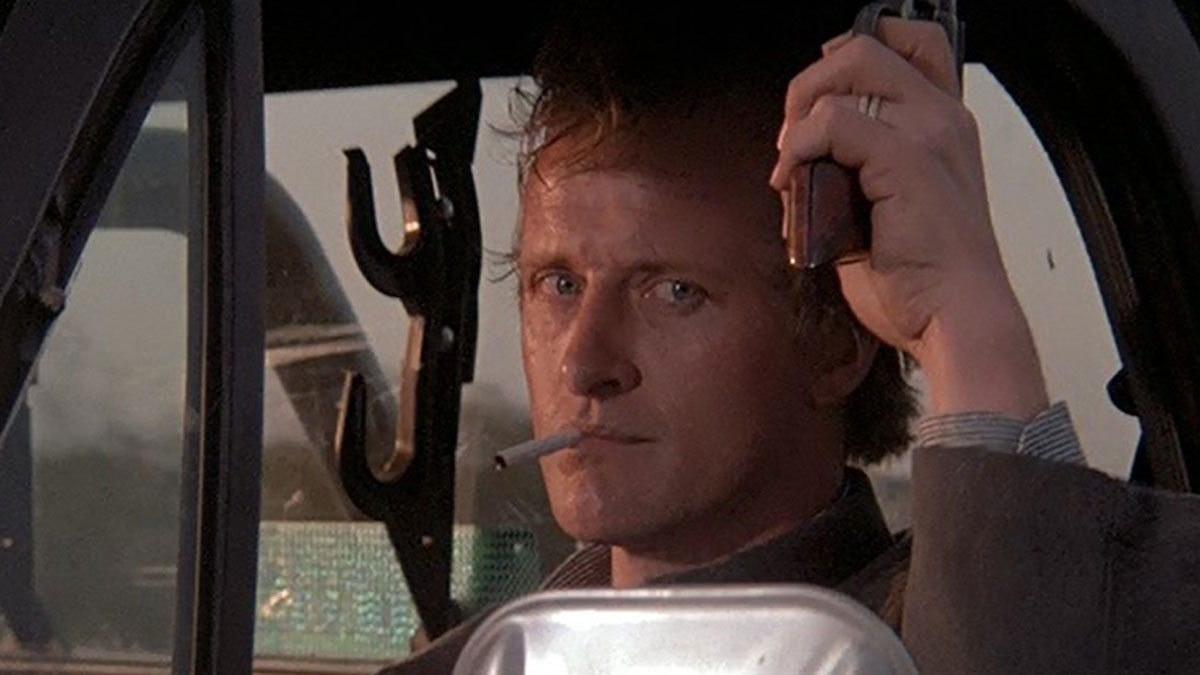
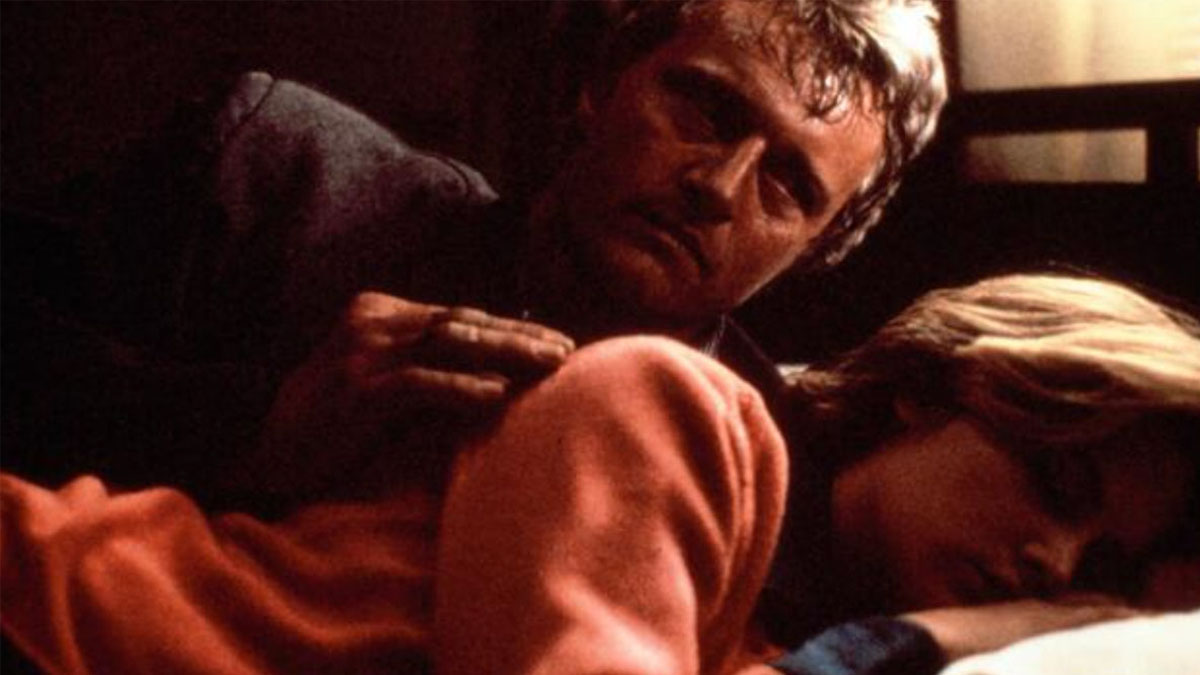
Hauer’s grounded performance complicates the single-minded cruelty that his character pursues. He brings a gentleness to his scenes that keeps Ryder from becoming a cipher or an allegory. Even as he pops up out of nowhere, omnipotently aware of Jim’s location, Ryder appears to be a real man with a hidden backstory. When he sneaks into Jim and Nash’s motel room and lays his head on the pillow next to her as she sleeps, something ripples across his face in response to some powerful emotion. Is it envy of Jim and his developing relationship with Nash? Is it lust for Jim? Or is Ryder remembering a quiet moment from his own past? It may be all of these things because Hauer has a face you can get lost in. His watery blue eyes are an oasis in the desert, the promise of a quenching that might be spiritual, or only a mirage to pull you deeper into wasteland. The most powerful moment of the film happens in the interrogation room when Ryder is in chains, sincerely accepting Jim’s proffered hand. The boy spits in his face—that hoary old you-break-my-body-not-my-soul trope—but somehow you feel for Ryder. And the way that Hauer smiles and snuggles into that saliva: it says all that one need say about the practical value of contempt.

So human is Hauer’s performance that it makes his program of dehumanization all the starker. And that is the program, which bears fruit at the story’s midpoint when Jim runs into the desert, his attempt to turn himself in foiled by yet another murder. He puts the gun to his own chin, ready to end it all. Then something changes his mind as he looks into the sky to see the sun hiding behind a cloud. The music in that moment—dreamy synth sounds scored by Mark Isham—along with a couple of extreme wide shots of Jim, suggests dissociation, the self floating away from the self, a common response to trauma. The violence and speed have peeled off pieces from his psyche, like a strong desert wind removing skin from your nose. Though Ryder is absent from this scene, we feel his presence. He has kept Jim always moving, allowing no time for introspection, no time for breath or belief, and it’s up to the viewer to decide whether the hero ever recovers from this moment.

Dissociation makes everything possible except return. After Jim decides to carry on, Ryder catches up with him in a diner and finally answers one of his questions: “Why are you doing this to me?” Ryder responds by placing two pennies on Jim’s eyes. One explanation for this ancient custom is that the coins are payment for Charon, the ferryman, to escort the newly dead to the underworld; another explanation is that the pennies stop the dead from seeing their way back home. Ryder seems to express the latter when he marks Jim, ferrying the boy out of the wasteful world of goodness and feeling, into a transactional world of violent action paired with its equal and opposite reaction. Ryder is ready to retire and be replaced.

In a tactic similar to John Doe’s in Se7en, Ryder lures Jim to the final stop in the desert, where he can admire the result of his human engineering and force one last showdown. By this point, Jim has matured and transformed himself physically into trademarked ’80s awesome, with his leather jacket and extra shirt button undone. He is as convincingly cool as Keith Gordon’s character at the end of Christine—in other words, he doesn’t quite carry it off. All we see is one more kid who’s had his insides hollowed out. Ryder has successfully forced Jim to conform to a universe where survival requires dissociation and a quick trigger reflex. Jim fulfills his assigned role by killing Ryder, who gets exactly what he wanted and, with a giddy smile, tosses the boy a set of prison chains as his parting gift. The Hitcher ends on a gorgeous, melancholy shot of Jim at rest at last, smoking alone by a stolen vehicle as the sun goes down. He has the rest of his life to ponder the new world he has inherited. As Ryder asks Jim in that diner, right after he decides to live rather than kill himself: “How do you like Shitsville?” 🩸

TOM PHELAN

a writer living outside Philadelphia, is currently working on a horror project set in western Pennsylvania. He co-wrote the movie Anamorph, starring Willem Dafoe.

How to see The Hitcher:

RELATED CONTENT
    FRESH BLOOD
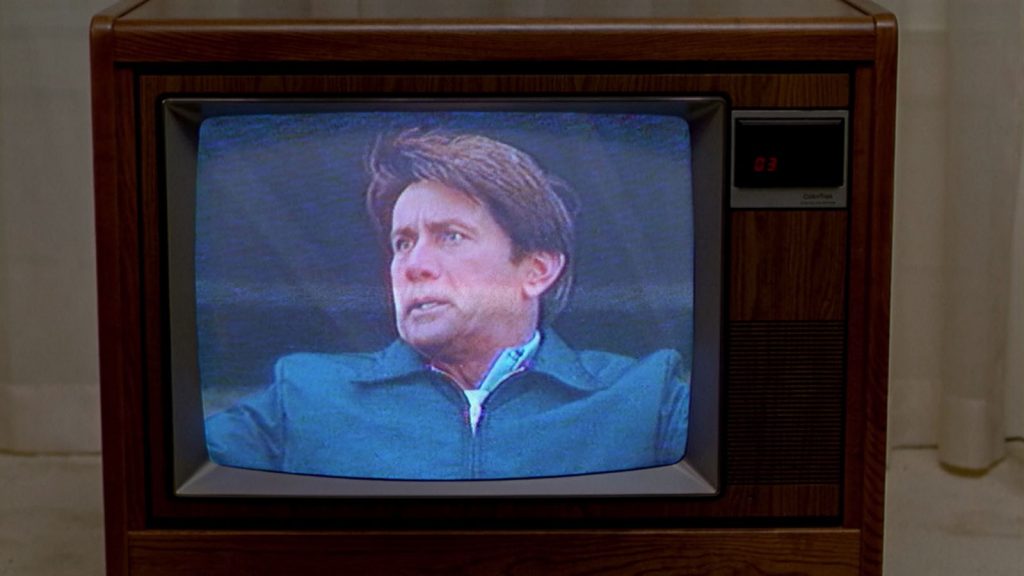
The dead-eyed political aspirant Greg Stillson in David Cronenberg’s Stephen King adaptation encapsulates Trump-level terror.

Before we assess the villain, let’s begin with the hero—and “hero” is the correct appellation for Johnny Smith, most especially because where he begins in this story is so touchingly ordinary.

BY JOSÉ TEODORO  |  November 3, 2024

The actor’s Oscar-nominated, atypically sinister turn supports the notion that unassuming fellows are often the ones to fear most.

After he’d fundamentally abandoned Hollywood moviemaking and cast his lot with the nascent medium of television, reinventing himself as a producer and host of live dramas...

BY STEVEN MEARS  |  August 20, 2024

ARTICLE | EMBODIMENTS OF EVIL
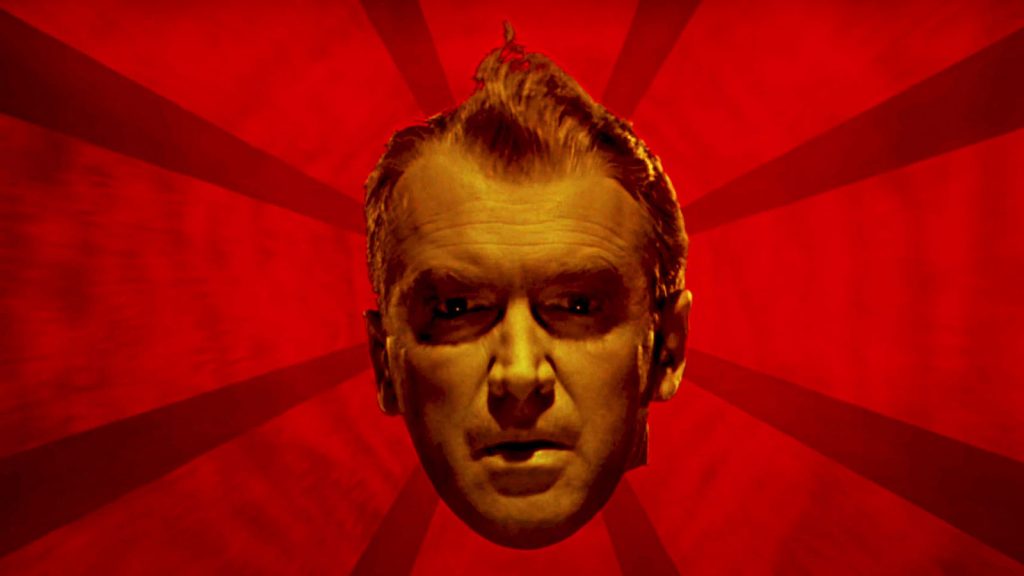
In the inaugural entry of a new column singling out enduringly creepy film characterizations, an American sweetheart cast against type emerges as one of cinema’s most unexpectedly chilling villains.

Sometimes all it takes is one sentence to demolish everything you thought you knew about a person. In the case of James Stewart—whom, it’s often noted, the world affectionately chose to call “Jimmy,” even though he was never...

BY STEVEN MEARS  |  February 7, 2024

RECOMMENDED
    RAVENOUS
GUIDE | ORIGINS

Supernatural

(Victor Halperin, USA, 1933)

This pre-Code offering packs a lot of story into its typically brisk running time, with several plot threads weaving together a (not always successful) tapestry of spooky and criminal doings.

READ MORE >

BY  ANN OLSSON  |  Month 00, 2021

REVIEW

The Keep

(Michael Mann, USA, 1983)

In what could be the fastest-resulting rape revenge movie, a drunken lout brutally forces himself on Ida, the young woman who doesn't return his affections, during a party over Labor Day.

READ MORE >

BY  LAURA KERN  |  Month 00, 2021

REVIEW

We Need To Do Something

(Sean King O'Grady, USA, 2021)

Beast is a lot of movies in one package - fractured fairy tale, belated-coming-of-age story, psychological drama, regional horror film - but above all it's a calling card for its leading lady, Jessie Buckley.

READ MORE >

BY  LAURA KERN  |  Month 00, 2021

🖨 📄