
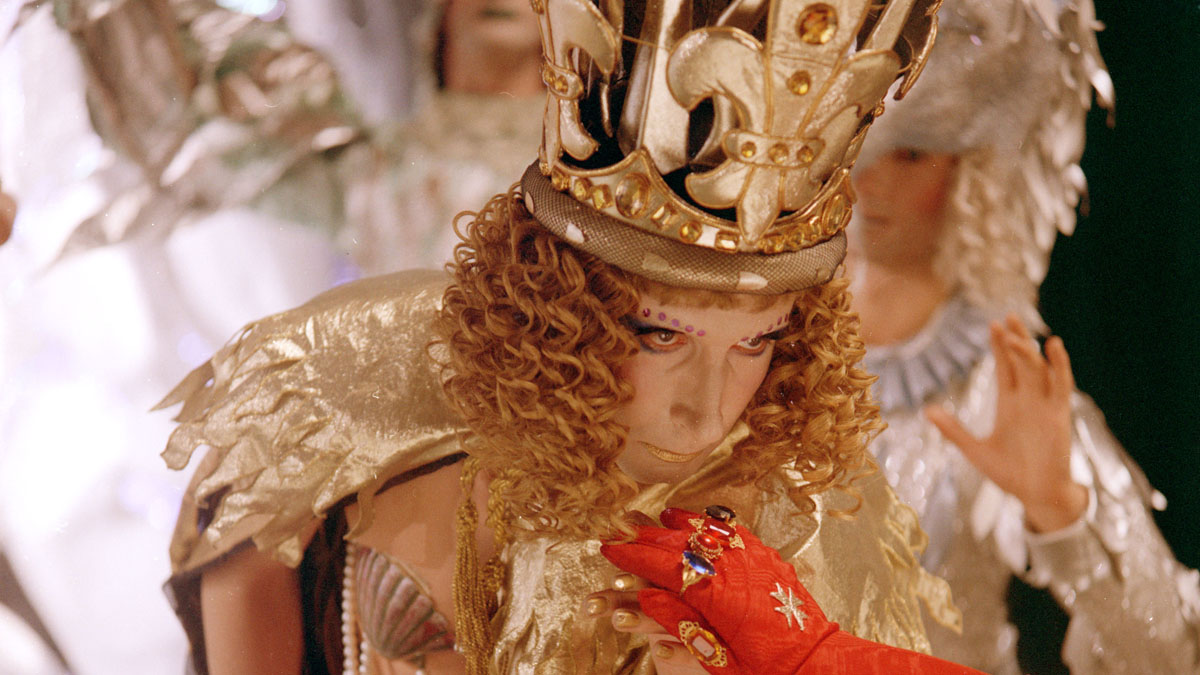
Ken Russell’s The Devils begins like a Ken Russell film. A glitzed-out Louis XIII (Graham Armitage) rises like Venus, campy on a clamshell in a painted sea, while Renaissance dance music plays. Bored members of the court exchange bitchy comments while Cardinal Richelieu (Christopher Logue), far from being shocked, can barely keep his eyes open. He follows a yawn with an invitation to kiss his ring. The king stoops to smirkingly oblige, and the music takes a turn as the somber score of Peter Maxwell Davies interrupts the dance. A burst of discordant notes from the horns and flute is buttressed by rumbling percussion. The film title fades up in scarlet over the beshadowed faces of the king and cardinal, lest you doubt who the devils in this film will be. And this becomes the Ken Russell film: a glorious spectacle powered by love, a startling sincerity, and fury at the warped pageants that power puts on to achieve its ends. The director finds a complex, sympathetic hero in Father Grandier (Oliver Reed), the deeply flawed 17th-century priest who defended the independence of the French town of Loudun against Richelieu’s plans to consolidate royal power. Grandier’s transformation from cynical libertine to hopeful liberator parallels the artistic transformation of the film itself.
Drawing on Aldous Huxley’s The Devils of Loudun, Russell rips a historical account of religious hypocrisy from its distant past and drops it on us still bleeding, its stakes painfully relevant today. The new 4K restoration gives full expression to the saturated colors and nightmare monochromes of Derek Jarman’s severe production design. Sister Jeanne—played by Vanessa Redgrave, who concocts a perfect blend of innocence, conspiracy, and pure madness—crawls like a snail trapped in a honeycomb, locked away with other inconvenient women in that despairing oubliette known as a convent. Shots frame her deformed body beneath low curving architecture, as if the weight of the lives lived above in the daylight has molded her this way. One of those lives belongs to Grandier, whose alluring world of philosophical sophistication and sensual luxury is equally removed from the world where the rest of us live, in the mud dying of plague. When Richelieu’s emissary Laubardemont (Dudley Sutton) arrives to demolish Loudun’s walls, Grandier, libido’s slave and sometime master of equivocation, awakens to the injustice threatening his town and discovers a new, unvarnished faith in the human spirit. Meanwhile, Sister Jeanne’s obsessive erotic visions drive her into doomed attempts to meet Grandier. The agents of Church and State—always on the prowl for another person’s passion—find in her the raw material for a performance designed to destroy Grandier and his political resistance.
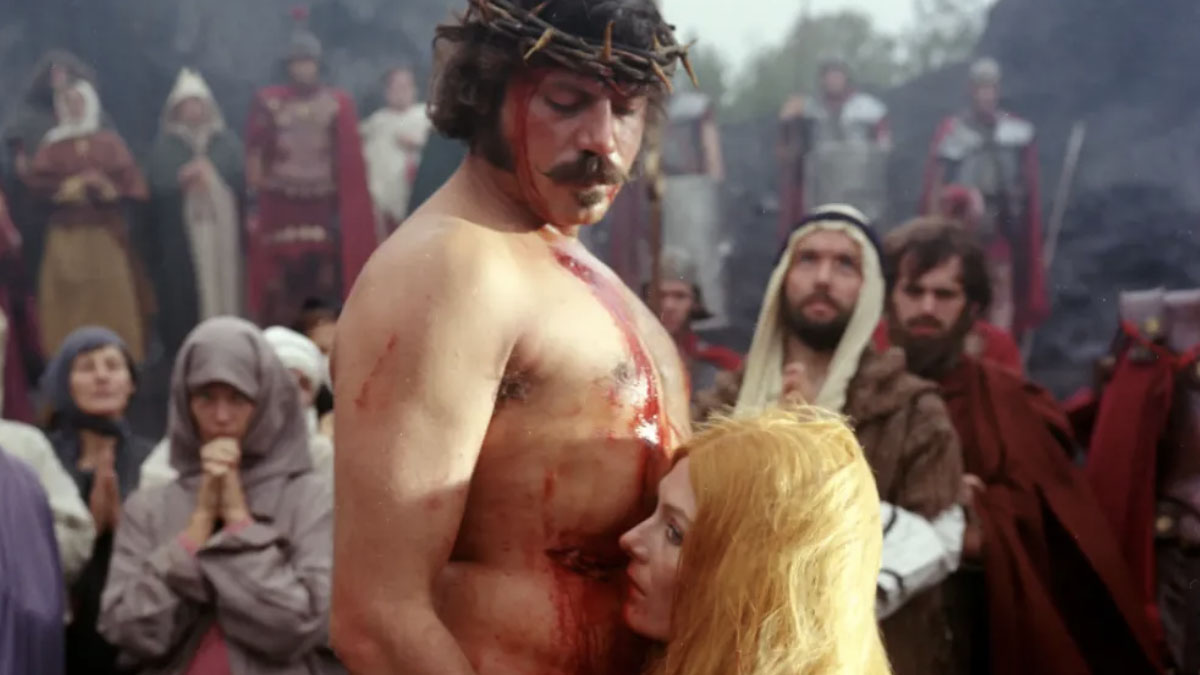
“Have fun,” says the King. In one of the film’s darkest moments, despite exposing the fraud of the demonic possession, he gives the exorcising priests his blessing to carry on: a real exorcism of imaginary devils. The spectacle erupts into pure shock in the legendary sequence known as the “Rape of Christ.” I can barely write the words—good former Catholic boy that I am—and can scarcely speak them above a whisper. And that is the trap Russell lays for us all. This scene of nuns sexually molesting a statue of Christ on the cross is blasphemous, horrifically comic in places, and it begs the viewer to be deeply offended. The trap may have worked too well: excised at the insistence of Warner Bros. and British censors before the film’s 1971 release, the sequence resurfaced briefly in 2004 but is only now being officially released in the director’s preferred cut. Russell dares us to be more scandalized by the sexual desecration of a symbol than by the torture and execution of a heretic or by the cruel debasement of a nun who accused him of witchcraft. The sequence is essential not for its shock value but for what it implies: spectacle in the hands of a filmmaker is art; spectacle in the hands of a nation’s rulers is atrocity.
The real horror is left until the end. Once Grandier’s lone voice of protest has been silenced, the city walls are blown to bits. The void that remains is an image you never forget. Gemma Jones as Madeleine, Grandier’s wife, wanders shell-shocked through the ruins, then climbs over the rubble where the walls once stood, onto a road she must now follow past bodies mounted high on “breaking wheels.” Leave it to humanity to invent something magnificent—the wheel—and then turn it into a torture device for breaking human bones and threading limbs through its spokes. In a world where such things are real, how sensational is Ken Russell’s imagination really? 
 FRESH BLOOD


 RAVENOUS


 JustWatch